
Stem-changing Verbs in Spanish: e → ie, o → ue and e → i
Learn how Spanish stem-changing verbs work in the present tense — from pensar → pienso and poder → puedo to pedir → pido, dormir → duermo and jugar → juego.
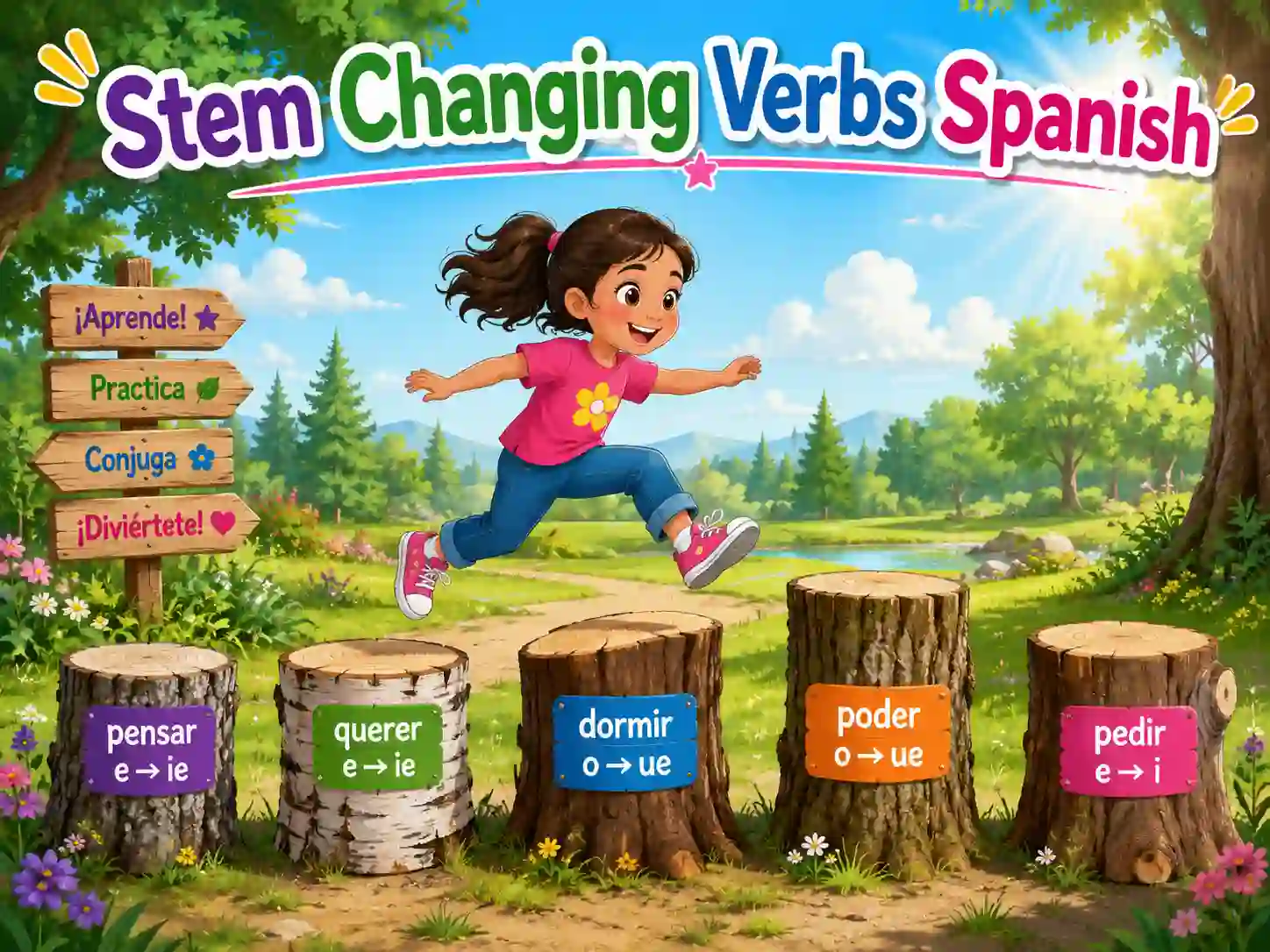
Why stem-changing verbs matter
Stem-changing verbs include many high-frequency Spanish verbs: querer, poder, pensar, entender, dormir, pedir, servir and jugar. They are especially important because several modal verbs and reflexive verbs also follow stem-changing patterns.
How to use this page
Use this page after regular verbs and before advanced irregular verbs. First learn the main vowel-change patterns, then practise the “boot” pattern in the present tense, and finally connect stem changes with modal and reflexive verbs.
Remove the infinitive ending: pensar → pens-, poder → pod-, pedir → ped-.
Change the vowel inside the stem: pens- → piens-, pod- → pued-, ped- → pid-.
Most present-tense endings remain regular: pienso, puedes, piden.
The core system: vowel change inside the stem
e → ie
The vowel e changes to ie in many present-tense forms.
pensar → pienso · querer → quiero · entender → entiendo
o → ue
The vowel o changes to ue in verbs such as poder, dormir and volver.
poder → puedo · dormir → duermo · volver → vuelvo
e → i
The vowel e changes to i in verbs such as pedir, servir and vestir.
pedir → pido · servir → sirvo · vestir → visto
Spanish stem-changing patterns at a glance
Stem-changing verbs are not random. Most common forms belong to a small number of repeated vowel-change patterns.
| Pattern | Infinitive | Present-tense example | Meaning | Common verbs |
|---|---|---|---|---|
| e → ie | pensar | pienso | I think / plan | pensar, querer, entender, empezar, cerrar |
| o → ue | poder | puedo | I can | poder, dormir, volver, encontrar, contar |
| e → i | pedir | pido | I ask for / order | pedir, servir, repetir, seguir, vestir |
| u → ue | jugar | juego | I play | jugar |
The “boot” pattern in the present tense
In the present tense, most stem-changing verbs change in all forms except nosotros and vosotros. This is often called the “boot” pattern because the changing forms make a boot-shaped pattern in many verb charts.
| Subject | Pensar | Poder | Pedir | Pattern note |
|---|---|---|---|---|
| yo | pienso | puedo | pido | stem change |
| tú | piensas | puedes | pides | stem change |
| él/ella/usted | piensa | puede | pide | stem change |
| nosotros | pensamos | podemos | pedimos | no stem change |
| vosotros | pensáis | podéis | pedís | no stem change |
| ellos/ellas/ustedes | piensan | pueden | piden | stem change |
e → ie stem-changing verbs
In e → ie verbs, the vowel e inside the stem changes to ie. Many very common verbs follow this pattern.
Pensar: pienso, piensas, piensa, pensamos, pensáis, piensan
Querer: quiero, quieres, quiere, queremos, queréis, quieren
Entender: entiendo, entiendes, entiende, entendemos, entendéis, entienden
o → ue stem-changing verbs
In o → ue verbs, the vowel o inside the stem changes to ue. This group includes important verbs for ability, sleep, return and finding.
Poder: puedo, puedes, puede, podemos, podéis, pueden
Dormir: duermo, duermes, duerme, dormimos, dormís, duermen
Volver: vuelvo, vuelves, vuelve, volvemos, volvéis, vuelven
e → i stem-changing verbs
In e → i verbs, the vowel e inside the stem changes to i. Many of these verbs are -ir verbs.
Pedir: pido, pides, pide, pedimos, pedís, piden
Servir: sirvo, sirves, sirve, servimos, servís, sirven
Repetir: repito, repites, repite, repetimos, repetís, repiten
u → ue: the special case of jugar
Jugar is a special stem-changing verb. Its u changes to ue in the same “boot” pattern.
Juego al fútbol.
Juegas muy bien.
Juega con sus amigos.
Jugamos los sábados.
Juegan en el parque.
Stem-changing modal and reflexive verbs
Stem-changing verbs are especially important because they appear in modal and reflexive structures. This means the stem change often combines with another grammar topic.
| Verb | Pattern | Example | Related topic |
|---|---|---|---|
| poder | o → ue | Puedo ayudarte. | modal verbs |
| querer | e → ie | Quiero aprender. | modal verbs |
| acostarse | o → ue | Me acuesto tarde. | reflexive verbs |
| sentarse | e → ie | Me siento aquí. | reflexive verbs |
| vestirse | e → i | Me visto rápido. | reflexive verbs |
| dormirse | o → ue | Se duerme temprano. | reflexive verbs |
When to use stem-changing verbs
Use e → ie verbs
Use verbs such as pensar, querer, entender and empezar.
Pienso viajar. · Quiero aprender.
Use o → ue verbs
Use verbs such as poder, dormir, volver and encontrar.
Puedo ayudarte. · Vuelvo mañana.
Use e → i verbs
Use verbs such as pedir, servir, seguir and repetir.
Pido café. · Repito la frase.
Related grammar topics
Regular Verbs
Review regular endings before adding stem changes.
Irregular Verbs
Connect stem changes with other types of Spanish irregular verb patterns.
Modal Verbs
Practise stem-changing modal verbs such as poder and querer.
Reflexive Verbs
Learn reflexive stem-changing verbs such as acostarse, sentarse and vestirse.
Present Tense
Review the tense where most beginner-level stem changes first appear.
Spanish Imperative
Connect stem-changing verbs with command forms such as piensa, vuelve and pide.
Typical mistakes with Spanish stem-changing verbs
- Changing the ending instead of the stem: in pienso, the ending is regular; the stem changes.
- Changing nosotros and vosotros in the present tense: say pensamos, not piensamos.
- Forgetting modal verb stem changes: say puedo and quiero, not regularized forms.
- Mixing patterns: pedir becomes pido, not piedo.
- Forgetting reflexive pronouns: say me acuesto, not only acuesto, when you mean “I go to bed”.
Where to go next
After stem-changing verbs, continue with irregular verbs, modal verbs and reflexive verbs. These topics show where stem changes appear in real Spanish structures.
Want personal guidance?
If stem-changing verbs feel confusing, individual guidance can help you practise vowel patterns, present-tense forms, modal verbs and reflexive verbs in real sentences.
FAQ: Stem-changing verbs in Spanish
What are stem-changing verbs in Spanish?
Spanish stem-changing verbs are verbs where the vowel inside the stem changes in many present-tense forms, while the endings often stay regular.
What are the main Spanish stem-changing patterns?
The main patterns are e → ie, o → ue, e → i and the special pattern u → ue in jugar.
Which forms change in the present tense?
Most present-tense stem-changing verbs change in all forms except nosotros and vosotros: pienso, piensas, piensa, pensamos, pensáis, piensan.
What are examples of e to ie verbs?
Examples of e → ie verbs include pensar, querer, entender, empezar and cerrar.
What are examples of o to ue verbs?
Examples of o → ue verbs include poder, dormir, volver, encontrar and contar.
Are poder and querer stem-changing verbs?
Yes. Poder changes o → ue: puedo. Querer changes e → ie: quiero.

MundoDele – Spanish learning for education, work and intercultural understanding
MundoDele connects online Spanish courses, DELE preparation, Business Spanish and cultural context into a personal Spanish learning platform.
Grammar pages are designed to explain Spanish clearly, with practical examples, real sentence logic and connected learning paths.