
Non-finite Verbs in Spanish: Infinitive, Gerund and Past Participle
Learn the three Spanish non-finite verb forms — hablar, hablando and hablado — and understand how infinitives, gerunds and past participles work in real Spanish sentences.
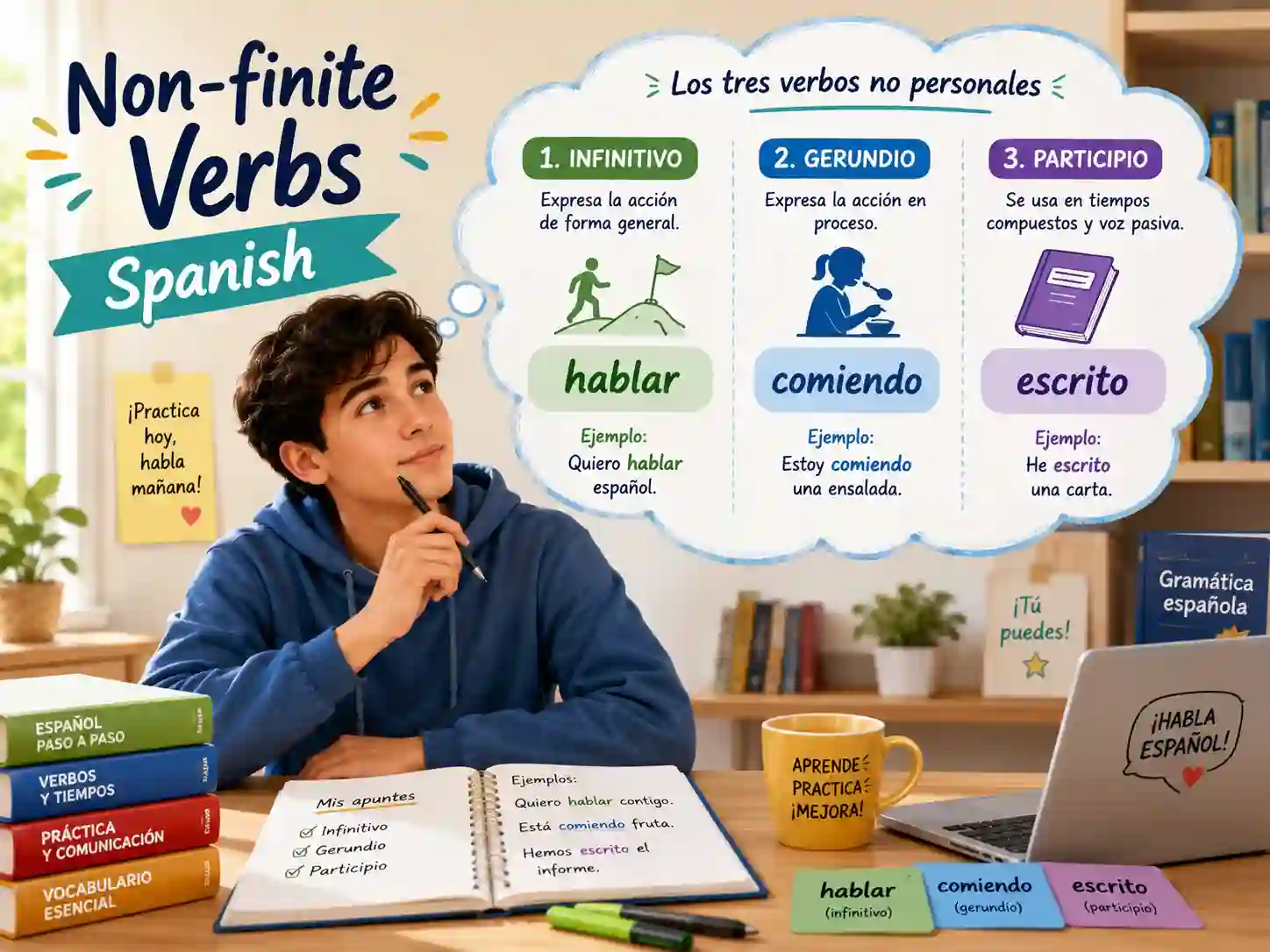
Why non-finite verb forms matter
Non-finite forms connect many parts of Spanish grammar. The infinitive is the basic verb form, the gerund expresses ongoing action, and the past participle helps form compound tenses and adjective-like descriptions. Learning them together prevents common mistakes, especially when translating English “to + verb” and “-ing” structures.
How to use this section
Use this page as the central entry point for Spanish non-finite forms. Start with the overview, then move into the three detail lessons: infinitive, gerund and past participle.
Learn the basic verb form: hablar, comer, vivir.
Learn ongoing forms with -ando and -iendo: estoy estudiando.
Learn compound-tense and adjective forms: he hablado, la puerta cerrada.
The core system: three forms, three functions
Infinitive
The infinitive is the basic verb form. It ends in -ar, -er or -ir.
hablar · comer · vivir
Gerund
The gerund often describes an action in progress, especially with estar.
estoy hablando · estamos aprendiendo
Past participle
The past participle is used with haber and also as an adjective.
he hablado · la puerta cerrada
Spanish non-finite forms at a glance
The three non-finite forms are easy to confuse because they all come from verbs but do different jobs. This table gives a practical overview before you study each form separately.
| Form | Regular endings | Examples | Main use | Detail lesson |
|---|---|---|---|---|
| Infinitive | -ar, -er, -ir | hablar, comer, vivir | Basic verb form, after modal verbs, after prepositions, noun-like use. | Spanish Infinitive |
| Gerund | -ando, -iendo | hablando, comiendo, viviendo | Ongoing action, especially with estar: estoy estudiando. | Spanish Gerund |
| Past participle | -ado, -ido | hablado, comido, vivido | Compound tenses with haber, adjectives and passive-style structures. | Past Participle |
Non-finite forms vs conjugated verbs
A conjugated verb form shows person, number and tense in the sentence: hablo, hablas, hablamos, hablaron. A non-finite form does not carry that full information by itself. It needs another verb, a structure or the surrounding sentence to show its exact role.
Quiero hablar español. — quiero is conjugated; hablar is infinitive.
Estoy hablando español. — estoy is conjugated; hablando is gerund.
He hablado español. — he is conjugated; hablado is past participle.
Spanish infinitive
The infinitive is the basic dictionary form of the verb. It is used after many verbs and expressions, after prepositions, and often where English uses “-ing” as a noun.
Quiero aprender español.
Voy a estudiar mañana.
Después de comer, salimos.
Leer es importante.
Learn the full form here: Spanish Infinitive.
Spanish gerund
The gerund often describes an action in progress. Regular forms use -ando or -iendo, and the most common structure is estar + gerund.
Estoy estudiando español.
Estamos preparando la clase.
Sigue practicando.
Voy entendiendo mejor.
Learn the full form here: Spanish Gerund.
Spanish past participle
The past participle appears in compound tenses with haber and can also work like an adjective. Regular forms use -ado or -ido, but common irregular forms include hecho, dicho, visto, escrito and puesto.
He hablado con Ana.
Hemos visto la película.
La puerta está cerrada.
Los documentos están firmados.
Learn the full form here: Past Participle.
English “to” and “-ing” vs Spanish non-finite forms
English and Spanish do not divide these forms in the same way. English “to + verb” often corresponds to the Spanish infinitive, but English “-ing” can correspond to either a Spanish gerund or a Spanish infinitive, depending on the function.
I want to learn. → Quiero aprender.
I am learning. → Estoy aprendiendo.
Learning Spanish is useful. → Aprender español es útil.
After eating, we left. → Después de comer, salimos.
This is why the Spanish gerund should not be used automatically for every English “-ing” form. In many cases, Spanish uses the infinitive instead.
When to use each non-finite form
Use the infinitive
Use the infinitive after modal verbs, after prepositions and to name an activity.
puedo hablar · después de comer · leer es útil
Use the gerund
Use the gerund mainly for ongoing action and certain continuation structures.
estoy leyendo · sigue practicando
Use the past participle
Use the participle with haber or as an adjective-like form.
he escrito · la carta escrita
Related grammar topics
Spanish Verbs
Return to the full Spanish verb overview, including conjugation, irregular verbs and verb structures.
Regular Verbs
Use infinitive endings to understand regular conjugation patterns.
Modal Verbs
Practise structures such as poder + infinitive, querer + infinitive and deber + infinitive.
Auxiliary Verbs
Understand how helper verbs combine with infinitives, gerunds and participles.
Ser and Estar
Review why progressive forms use estar: estoy estudiando.
Compound Tenses
Learn how haber and the past participle form perfect tenses.
Typical mistakes with Spanish non-finite forms
- Using the gerund for every English “-ing”: say Aprender español es útil, not Aprendiendo español es útil.
- Conjugating the second verb: say quiero aprender, not quiero aprendo.
- Using the gerund after prepositions: say después de comer, not después de comiendo.
- Confusing gerund and past participle: estoy hablando means “I am speaking”; he hablado means “I have spoken”.
- Changing participles after haber: say he escrito la carta, not he escrita la carta.
Where to go next
After this overview, continue with the three detail pages. They explain each form more clearly and show the most important patterns.
Want personal guidance?
If Spanish non-finite forms feel confusing, individual guidance can help you separate infinitives, gerunds and participles and use them correctly in real sentences.
FAQ: Non-finite verbs in Spanish
What are non-finite verb forms in Spanish?
Spanish non-finite verb forms are verb forms that do not show person, number or a full tense by themselves. The main forms are the infinitive, the gerund and the past participle.
What are the three non-finite forms in Spanish?
The three main non-finite forms are the infinitive, the gerund and the past participle: hablar, hablando, hablado.
What is the Spanish infinitive?
The Spanish infinitive is the basic verb form ending in -ar, -er or -ir: hablar, comer, vivir.
What is the Spanish gerund?
The Spanish gerund usually ends in -ando or -iendo and often describes ongoing action with estar: estoy estudiando.
What is the Spanish past participle?
The Spanish past participle usually ends in -ado or -ido and is used with haber in compound tenses or as an adjective.
Is the Spanish gerund the same as English “-ing”?
No. English “-ing” has several uses. Spanish often uses the infinitive where English uses “-ing” as a noun: Aprender español es útil.

MundoDele – Spanish learning for education, work and intercultural understanding
MundoDele connects online Spanish courses, DELE preparation, Business Spanish and cultural context into a personal Spanish learning platform.
Grammar pages are designed to explain Spanish clearly, with practical examples, real sentence logic and connected learning paths.