
Spanish Modal Verbs: Poder, Querer, Deber and More
Learn how Spanish modal verbs and modal-like structures work with the infinitive — from puedo hablar, quiero aprender and debes estudiar to tengo que trabajar, necesito practicar and suelo leer.
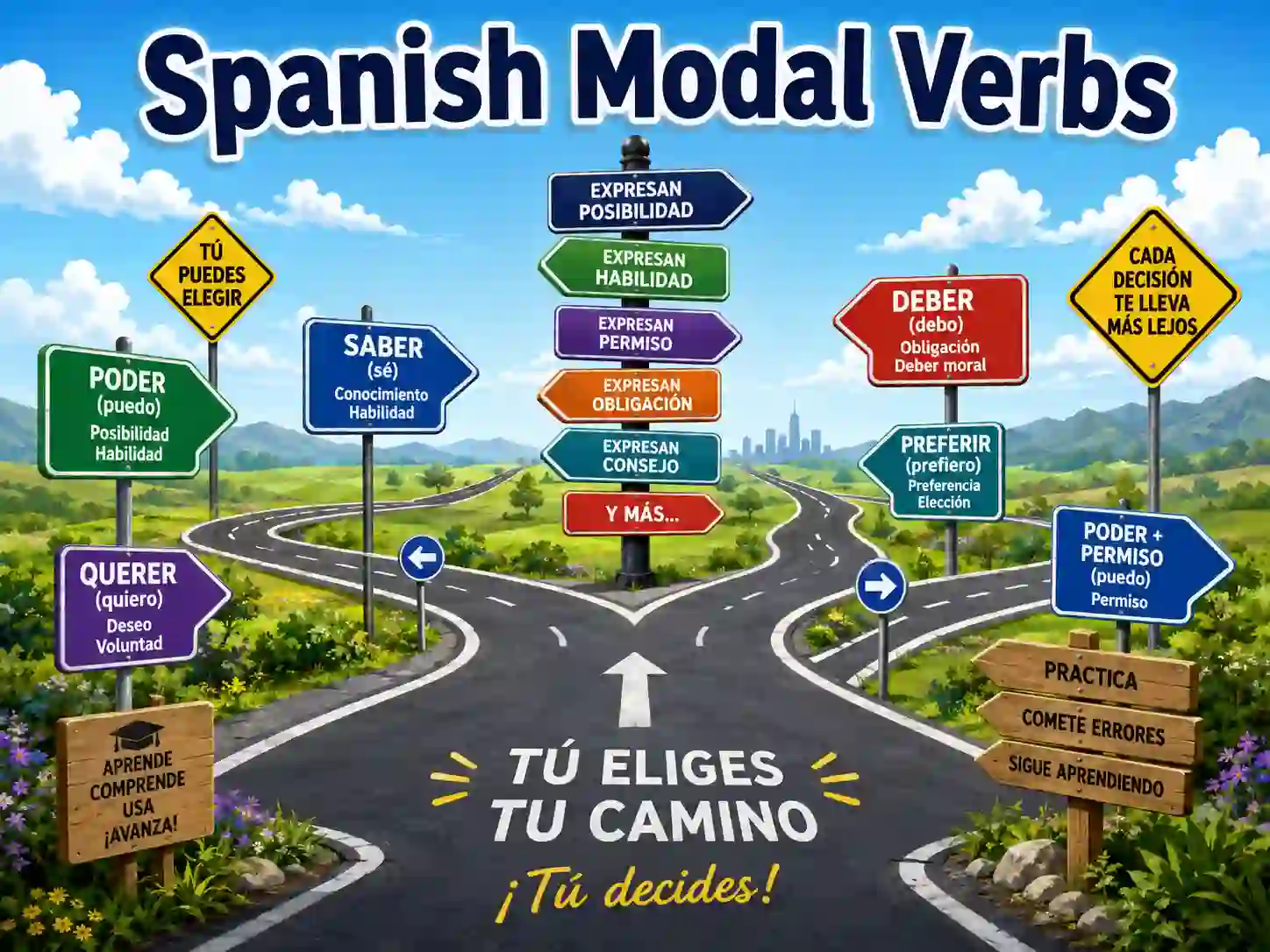
Why Spanish modal verbs matter
Modal verbs are essential for real communication. They help you say what you can do, want to do, must do, should do, need to do or usually do. For learners, the main grammar rule is simple but important: conjugate the modal verb and keep the following verb in the infinitive.
How to use this page
Use this page after the general Spanish verbs overview and the infinitive lesson. First learn the main modal meanings, then practise the full pattern: modal verb + infinitive.
Decide whether the sentence expresses ability, wish, obligation, advice, need or habit.
Use forms such as puedo, quieres, debe, tenemos que or necesitan.
Say puedo hablar, quiero aprender, tenemos que salir, not puedo hablo.
The core system: modal verb + infinitive
Ability
Use poder + infinitive to express ability or possibility.
Puedo hablar español. · Podemos ayudarte.
Wish or intention
Use querer + infinitive to express what someone wants to do.
Quiero aprender. · Quiere viajar.
Obligation or advice
Use deber, tener que or necesitar with the infinitive.
Debes practicar. · Tengo que estudiar.
Spanish modal verbs at a glance
Spanish does not have exactly the same modal system as English. Instead, Spanish uses several very common verbs and verbal expressions followed by the infinitive.
| Verb or expression | Main meaning | Structure | Example | English meaning |
|---|---|---|---|---|
| poder | can, be able to, may | poder + infinitive | Puedo hablar español. | I can speak Spanish. |
| querer | want to | querer + infinitive | Quiero aprender más. | I want to learn more. |
| deber | should, must | deber + infinitive | Debes estudiar hoy. | You should study today. |
| tener que | have to | tener que + infinitive | Tengo que trabajar. | I have to work. |
| necesitar | need to | necesitar + infinitive | Necesito practicar. | I need to practise. |
| soler | usually do something | soler + infinitive | Suelo leer por la noche. | I usually read at night. |
| saber | know how to | saber + infinitive | Sé conducir. | I know how to drive. |
Poder + infinitive: ability and possibility
Poder expresses ability, possibility or permission depending on context. It is followed by an infinitive and is often translated as “can”, “be able to” or “may”.
Puedo hablar español. — I can speak Spanish.
No puedo venir mañana. — I cannot come tomorrow.
¿Puedes ayudarme? — Can you help me?
Podemos empezar ahora. — We can start now.
Poder is also an irregular and stem-changing verb in the present tense: puedo, puedes, puede, podemos, podéis, pueden.
Querer + infinitive: wish and intention
Querer expresses wish, intention or desire. It is followed by the infinitive when someone wants to do something.
Quiero aprender español. — I want to learn Spanish.
¿Quieres salir? — Do you want to go out?
Quiere trabajar en Argentina. — He / she wants to work in Argentina.
Queremos practicar más. — We want to practise more.
Like poder, querer is stem-changing in the present tense: quiero, quieres, quiere, queremos, queréis, quieren.
Deber + infinitive: should, must and probability
Deber + infinitive can express duty, advice or obligation. In some contexts, it can also express probability.
Debes estudiar más. — You should study more.
Debemos salir temprano. — We should leave early.
No debes fumar aquí. — You must not smoke here.
Debe ser difícil. — It must be difficult / it is probably difficult.
For strong practical obligation, Spanish often uses tener que + infinitive. For softer advice, deber + infinitive is common.
Tener que + infinitive: obligation
Tener que + infinitive expresses practical obligation or necessity. It is one of the most common ways to say “have to” in Spanish.
Tengo que trabajar. — I have to work.
Tienes que estudiar. — You have to study.
Tiene que llamar al médico. — He / she has to call the doctor.
Tenemos que salir ahora. — We have to leave now.
Do not confuse tener que with possession. Tengo un libro means “I have a book”; tengo que leer means “I have to read”.
Necesitar, soler and saber with infinitives
Some common Spanish verbs are not always classified as strict modal verbs, but they behave in a similar way because they are followed by an infinitive and add meaning to the main action.
| Verb | Meaning | Example | Grammar note |
|---|---|---|---|
| necesitar | need to | Necesito estudiar. | Regular verb followed by infinitive. |
| soler | usually do something | Suelo leer por la mañana. | Common for habitual actions. |
| saber | know how to | Sé nadar. | Ability learned as a skill. |
| preferir | prefer to | Prefiero quedarme en casa. | Often followed by infinitive. |
| intentar | try to | Intento hablar más. | Action intention or attempt. |
Word order with Spanish modal verbs
In a modal-verb structure, the first verb is conjugated and the second verb remains in the infinitive. This pattern is very stable and very important.
Quiero aprender. — correct
Quiero aprendo. — incorrect
Podemos salir. — correct
Podemos salimos. — incorrect
Tengo que estudiar. — correct
Tengo que estudio. — incorrect
This is why the infinitive is central for modal verbs. Learn it here: Spanish Infinitive.
Pronouns with modal verbs
With modal verbs followed by an infinitive, object and reflexive pronouns can often go before the conjugated verb or attach to the infinitive.
Te puedo ayudar. / Puedo ayudarte. — I can help you.
Me quiero levantar. / Quiero levantarme. — I want to get up.
Lo debes leer. / Debes leerlo. — You should read it.
Nos tenemos que ir. / Tenemos que irnos. — We have to leave.
Learn the full word-order system here: Pronoun Position.
Modal verbs vs auxiliary verbs
Modal verbs and auxiliary verbs are related because both help another verb. The difference is that modal verbs usually express meaning such as ability, wish, obligation or need, while auxiliary verbs often build tense, aspect or voice.
Puedo hablar. — modal meaning: ability
Quiero hablar. — modal meaning: wish
He hablado. — auxiliary structure: perfect tense
Estoy hablando. — auxiliary structure: progressive form
Learn the auxiliary side here: Auxiliary Verbs in Spanish.
When to use Spanish modal verbs
Use poder
Use poder + infinitive to say what someone can do or what is possible.
Puedo hablar. · Podemos empezar.
Use querer
Use querer + infinitive to say what someone wants to do.
Quiero aprender. · Quiere viajar.
Use deber, tener que or necesitar
Use these structures for advice, duty, obligation or need.
Debes practicar. · Tengo que estudiar.
Related grammar topics
Spanish Infinitive
Review why modal verbs are followed by infinitives: puedo hablar, quiero aprender.
Auxiliary Verbs
Compare modal meaning with auxiliary structures such as he hablado and estoy hablando.
Stem-changing Verbs
Connect poder and querer with stem-changing present-tense patterns.
Irregular Verbs
Review common irregular verbs that appear in modal and modal-like structures.
Near Future
Compare modal structures with ir a + infinitive: voy a estudiar.
Pronoun Position
Learn why both te puedo ayudar and puedo ayudarte are possible.
Typical mistakes with Spanish modal verbs
- Conjugating both verbs: say quiero aprender, not quiero aprendo.
- Forgetting the infinitive: say puedo hablar, not only puedo when the action is needed.
- Dropping que in tener que: say tengo que estudiar, not tengo estudiar.
- Confusing poder and saber: puedo nadar means “I can swim” in a situation; sé nadar means “I know how to swim”.
- Placing pronouns incorrectly: say puedo ayudarte or te puedo ayudar, not puedo te ayudar.
Where to go next
After modal verbs, continue with infinitives, auxiliary verbs and pronoun position. These topics explain the structure behind most modal-verb sentences.
Want personal guidance?
If Spanish modal verbs feel confusing, individual guidance can help you practise ability, wish, obligation, need, habit and pronoun position in real sentences.
FAQ: Spanish modal verbs
What are modal verbs in Spanish?
Spanish modal verbs and modal-like structures express ability, wish, obligation, need, advice or habit. They are usually followed by an infinitive.
What are common Spanish modal verbs?
Common Spanish modal verbs and modal-like structures include poder, querer, deber, tener que, necesitar, soler and saber with an infinitive.
What form follows Spanish modal verbs?
Spanish modal verbs are usually followed by the infinitive: puedo hablar, quiero aprender, debes estudiar.
Do you conjugate both verbs in a modal structure?
No. The first verb is conjugated and the second verb stays in the infinitive: quiero aprender, not quiero aprendo.
What is the difference between poder and saber?
Poder often means “can” or “be able to” in a situation. Saber + infinitive means “know how to” do something as a learned skill.
Where do pronouns go with Spanish modal verbs?
Pronouns can often go before the conjugated modal verb or attach to the infinitive: te puedo ayudar or puedo ayudarte.

MundoDele – Spanish learning for education, work and intercultural understanding
MundoDele connects online Spanish courses, DELE preparation, Business Spanish and cultural context into a personal Spanish learning platform.
Grammar pages are designed to explain Spanish clearly, with practical examples, real sentence logic and connected learning paths.