
Subordinating Conjunctions in Spanish
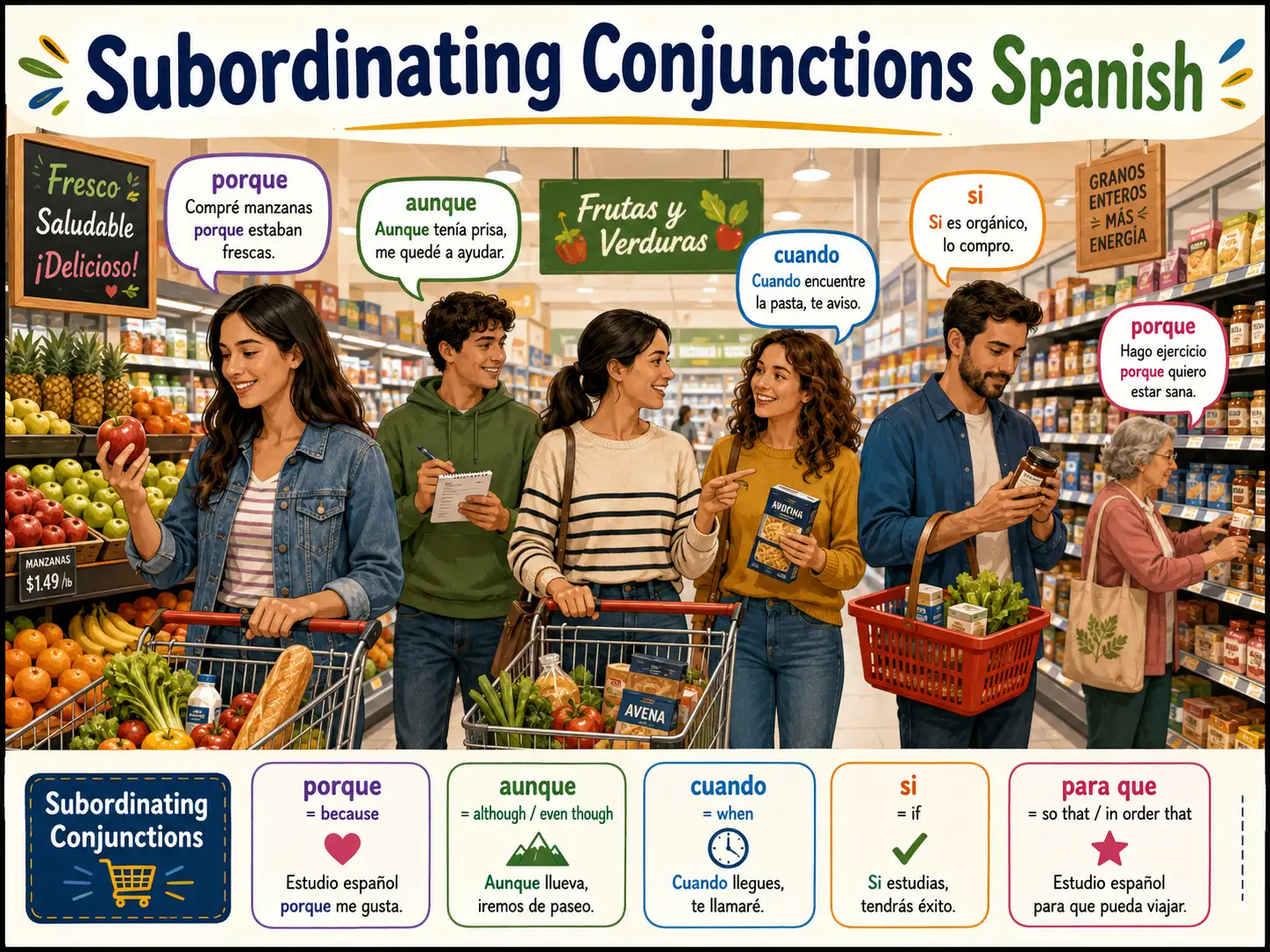
Learn how Spanish subordinating conjunctions connect a main clause with a dependent clause. This guide explains causal, final, temporal, conditional, concessive, consecutive and modal conjunctions, including porque, para que, aunque, cuando, antes de que, si, a menos que, como si and de modo que.
Why learn subordinating conjunctions with MundoDele?
Subordinating conjunctions are easier to understand when they are taught as sentence logic, not as isolated lists. MundoDele explains these connectors through real clause patterns: reason, purpose, time, condition, contrast, result and manner.
The key idea is simple: a subordinating conjunction opens a dependent clause. That clause cannot always stand alone because it depends on the main clause: porque estaba cansado, para que apruebes, aunque llueva, cuando llegue.
How to use this page
Use this page as the main overview for Spanish subordinating conjunctions. First understand the relationship between the two clauses. Then study the connector group: cause, purpose, time, condition, contrast, result or manner. Finally, check whether the verb after the conjunction needs the indicative or the subjunctive.
Main clause
The main clause can usually stand alone.
No fui
I did not go.
Subordinating conjunction
The conjunction introduces the dependent part.
porque, aunque, cuando, si.
Dependent clause
The dependent clause adds reason, time, condition, purpose or contrast.
porque estaba enfermo
because I was sick.
What are subordinating conjunctions in Spanish?
Subordinating conjunctions introduce dependent clauses. A dependent clause gives extra information about the main clause. It can explain the reason, purpose, condition, time, contrast, result or manner of the main action.
| Main clause | Subordinating conjunction | Dependent clause | Meaning |
|---|---|---|---|
| No fui | porque | estaba enfermo. | Reason: I did not go because I was sick. |
| Te ayudo | para que | apruebes. | Purpose: I help you so that you pass. |
| Te llamaré | cuando | llegue. | Time: I will call you when I arrive. |
| Iremos | si | tenemos tiempo. | Condition: We will go if we have time. |
| Saldremos | aunque | llueva. | Concession: We will go out even if it rains. |
Main types of Spanish subordinating conjunctions
Spanish subordinating conjunctions can be grouped by the relationship they express. This is the most practical way to learn them because the meaning of the connector determines the sentence logic.
| Type | Function | Common conjunctions | Example |
|---|---|---|---|
| Causal | Reason or cause | porque, ya que, puesto que, dado que | No fui porque estaba cansado. |
| Final | Purpose or aim | para que, a fin de que, con el fin de que | Te ayudo para que apruebes. |
| Temporal | Time relationship | cuando, antes de que, después de que, hasta que | Llámame cuando llegues. |
| Conditional | Condition or exception | si, a menos que, con tal de que, en caso de que | No salimos a menos que deje de llover. |
| Concessive | Contrast despite an obstacle | aunque, a pesar de que, pese a que, si bien | Aunque llueva, saldremos. |
| Consecutive | Result or consequence | de modo que, de manera que, tan...que, tanto...que | Estaba tan cansado que se durmió. |
| Modal | Manner or comparison | como, según, conforme, como si | Hazlo como quieras. |
Causal subordinating conjunctions
Causal conjunctions introduce the reason or cause of the main clause. They answer the question “why?”.
| Conjunction | Meaning | Spanish example | Use |
|---|---|---|---|
| porque | because | No fui porque estaba enfermo. | Most common reason connector. |
| ya que | since / as | Ya que estás aquí, empezamos. | Known or assumed reason. |
| puesto que | since / given that | Puesto que no hay datos, no podemos decidir. | Formal explanation. |
| dado que | given that | Dado que es urgente, actuamos hoy. | Formal or analytical reason. |
Related page: Causal Conjunctions in Spanish.
Final subordinating conjunctions
Final conjunctions introduce purpose or aim. They answer the question “what for?” and often use the subjunctive when the subject changes.
| Conjunction | Meaning | Spanish example | Grammar point |
|---|---|---|---|
| para que | so that | Te ayudo para que apruebes. | Purpose + subjunctive. |
| a fin de que | in order that | Lo repito a fin de que quede claro. | Formal purpose. |
| con el fin de que | with the aim that | Lo explicamos con el fin de que todos lo entiendan. | Explicit aim. |
| de modo que | so that / in such a way that | Habla de modo que todos te entiendan. | Purpose or manner depending on context. |
Related page: Final Conjunctions in Spanish.
Temporal subordinating conjunctions
Temporal conjunctions introduce a time relationship. They can refer to past, present, repeated or future actions. Future or not-yet-completed actions often use the subjunctive.
| Conjunction | Meaning | Spanish example | Grammar point |
|---|---|---|---|
| cuando | when | Te llamaré cuando llegue. | Future time + subjunctive. |
| mientras | while | Escucho música mientras trabajo. | Simultaneous action. |
| antes de que | before | Llámame antes de que salgas. | Usually subjunctive. |
| después de que | after | Después de que llegue, cenaremos. | Future time + subjunctive. |
| hasta que | until | Esperaré hasta que termines. | Future or not completed + subjunctive. |
Related page: Temporal Conjunctions in Spanish.
Conditional subordinating conjunctions
Conditional conjunctions introduce a condition, requirement or exception. The most important connector is si, but it has special tense rules.
| Conjunction | Meaning | Spanish example | Grammar point |
|---|---|---|---|
| si | if | Si tengo tiempo, voy. | Use indicative for real conditions. |
| a menos que | unless | No salimos a menos que deje de llover. | Exception + subjunctive. |
| con tal de que | provided that | Acepto con tal de que vengas. | Requirement + subjunctive. |
| en caso de que | in case | Llama en caso de que necesites ayuda. | Possible situation + subjunctive. |
Related page: Conditional Conjunctions in Spanish.
Concessive subordinating conjunctions
Concessive conjunctions introduce contrast or concession. They show that an obstacle does not stop the main action.
| Conjunction | Meaning | Spanish example | Grammar point |
|---|---|---|---|
| aunque | although / even if | Aunque llueve, salimos. | Indicative for factual contrast. |
| aunque | even if | Aunque llueva, saldremos. | Subjunctive for possible contrast. |
| a pesar de que | despite the fact that | A pesar de que es difícil, seguimos. | Formal or explicit contrast. |
| si bien | although / while | Si bien es caro, vale la pena. | Often formal or written. |
Related page: Concessive Conjunctions in Spanish.
Consecutive subordinating conjunctions and result connectors
Consecutive conjunctions and result connectors introduce a consequence. Some are clearly subordinate structures, while others function more like sentence connectors.
| Connector | Meaning | Spanish example | Use |
|---|---|---|---|
| tan...que | so...that | Estaba tan cansado que se durmió. | Degree and result. |
| tanto...que | so much...that | Trabajó tanto que se agotó. | Intensity and result. |
| de modo que | so / so that | No había entradas, de modo que nos fuimos. | Result or purpose depending on context. |
| por eso | that is why | Estaba enfermo, por eso no fue. | Consequence connector. |
Related page: Consecutive Conjunctions in Spanish.
Modal subordinating conjunctions
Modal conjunctions show manner, comparison or way of doing something. They answer the question “how?” or “in what way?”.
| Conjunction | Meaning | Spanish example | Use |
|---|---|---|---|
| como | as / like | Hazlo como quieras. | Manner or way. |
| según | according to / as | Hazlo según te expliqué. | According to instructions. |
| conforme | as / according as | Actúa conforme indique la norma. | Formal manner or rule-based action. |
| como si | as if | Habla como si supiera todo. | Hypothetical comparison. |
Related page: Modal Conjunctions in Spanish.
Indicative or subjunctive after subordinating conjunctions
The verb mood depends on the conjunction and the meaning of the clause. Factual, known or repeated actions often use the indicative. Future, uncertain, desired, hypothetical or not-yet-completed actions often use the subjunctive.
| Conjunction type | Indicative example | Subjunctive example | Difference |
|---|---|---|---|
| Temporal | Cuando llega, llama. | Cuando llegue, llamará. | Repeated fact vs future action. |
| Concessive | Aunque llueve, salimos. | Aunque llueva, saldremos. | Factual rain vs possible rain. |
| Conditional | Si tengo tiempo, voy. | A menos que llueva, iremos. | Si has special rules; many other conditional connectors use subjunctive. |
| Final | Usually not indicative in full purpose clauses | Te ayudo para que apruebes. | Purpose clauses commonly use subjunctive. |
| Causal | No fui porque estaba enfermo. | Less common; depends on special contexts | Cause is usually presented as factual. |
The role of que in subordinating conjunctions
Many Spanish subordinating conjunctions contain que. The meaning comes from the full expression, not from que alone.
| Expression | Type | Example | Meaning |
|---|---|---|---|
| para que | Final | Te llamo para que vengas. | Purpose. |
| antes de que | Temporal | Llámame antes de que salgas. | Time before another action. |
| a menos que | Conditional | No salimos a menos que deje de llover. | Exception. |
| aunque | Concessive | Aunque sea difícil, lo haré. | Contrast or concession. |
| porque | Causal | No fui porque estaba cansado. | Reason. |
Related page: Spanish Conjunctions with Que.
Subordinating vs coordinating conjunctions
Coordinating conjunctions connect elements of similar grammatical level. Subordinating conjunctions make one clause dependent on another.
| Type | Spanish example | English meaning | Logic |
|---|---|---|---|
| Coordinating | Quiero café y pan. | I want coffee and bread. | Connects similar elements. |
| Coordinating | Estudio, pero estoy cansado. | I study, but I am tired. | Connects two coordinated clauses. |
| Subordinating | No fui porque estaba enfermo. | I did not go because I was sick. | The reason clause depends on the main clause. |
| Subordinating | Te llamaré cuando llegue. | I will call you when I arrive. | The time clause depends on the main clause. |
Practice exercises: subordinating conjunctions
Try to answer before opening the solutions. These exercises focus on meaning, connector type and indicative vs subjunctive.
Exercise 1: identify the type
- No fui porque estaba enfermo.
- Te ayudo para que apruebes.
- Llámame cuando llegues.
- No salimos a menos que deje de llover.
Show answers
1. Causal
2. Final / purpose
3. Temporal
4. Conditional / exception
Exercise 2: choose the conjunction
- No fui ___ estaba cansado. = because
- Te ayudo ___ apruebes. = so that
- Te llamaré ___ llegue. = when
- Saldremos ___ llueva. = even if
Show answers
1. porque
2. para que
3. cuando
4. aunque
Exercise 3: indicative or subjunctive?
- No fui porque ___ cansado. estar
- Te ayudo para que ___. aprobar
- Cuando ___, te llamaré. llegar
- Si ___ tiempo, voy. tener
Show answers
1. estaba
2. apruebes
3. llegue
4. tengo
Typical mistakes with Spanish subordinating conjunctions
- Learning only translations: learn the clause function too: reason, purpose, time, condition, contrast, result or manner.
- Forgetting the subjunctive after purpose connectors: say para que apruebes, not para que apruebas.
- Using present subjunctive after normal si clauses: say si tengo tiempo, not si tenga tiempo.
- Confusing cause and result: porque gives the reason; por eso gives the consequence.
- Confusing purpose and cause: para que means “so that”; porque means “because”.
- Ignoring factual vs hypothetical meaning: aunque llueve and aunque llueva are both correct, but they mean different things.
Related grammar topics
Spanish Conjunctions
Learn how Spanish conjunctions connect words, phrases and clauses.
Conjunctions with Que
Study que, qué, porque, para que and other que expressions.
Final Conjunctions
Study para que, a fin de que and purpose clauses.
Causal Conjunctions
Study porque, ya que, puesto que and dado que.
Temporal Conjunctions
Study cuando, mientras, antes de que and hasta que.
Conditional Conjunctions
Study si, a menos que, con tal de que and en caso de que.
Where to go next
After subordinating conjunctions, continue with conjunctions with que, final conjunctions and temporal conjunctions. These pages explain the most common structures where learners need to choose between indicative, subjunctive and infinitive.
Learn Spanish grammar with MundoDele
If Spanish subordinating conjunctions feel confusing, this lesson can help you practise porque, para que, aunque, cuando, si, a menos que, clause logic and real Spanish sentence patterns in a clear and structured way.
FAQ: subordinating conjunctions in Spanish
What are subordinating conjunctions in Spanish?
Subordinating conjunctions connect a main clause with a dependent clause. They express relationships such as cause, purpose, time, condition, contrast, result or manner.
What are examples of Spanish subordinating conjunctions?
Common examples include porque, para que, aunque, cuando, antes de que, si, a menos que, con tal de que and como si.
Do subordinating conjunctions take the subjunctive in Spanish?
Some do, some do not, and some can take both. Para que usually takes the subjunctive, porque often takes the indicative, and aunque can take either depending on meaning.
What is the difference between coordinating and subordinating conjunctions?
Coordinating conjunctions connect elements of similar level, such as y or pero. Subordinating conjunctions introduce a dependent clause, such as porque estaba enfermo or cuando llegue.
Is porque a subordinating conjunction?
Yes. Porque introduces a causal dependent clause: No fui porque estaba enfermo.
Is si followed by the subjunctive?
Not in normal real conditions. Say si tengo tiempo, not si tenga tiempo. For hypothetical conditions, Spanish uses the imperfect subjunctive: si tuviera tiempo.

About MundoDele
MundoDele connects online Spanish courses, DELE preparation, Business Spanish and cultural context into a personal Spanish learning platform.
Grammar pages are designed to explain Spanish clearly, with practical examples, real sentence logic and connected learning paths.