
Spanish Indefinite Determiners: Algún, Ningún, Otro and More
Learn how Spanish indefinite determiners introduce nouns in a non-specific way — from algún día, ningún problema and otro libro to cierta persona, cualquier estudiante and tal idea.
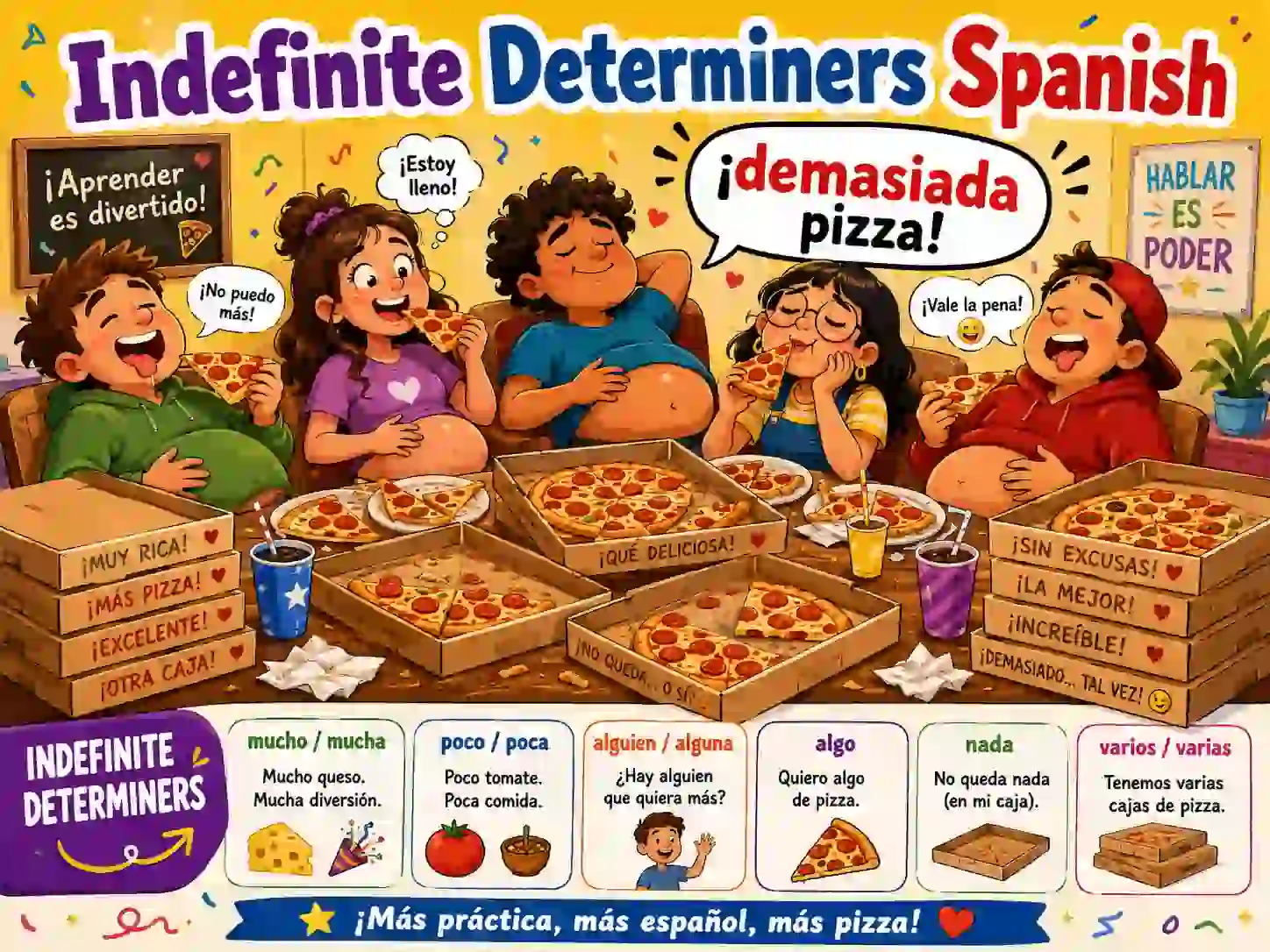
Why Spanish indefinite determiners matter
Indefinite determiners are common in everyday Spanish because they help you speak about non-specific people, things, options, alternatives and absence. They are close to indefinite pronouns and quantifiers, but their main function here is clear: they come before a noun and help define how specific or non-specific that noun is.
How to use this page
Use this page after articles, nouns and basic determiners. Focus on the difference between a word used before a noun and the same or similar word used alone as a pronoun.
In algún problema, otra clase and cualquier persona, the determiner comes before a noun.
Use forms such as algún libro, alguna pregunta, otros días, otras ideas.
Algún libro has a noun after it. Alguno can stand alone as a pronoun.
The core system: non-specific reference before a noun
Some or any
Use algún forms when the noun is indefinite but possible or available.
algún día · alguna idea · algunos libros
No or not any
Use ningún forms to deny the existence or relevance of a noun.
ningún problema · ninguna pregunta
Another, other or any
Use otro, cierto, cualquier and tal for alternatives, vague reference or open choice.
otro ejemplo · cierta persona · cualquier día
Spanish indefinite determiners at a glance
These forms are used before nouns. Some agree fully with gender and number. Others have special shortened forms.
| Determiner | Main meaning | Forms | Example | Grammar note |
|---|---|---|---|---|
| alguno | some, any | algún, alguna, algunos, algunas | algún problema | Alguno becomes algún before masculine singular nouns. |
| ninguno | no, not any | ningún, ninguna | ningún error | Ninguno becomes ningún before masculine singular nouns. |
| otro | another, other | otro, otra, otros, otras | otro libro | No un before otro in standard Spanish. |
| cierto | a certain, certain | cierto, cierta, ciertos, ciertas | cierta persona | Before a noun, it often means “a certain”. |
| cualquier | any, whichever | cualquier | cualquier día | Used before singular masculine or feminine nouns. |
| tal | such, such a, a certain | tal, tales | tal problema | Can refer vaguely or evaluate a type of noun. |
| varios | several | varios, varias | varias opciones | Also works as a quantifier; study with quantifiers too. |
Algún, alguna, algunos and algunas
Algún forms express “some” or “any” before nouns. The form depends on the gender and number of the noun.
| Form | Used before | Example | English meaning |
|---|---|---|---|
| algún | masculine singular noun | algún día | some day / one day |
| alguna | feminine singular noun | alguna pregunta | some question / any question |
| algunos | masculine plural noun | algunos libros | some books |
| algunas | feminine plural noun | algunas personas | some people |
Notice the shortened masculine singular form: alguno becomes algún before a masculine singular noun: algún problema, algún libro, algún estudiante.
Ningún and ninguna
Ningún and ninguna express absence: “no” or “not any”. They are commonly used in negative sentences.
No tengo ningún problema. — I do not have any problem.
No hay ninguna pregunta. — There is no question.
No conozco ningún restaurante aquí. — I do not know any restaurant here.
No veo ninguna diferencia. — I do not see any difference.
Like alguno, ninguno shortens before masculine singular nouns: ningún problema, not ninguno problema.
Otro, otra, otros and otras
Otro means “another” or “other”. It agrees with the noun in gender and number. In standard Spanish, do not use un before otro when you mean “another”.
| Form | Example | Meaning | Note |
|---|---|---|---|
| otro | otro libro | another book | masculine singular |
| otra | otra clase | another class | feminine singular |
| otros | otros ejemplos | other examples | masculine plural |
| otras | otras ideas | other ideas | feminine plural |
Correct: Quiero otro café.
Avoid in standard Spanish: Quiero un otro café.
Cierto, cierta, ciertos and ciertas
Before a noun, cierto often means “a certain” or “some particular but unspecified”. It agrees with the noun.
Cierto día, decidió viajar. — One certain day, he/she decided to travel.
Cierta persona me llamó. — A certain person called me.
Ciertos detalles son importantes. — Certain details are important.
Ciertas palabras son difíciles. — Certain words are difficult.
Word position matters: cierta información can mean “certain/some specific information”, while información cierta means “true information”.
Cualquier before singular nouns
Cualquier means “any”, “whichever” or “no matter which” before singular nouns. It is used before both masculine and feminine singular nouns.
cualquier día — any day
cualquier persona — any person
cualquier problema — any problem
cualquier opción — any option
Cualquiera can stand alone as a pronoun, but before a singular noun it normally becomes cualquier: cualquier estudiante, not cualquiera estudiante.
Tal and tales
Tal can mean “such”, “such a” or “a certain”, depending on the context. It is often more formal or emphatic than basic indefinite determiners.
No acepto tal explicación. — I do not accept such an explanation.
Tal problema requiere tiempo. — Such a problem requires time.
Tales decisiones son difíciles. — Such decisions are difficult.
Tal is singular and tales is plural. It does not change for masculine or feminine gender.
Indefinite determiners vs quantifiers
Some words overlap with quantifier use because they also express vague quantity. The useful distinction is the function in the noun phrase.
| Function | Example | Meaning | Best related lesson |
|---|---|---|---|
| Indefinite determiner | algún problema | some/any problem | Indefinite determiners |
| Indefinite determiner | otro ejemplo | another example | Indefinite determiners |
| Quantifier | muchos problemas | many problems | Spanish Quantifiers |
| Quantifier / indefinite quantity | varias opciones | several options | Spanish Quantifiers |
Indefinite determiners vs indefinite pronouns
An indefinite determiner comes before a noun. An indefinite pronoun stands alone and replaces the noun phrase.
| Determiner before a noun | Pronoun standing alone | Explanation |
|---|---|---|
| algún libro | alguno | The noun libro is present in the determiner phrase. |
| ningún problema | ninguno | Ninguno can stand alone as “none”. |
| otra pregunta | otra | The pronoun form replaces the noun when it is understood. |
| cualquier persona | cualquiera | Cualquier comes before a noun; cualquiera can stand alone. |
Learn pronoun use separately here: Spanish Indefinite Pronouns.
When to use Spanish indefinite determiners
Use algún forms
Use these when something is possible, unknown or not fully specified.
algún día · alguna pregunta · algunos ejemplos
Use ningún forms
Use these in negative contexts to deny the presence of a noun.
ningún problema · ninguna duda
Use otro and cualquier
Use these for another option or any possible option.
otro camino · cualquier persona
Related grammar topics
Spanish Determiners
Understand how determiners introduce, specify, quantify or question nouns.
Indefinite Articles
Compare un, una, unos, unas with indefinite determiners such as algún and otro.
Spanish Quantifiers
Compare indefinite reference with quantity words such as mucho, poco, todo and varios.
Spanish Nouns
Review gender and number because many indefinite determiners agree with nouns.
Spanish Adjectives
Compare determiner agreement with adjective agreement in noun phrases.
Indefinite Pronouns
Learn what happens when words such as alguno, ninguno and cualquiera stand alone.
Typical mistakes with Spanish indefinite determiners
- Using alguno before a masculine singular noun: say algún problema, not alguno problema.
- Using ninguno before a masculine singular noun: say ningún libro, not ninguno libro.
- Adding un before otro: say otro café, not un otro café.
- Using cualquiera before a singular noun: say cualquier persona, not cualquiera persona.
- Confusing determiners and pronouns: algún libro has a noun after it; alguno stands alone.
Where to go next
After indefinite determiners, continue with indefinite pronouns, quantifiers and indefinite articles. These topics explain the difference between non-specific nouns, vague quantities and pronoun replacement.
Want personal guidance?
If Spanish indefinite forms feel confusing, individual guidance can help you practise algún, ningún, otro, cualquier, noun agreement and the difference between determiners and pronouns.
FAQ: Spanish indefinite determiners
What are Spanish indefinite determiners?
Spanish indefinite determiners are words used before nouns when the noun is not fully specific. Examples include algún, ningún, otro, cierto, cualquier and tal.
What is the difference between algún and alguno?
Algún is used before masculine singular nouns: algún problema. Alguno can stand alone as a pronoun or appear in other positions.
What is the difference between ningún and ninguno?
Ningún is used before masculine singular nouns: ningún libro. Ninguno can stand alone as a pronoun meaning “none”.
Do you say un otro in Spanish?
No. Standard Spanish uses otro directly before the noun: otro café, otra pregunta, otros ejemplos.
How do you use cualquier before nouns?
Cualquier is used before singular masculine or feminine nouns: cualquier día, cualquier persona, cualquier problema.
What is the difference between indefinite determiners and indefinite pronouns?
Indefinite determiners come before nouns, as in algún libro. Indefinite pronouns stand alone, as in alguno, ninguno or cualquiera.

MundoDele – Spanish learning for education, work and intercultural understanding
MundoDele connects online Spanish courses, DELE preparation, Business Spanish and cultural context into a personal Spanish learning platform.
Grammar pages are designed to explain Spanish clearly, with practical examples, real sentence logic and connected learning paths.