
Spanish Interrogative Determiners: Qué and Cuánto
Learn how Spanish question words work before nouns — from ¿Qué libro lees? and ¿Cuánto dinero necesitas? to ¿Cuántas personas vienen? and indirect questions such as No sé cuántos estudiantes hay.
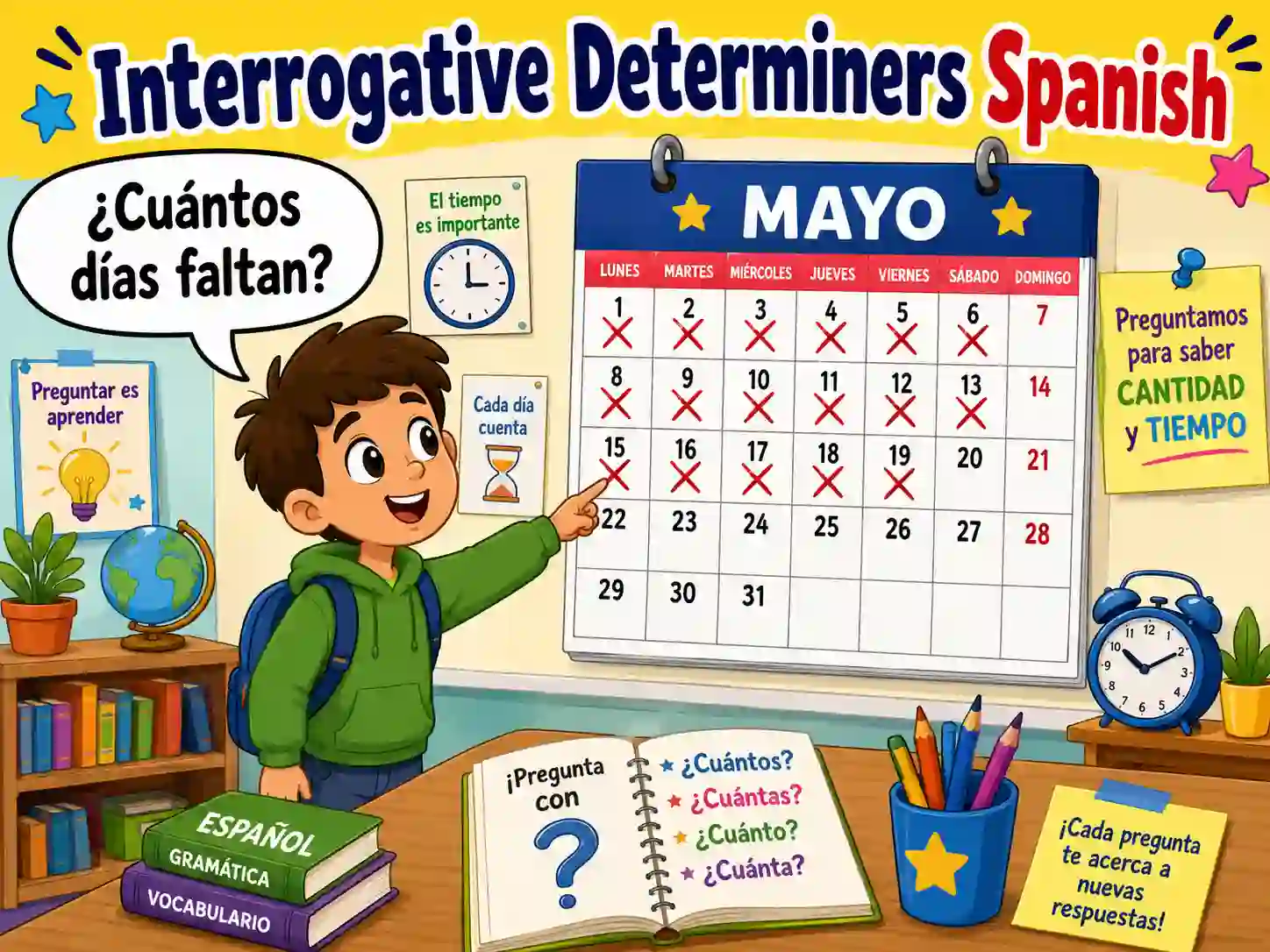
Why Spanish interrogative determiners matter
Interrogative determiners are essential for asking precise questions about nouns: what book, which class, how much money, how many people. They also appear in indirect questions and exclamations. The main grammar points are accent marks, agreement with the following noun and the difference between determiner use and pronoun use.
How to use this page
Use this page after articles, nouns and quantifiers. First learn qué + noun, then practise cuánto agreement, and finally separate qué from cuál.
If a question word comes directly before a noun, it is functioning as a determiner: qué libro, cuántas personas.
Interrogative and exclamative forms have accents: qué, cuánto, cuánta, cuántos, cuántas.
Use cuánto dinero, cuánta agua, cuántos libros, cuántas clases.
The core system: question word + noun
Qué + noun
Use qué before a noun to ask “what” or “which” in a broad sense.
¿Qué libro lees? · ¿Qué clase tienes?
Cuánto + noun
Use cuánto forms before nouns to ask about amount or number.
¿Cuánto tiempo? · ¿Cuántas personas?
Cuál usually stands alone
Cuál and cuáles usually work as pronouns or with de, not as the main noun determiner.
¿Cuál prefieres? · ¿Cuál de estos libros?
Spanish interrogative determiners at a glance
Interrogative determiners are used before nouns in direct questions, indirect questions and exclamations.
| Form | Main meaning | Used before | Example | Grammar note |
|---|---|---|---|---|
| qué | what, which | singular or plural nouns | ¿Qué libro lees? | Invariable; always accented in questions and exclamations. |
| cuánto | how much | masculine singular nouns | ¿Cuánto dinero tienes? | Agrees with the following noun. |
| cuánta | how much | feminine singular nouns | ¿Cuánta agua necesitas? | Used with feminine singular nouns. |
| cuántos | how many | masculine plural nouns | ¿Cuántos estudiantes vienen? | Used with masculine plural nouns. |
| cuántas | how many | feminine plural nouns | ¿Cuántas clases tienes? | Used with feminine plural nouns. |
| cuál / cuáles | which one(s) | usually no direct noun after it | ¿Cuál de estos libros prefieres? | Usually treated as interrogative pronoun in standard teaching. |
Qué before nouns
Qué is the most common interrogative determiner in Spanish. It is used before a noun to ask what kind, what type or which item is meant. It does not change for gender or number.
¿Qué libro lees? — What book are you reading?
¿Qué idioma estudias? — What language are you studying?
¿Qué clases tienes hoy? — What classes do you have today?
¿Qué problemas hay? — What problems are there?
In exclamations, qué also has an accent: ¡Qué idea!, ¡Qué día!, ¡Qué sorpresa!.
Cuánto, cuánta, cuántos and cuántas
Cuánto forms ask about quantity. They agree with the noun that follows in gender and number. Use singular forms for uncountable or singular nouns, and plural forms for countable plural nouns.
| Form | Noun type | Example | English meaning |
|---|---|---|---|
| cuánto | masculine singular | ¿Cuánto tiempo necesitas? | How much time do you need? |
| cuánta | feminine singular | ¿Cuánta agua quieres? | How much water do you want? |
| cuántos | masculine plural | ¿Cuántos libros tienes? | How many books do you have? |
| cuántas | feminine plural | ¿Cuántas personas vienen? | How many people are coming? |
Direct and indirect questions
Interrogative determiners keep their accent in both direct and indirect questions. Direct questions use question marks. Indirect questions are embedded inside another sentence.
| Direct question | Indirect question | Meaning |
|---|---|---|
| ¿Qué libro lees? | No sé qué libro lees. | I do not know what book you are reading. |
| ¿Cuánto dinero tienes? | No sé cuánto dinero tienes. | I do not know how much money you have. |
| ¿Cuántas clases hay? | Pregunto cuántas clases hay. | I ask how many classes there are. |
| ¿Qué problema tiene? | No entiendo qué problema tiene. | I do not understand what problem he/she has. |
Qué vs cuál before nouns
For standard learner Spanish, use qué + noun when a noun follows directly: ¿Qué libro prefieres?. Use cuál or cuáles when the noun is not directly after the question word, especially in cuál de structures.
¿Qué libro prefieres? — Which book do you prefer?
¿Cuál prefieres? — Which one do you prefer?
¿Cuál de estos libros prefieres? — Which of these books do you prefer?
¿Cuáles son tus favoritos? — Which ones are your favourites?
In some regions, speakers may use cuál + noun, but for clear standard usage, qué + noun is the safer model for learners.
Interrogative and exclamative use
The same accented forms are used in exclamations. In questions, they ask for information. In exclamations, they express emotion, surprise or intensity.
| Question | Exclamation | Note |
|---|---|---|
| ¿Qué día es hoy? | ¡Qué día! | Qué stays invariable. |
| ¿Cuánto trabajo tienes? | ¡Cuánto trabajo! | Masculine singular agreement. |
| ¿Cuánta gente hay? | ¡Cuánta gente! | Feminine singular agreement. |
| ¿Cuántos problemas hay? | ¡Cuántos problemas! | Masculine plural agreement. |
| ¿Cuántas ideas tienes? | ¡Cuántas ideas! | Feminine plural agreement. |
Accent marks: qué, cuánto and cuanto
Interrogative and exclamative forms carry an accent. Relative forms do not. This is especially important with cuánto and cuanto.
¿Cuántos libros tienes? — How many books do you have?
No sé cuántos libros tienes. — I do not know how many books you have.
Lee cuantos libros puede. — He reads as many books as he can.
¿Qué clase tienes? — What class do you have?
Learn the non-accented relative quantity forms here: Relative Determiners.
Interrogative determiners vs interrogative pronouns
Interrogative determiners come before nouns. Interrogative pronouns stand alone or replace a noun phrase. The distinction is useful because qué can work in both ways, while cuál usually works as a pronoun.
| Type | Example | Explanation |
|---|---|---|
| Determiner | ¿Qué libro lees? | Qué comes before the noun libro. |
| Pronoun | ¿Qué lees? | Qué stands alone and replaces the object. |
| Determiner | ¿Cuántas clases tienes? | Cuántas comes before the noun clases. |
| Pronoun | ¿Cuántas tienes? | The noun is omitted but understood. |
| Pronoun | ¿Cuál prefieres? | Cuál stands for “which one”. |
Learn pronoun use separately here: Interrogative Pronouns.
When to use Spanish interrogative determiners
Use qué + noun
Use qué when asking what or which noun is meant.
¿Qué idioma estudias?
Use singular cuánto forms
Use cuánto or cuánta for singular or uncountable nouns.
¿Cuánto tiempo? · ¿Cuánta agua?
Use plural cuántos forms
Use cuántos or cuántas for plural countable nouns.
¿Cuántos libros? · ¿Cuántas personas?
Related grammar topics
Spanish Determiners
Understand how determiners introduce, specify, quantify or question nouns.
Spanish Quantifiers
Compare cuánto forms with quantity words such as mucho, poco and todo.
Relative Determiners
Compare interrogative cuánto with relative cuanto.
Spanish Nouns
Review gender and number because cuánto forms agree with nouns.
Interrogative Pronouns
Learn when qué, cuál and cuánto stand alone instead of determining a noun.
Spanish Questions
Connect interrogative determiners with full question structure and word order.
Typical mistakes with Spanish interrogative determiners
- Forgetting the accent: write qué and cuántos in questions and indirect questions.
- Using the wrong cuánto form: say cuántas personas, not cuántos personas.
- Confusing qué and cuál: use qué + noun for standard learner Spanish: ¿Qué libro?.
- Dropping the accent in indirect questions: write No sé cuántos estudiantes hay, not No sé cuantos estudiantes hay.
- Confusing interrogative cuánto and relative cuanto: questions need the accent; relative quantity forms do not.
Where to go next
After interrogative determiners, continue with interrogative pronouns, quantifiers and Spanish questions. These topics explain the difference between asking about a noun and replacing a noun in a question.
Want personal guidance?
If Spanish question words feel confusing, individual guidance can help you practise qué, cuánto forms, accents, indirect questions and the difference between determiners and pronouns.
FAQ: Spanish interrogative determiners
What are Spanish interrogative determiners?
Spanish interrogative determiners are question words used before nouns. The main forms are qué and cuánto, cuánta, cuántos, cuántas.
What does qué mean before a noun?
Qué before a noun means “what” or “which”: ¿Qué libro lees?, ¿Qué idioma estudias?.
How do cuánto forms agree in Spanish?
Cuánto forms agree with the following noun: cuánto tiempo, cuánta agua, cuántos libros, cuántas personas.
Do interrogative determiners have accents?
Yes. Interrogative and exclamative forms carry accents in direct and indirect questions: qué, cuánto, cuánta, cuántos, cuántas.
What is the difference between qué and cuál?
Use qué before a noun in standard learner Spanish: ¿Qué libro prefieres?. Use cuál when it stands for “which one”: ¿Cuál prefieres? or ¿Cuál de estos libros?.
What is the difference between cuánto and cuanto?
Cuánto with an accent is interrogative or exclamative. Cuanto without accent can be a relative quantity form, as in lee cuantos libros puede.

MundoDele – Spanish learning for education, work and intercultural understanding
MundoDele connects online Spanish courses, DELE preparation, Business Spanish and cultural context into a personal Spanish learning platform.
Grammar pages are designed to explain Spanish clearly, with practical examples, real sentence logic and connected learning paths.