
Spanish Possessive Determiners: Mi, Tu, Su and More
Learn how Spanish possessive determiners show ownership, relationship and belonging — from mi casa, tus libros and su familia to nuestro profesor, nuestras clases and sus amigos.
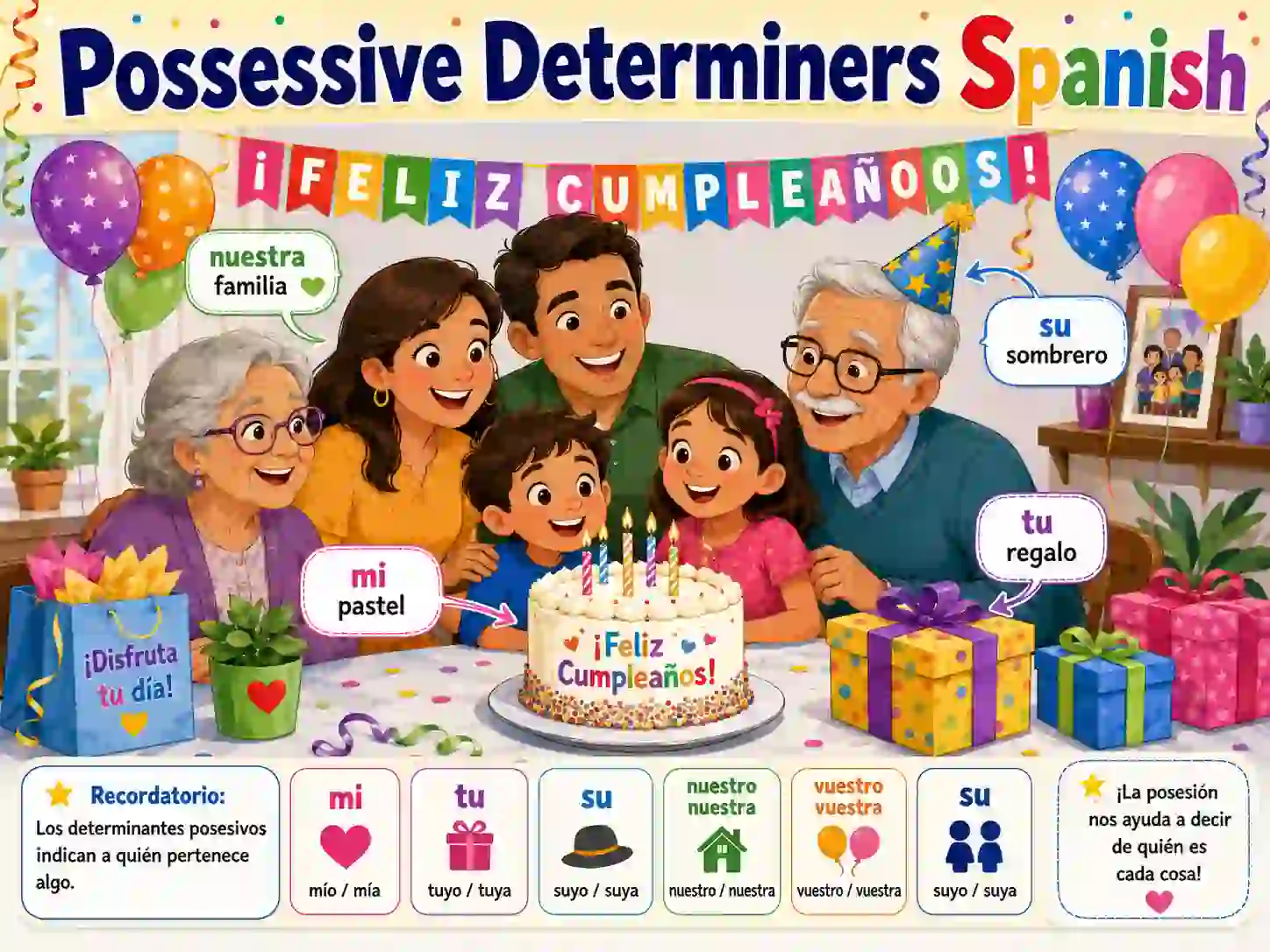
Why Spanish possessive determiners matter
Possessive determiners are basic but very frequent. They let you talk about family, objects, names, homes, studies, work and relationships. The main challenge is that Spanish possessives agree with the possessed noun, not with the person who owns it. Another important point is that su can mean several different things, depending on context.
How to use this page
Use this page after learning articles, nouns and adjective agreement. First learn the short possessive forms before nouns, then study agreement and the difference between possessive determiners and possessive pronouns.
Ask who the noun belongs or relates to: I, you, he, she, we, you all, they.
The possessive form changes according to the noun: mi libro, mis libros, nuestra casa.
Say mi casa, tu amigo, su coche, not la mi casa.
The core system: owner + possessed noun
Before the noun
Short possessive determiners normally come before the noun.
mi casa · tu libro · su familia
Agreement with the possessed noun
The form agrees with the noun that is possessed, not with the person who owns it.
nuestro amigo · nuestra amiga · nuestros libros
Su can be ambiguous
Su can mean his, her, its, your formal or their.
su casa = his/her/your/their house
Spanish possessive determiners at a glance
These are the short possessive forms used before nouns. In many learner materials they are also called possessive adjectives.
| Owner | Singular possessed noun | Plural possessed noun | Example | Meaning |
|---|---|---|---|---|
| I | mi | mis | mi libro · mis libros | my book · my books |
| you informal singular | tu | tus | tu casa · tus casas | your house · your houses |
| he / she / it / usted | su | sus | su coche · sus coches | his/her/its/your formal car · cars |
| we | nuestro, nuestra | nuestros, nuestras | nuestra clase · nuestros amigos | our class · our friends |
| you plural in Spain | vuestro, vuestra | vuestros, vuestras | vuestro profesor · vuestras ideas | your teacher · your ideas |
| they / ustedes | su | sus | su familia · sus hijos | their/your plural family · children |
Mi, tu and su
Mi, tu and su are the most common short possessive determiners. They do not change for masculine or feminine nouns. They only change between singular and plural: mi/mis, tu/tus, su/sus.
mi casa — my house
mis casas — my houses
tu amigo — your friend
tus amigos — your friends
su madre — his/her/your/their mother
sus padres — his/her/your/their parents
The plural s refers to the number of things possessed, not to the number of owners: mi libro is one book; mis libros is more than one book.
Nuestro and vuestro
Nuestro and vuestro agree in gender and number with the possessed noun. Vuestro is mainly used in Spain with vosotros. In Latin America, speakers normally use su/sus for plural “your”.
| Form | Used before | Example | Meaning |
|---|---|---|---|
| nuestro | masculine singular noun | nuestro profesor | our teacher |
| nuestra | feminine singular noun | nuestra escuela | our school |
| nuestros | masculine plural noun | nuestros amigos | our friends |
| nuestras | feminine plural noun | nuestras clases | our classes |
| vuestro | masculine singular noun | vuestro libro | your book, Spain |
| vuestras | feminine plural noun | vuestras preguntas | your questions, Spain |
Agreement with the possessed noun
Spanish possessive determiners agree with the noun that follows them. They do not agree with the owner. This is especially important with nuestro and vuestro.
nuestro padre — our father
nuestra madre — our mother
nuestros padres — our parents
nuestras hermanas — our sisters
In all four examples, the owner is “we”. The possessive changes only because the possessed noun changes.
The ambiguity of su and sus
Su and sus are very useful, but they can be ambiguous because they can refer to several different owners: él, ella, usted, ellos, ellas or ustedes.
| Spanish phrase | Possible meanings | Clearer option if needed |
|---|---|---|
| su libro | his book, her book, your formal book, their book | el libro de él, el libro de ella, el libro de usted |
| su casa | his house, her house, your formal house, their house | la casa de ella, la casa de ellos |
| sus hijos | his children, her children, your children, their children | los hijos de él, los hijos de ustedes |
In many contexts, su is clear from the situation. When it is not clear, Spanish can use de él, de ella, de usted, de ellos or de ustedes.
No article before short possessives
Short possessive determiners already determine the noun. Standard Spanish does not normally add el, la, los or las before them.
| Correct | Incorrect | Reason |
|---|---|---|
| mi casa | la mi casa | Mi already determines the noun. |
| tu amigo | el tu amigo | Do not use an article before short possessives. |
| su coche | el su coche | Su functions like a determiner. |
| nuestra escuela | la nuestra escuela | Use nuestra escuela before a noun. |
Short possessives vs long possessives
Spanish has short possessive determiners before nouns and long possessive forms that usually appear after nouns or as possessive pronouns. The long forms add emphasis, contrast or independence.
| Short determiner before noun | Long form after noun | Possessive pronoun | Meaning |
|---|---|---|---|
| mi libro | un libro mío | el mío | my book / a book of mine / mine |
| tu amiga | una amiga tuya | la tuya | your friend / a friend of yours / yours |
| su casa | una casa suya | la suya | his/her/your/their house / his/hers/yours/theirs |
| nuestro coche | un coche nuestro | el nuestro | our car / a car of ours / ours |
Learn the pronoun side separately here: Spanish Possessive Pronouns.
Tu vs tú and mi vs mí
Spanish distinguishes possessive determiners without accents from personal pronouns with accents. This difference matters in writing.
tu casa — your house
tú estudias — you study
mi libro — my book
para mí — for me
Use tu and mi before nouns. Use tú and mí when they function as personal pronouns.
Possessives with family, body parts and personal items
Spanish uses possessive determiners often with family and personal relationships: mi madre, tu hermano, su familia, nuestros amigos. With body parts and clothing, Spanish often uses definite articles when the owner is already clear from the context.
Mi madre vive en Chile. — My mother lives in Chile.
Tu hermano habla español. — Your brother speaks Spanish.
Me duele la cabeza. — My head hurts.
Se lava las manos. — He/she washes his/her hands.
This is why English “my head” or “his hands” often becomes la cabeza or las manos in Spanish when the owner is already grammatically clear.
When to use Spanish possessive determiners
Use mi, tu and su
Use these for everyday objects and relationships.
mi teléfono · tu mochila · su coche
Use nuestro forms
Use nuestro when the owner is “we”.
nuestra casa · nuestros amigos
Use de él, de ella, de ellos
Use these when su is not clear enough.
el libro de ella · la casa de ellos
Related grammar topics
Spanish Determiners
Understand how determiners introduce, specify, quantify or question nouns.
Spanish Nouns
Review gender and number because possessive forms agree with nouns.
Spanish Adjectives
Compare possessive agreement with adjective agreement.
Possessive Pronouns
Learn forms such as el mío, la tuya, los nuestros and las suyas.
Personal Pronouns
Compare tu with tú, and mi with mí.
Spanish Articles
Review why short possessive determiners normally replace articles before nouns.
Typical mistakes with Spanish possessive determiners
- Adding an article before a short possessive: say mi casa, not la mi casa.
- Making the possessive agree with the owner: nuestro agrees with the possessed noun, not with the people who own it.
- Forgetting plural agreement: say mis libros, tus amigos, sus hijos.
- Confusing su meanings: su can mean his, her, its, your formal or their; clarify with de él, de ella or de ellos when needed.
- Confusing accents: tu casa has no accent, but tú estudias has an accent; mi libro has no accent, but para mí has an accent.
Where to go next
After possessive determiners, continue with possessive pronouns, nouns and adjectives. These topics explain agreement, ownership and noun-phrase structure in more detail.
Want personal guidance?
If Spanish possessives feel confusing, individual guidance can help you practise mi, tu, su, nuestro, agreement, su ambiguity and the difference between determiners and pronouns.
FAQ: Spanish possessive determiners
What are Spanish possessive determiners?
Spanish possessive determiners are words used before nouns to show possession or relationship, such as mi, tu, su, nuestro and vuestro.
What are the main Spanish possessive determiners?
The main short possessive determiners are mi/mis, tu/tus, su/sus, nuestro/nuestra/nuestros/nuestras and vuestro/vuestra/vuestros/vuestras.
Do Spanish possessive determiners agree with the owner?
No. They agree with the possessed noun, not with the owner: nuestro padre, nuestra madre, nuestros libros, nuestras clases.
What does su mean in Spanish?
Su can mean his, her, its, your formal or their. If the meaning is unclear, Spanish can clarify with forms such as de él, de ella, de usted or de ellos.
Do you use articles before possessive determiners?
No. Standard Spanish says mi casa, tu amigo, su coche and nuestra escuela, without el or la before the short possessive.
What is the difference between mi and mí?
Mi without accent is a possessive determiner before a noun: mi libro. Mí with accent is a personal pronoun after a preposition: para mí.

MundoDele – Spanish learning for education, work and intercultural understanding
MundoDele connects online Spanish courses, DELE preparation, Business Spanish and cultural context into a personal Spanish learning platform.
Grammar pages are designed to explain Spanish clearly, with practical examples, real sentence logic and connected learning paths.