
Spanish Indefinite Articles: Un, Una, Unos and Unas
Learn how Spanish indefinite articles work with masculine, feminine, singular and plural nouns — and how un, una, unos and unas differ from English “a”, “an” and “some”.
Why learn indefinite articles with MundoDele?
MundoDele teaches articles as part of real noun phrases. You learn how un, una, unos and unas work with gender, plural forms and meaning, instead of memorizing them as isolated words.
How do Spanish indefinite articles work?
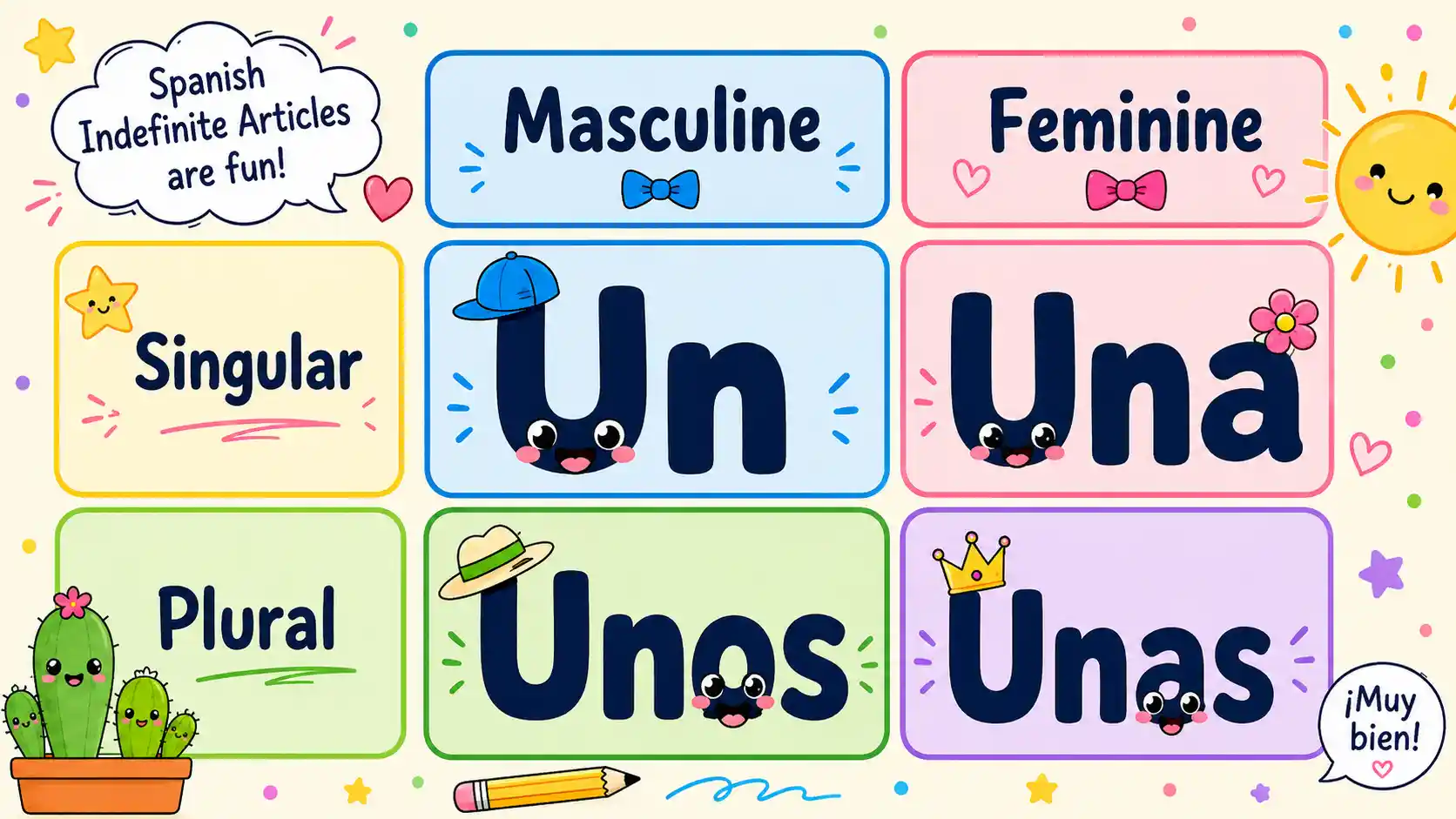
Indefinite articles introduce a non-specific person, place, thing or idea. In Spanish, they also show whether the noun is masculine or feminine, singular or plural.
1. Un: masculine singular
Use un with masculine singular nouns.
un libro · un coche · un problema
2. Una: feminine singular
Use una with feminine singular nouns.
una casa · una mesa · una ciudad
3. Unos: masculine plural
Use unos with masculine plural nouns. It often means “some” or “a few”.
unos libros · unos coches · unos problemas
4. Unas: feminine plural
Use unas with feminine plural nouns. It often means “some” or “a few”.
unas casas · unas mesas · unas ciudades
5. Articles agree with the noun
The article must match the noun’s gender and number, even when the ending is unexpected.
un problema is masculine, although it ends in -a.
6. Spanish often omits indefinite articles
Spanish does not always use un or una where English uses “a” or “an”, especially with professions after ser.
Soy profesor.
I am a teacher.
Common mistakes with Spanish indefinite articles
- Using una with masculine exceptions: say un problema, not una problema.
- Forgetting plural forms: say unos libros and unas casas.
- Overusing un/una with professions: say Soy estudiante, not usually Soy un estudiante in neutral identification.
- Translating “some” mechanically: sometimes Spanish uses unos/unas, but sometimes no article is needed.
- Ignoring adjective agreement: articles, nouns and adjectives must work together: unas casas blancas.
When Spanish uses indefinite articles
One non-specific item
Necesito un libro.
I need a book.
One feminine item
Busco una casa.
I am looking for a house.
Some / a few
Tengo unas preguntas.
I have some questions.
Approximate quantity
Hay unos veinte estudiantes.
There are about twenty students.
Exercises: Spanish indefinite articles
Try the tasks first. The answers are hidden so you can check yourself after practicing.
Exercise 1: Choose un, una, unos or unas
Complete each noun phrase with the correct indefinite article.
- ___ libro
- ___ casa
- ___ problemas
- ___ ciudades
- ___ canción
Show answer key
- un libro
- una casa
- unos problemas
- unas ciudades
- una canción
Exercise 2: Make the phrase plural
Change the indefinite article and noun from singular to plural.
- un coche
- una mesa
- un problema
- una ciudad
Show answer key
- unos coches
- unas mesas
- unos problemas
- unas ciudades
Exercise 3: Correct the article mistake
Rewrite each phrase with the correct indefinite article.
- una problema
- un ciudad
- unos casas
- unas libros
Show answer key
- un problema
- una ciudad
- unas casas
- unos libros
Exercise 4: Build full noun phrases
Add the correct indefinite article and adjective ending.
- book / new → ___ libro ___
- house / white → ___ casa ___
- cities / big → ___ ciudades ___
- problems / important → ___ problemas ___
Show answer key
- un libro nuevo
- una casa blanca
- unas ciudades grandes
- unos problemas importantes
Related Spanish grammar
Want personal guidance?
If Spanish articles, gender and plural agreement feel confusing, individual guidance can help you build correct noun phrases from the beginning.
FAQ: Spanish indefinite articles
What are the indefinite articles in Spanish?
The Spanish indefinite articles are un, una, unos and unas.
What is the difference between un and una?
Un is used with masculine singular nouns, while una is used with feminine singular nouns.
What do unos and unas mean?
Unos and unas often mean “some”, “a few” or an approximate number, depending on context.
Why is it un problema and not una problema?
Problema is a masculine noun despite ending in -a, so it uses un.
Do you always use un or una for English “a” or “an”?
No. Spanish often omits the indefinite article in some contexts, especially with professions after ser, as in Soy profesor.

MundoDele – Spanish learning for education, work and intercultural understanding
MundoDele connects online Spanish courses, DELE preparation, Business Spanish and cultural context into a personal Spanish learning platform.
Travel and culture content help you understand Spanish not as abstract grammar, but as language used in real situations, conversations and written communication.