
Modal Conjunctions in Spanish
Learn how Spanish modal conjunctions express manner, way, comparison and apparent reality. This guide explains como, según, conforme, tal como, de la manera que, de modo que and como si, including the difference between indicative and subjunctive.
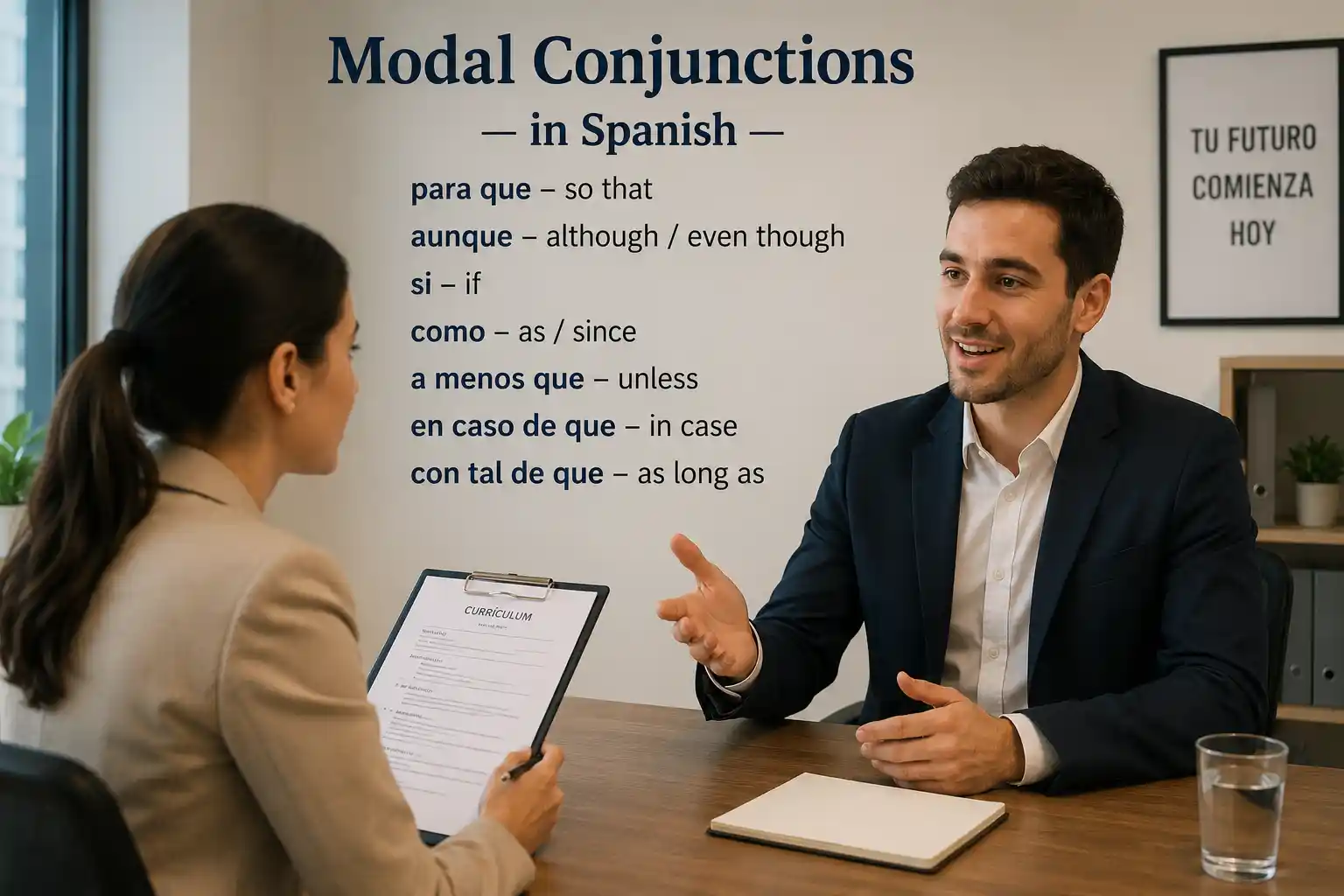
Why modal conjunctions matter
Modal conjunctions help you explain how something is done, how something appears, or according to which rule, instruction or model something happens. They are common in instructions, comparisons, descriptions, formal writing and everyday speech: hazlo como quieras, según dice el profesor, tal como esperábamos, como si nada hubiera pasado.
How to use this page
Use this page after learning basic conjunctions and verb moods. First learn the meaning of each modal conjunction. Then focus on the verb form: factual manner usually takes the indicative, while hypothetical or not-yet-defined manner often takes the subjunctive.
Real manner
Use the indicative when the manner is factual or known.
Lo hice como me dijiste.
I did it as you told me.
Unknown or flexible manner
Use the subjunctive when the way is open, desired or not defined.
Hazlo como quieras.
Do it however you want.
Imagined comparison
Como si normally introduces an unreal comparison with the imperfect or pluperfect subjunctive.
Habla como si fuera experto.
He speaks as if he were an expert.
Main modal conjunctions in Spanish
Modal conjunctions describe manner, method, model or apparent similarity. They often answer the question: how?
| Spanish conjunction | English meaning | Example | Use |
|---|---|---|---|
| como | as / like / how | Hazlo como quieras. | Way, manner or method. |
| según | according to / as | Según dice Ana, la clase empieza a las ocho. | According to someone or something. |
| conforme | as / in accordance with | Actúa conforme indican las reglas. | In accordance with a rule, model or instruction. |
| tal como | just as / exactly as | Lo hice tal como me explicaste. | Exact correspondence with a model or instruction. |
| de la manera que | in the way that | Explícalo de la manera que prefieras. | Manner, often with flexible or chosen method. |
| de modo que | in such a way that / so that | Organízalo de modo que todos lo entiendan. | Manner or result, depending on context. |
| como si | as if | Habla como si supiera todo. | Imagined or unreal comparison. |
Como: as, like, how
Como is the most common modal conjunction. It can introduce a real manner, an instruction, a comparison or an open way of doing something.
| Spanish | English meaning | Verb mood | Reason |
|---|---|---|---|
| Lo hice como me dijiste. | I did it as you told me. | Indicative | The instruction was real and known. |
| Hazlo como quieras. | Do it however you want. | Subjunctive | The manner is open or not defined. |
| Explícalo como puedas. | Explain it as best as you can. | Subjunctive | The exact manner is flexible. |
| Lo preparé como aparece en la receta. | I prepared it as it appears in the recipe. | Indicative | The model is factual or visible. |
Según and conforme: according to / in accordance with
Según introduces a source, rule, instruction or perspective. Conforme is more formal and means “as” or “in accordance with”.
| Conjunction | Spanish example | English meaning | Use |
|---|---|---|---|
| según | Según dice el profesor, el examen es fácil. | According to the teacher, the exam is easy. | Source or reported statement. |
| según | Hazlo según indican las instrucciones. | Do it as the instructions indicate. | Manner according to instructions. |
| conforme | Actúa conforme exige la ley. | Act in accordance with what the law requires. | Formal rule or standard. |
| conforme | Procedemos conforme establece el acuerdo. | We proceed as the agreement establishes. | Formal or administrative language. |
Tal como: just as / exactly as
Tal como emphasizes exact similarity or correspondence. It often means “just as” or “exactly as”.
| Spanish example | English meaning | Use |
|---|---|---|
| Lo hice tal como me explicaste. | I did it exactly as you explained it to me. | Exact instruction or model. |
| La situación cambió tal como esperábamos. | The situation changed just as we expected. | Expectation and real outcome. |
| Es tal como lo imaginaba. | It is just as I imagined it. | Exact comparison. |
| Funciona tal como indica el manual. | It works exactly as the manual says. | Technical or instructional description. |
Como si: as if
Como si introduces an imagined, unreal or hypothetical comparison. It is normally followed by the imperfect subjunctive or the pluperfect subjunctive.
| Spanish example | English meaning | Verb form | Meaning |
|---|---|---|---|
| Habla como si fuera experto. | He speaks as if he were an expert. | Imperfect subjunctive | Unreal or doubtful present comparison. |
| Me mira como si no me conociera. | He/she looks at me as if he/she did not know me. | Imperfect subjunctive | Unreal or imagined situation. |
| Actúan como si nada hubiera pasado. | They act as if nothing had happened. | Pluperfect subjunctive | Unreal comparison about the past. |
| Lo dijo como si ya lo hubiera decidido. | He/she said it as if he/she had already decided it. | Pluperfect subjunctive | Imagined earlier completed action. |
Indicative or subjunctive with modal conjunctions
The indicative normally presents the manner as real, known or factual. The subjunctive presents the manner as open, desired, hypothetical, unknown or unreal.
| Meaning | Indicative | Subjunctive | Difference |
|---|---|---|---|
| As / how | Lo hice como me dijiste. | Hazlo como quieras. | Known instruction vs open manner. |
| According to | Según dice Ana, es fácil. | Según lo vea el profesor, puede cambiar. | Reported statement vs uncertain perspective. |
| In the way that | Lo expliqué de la manera que aprendí. | Explícalo de la manera que prefieras. | Known method vs chosen method. |
| As if | Not normally used for unreal como si clauses. | Habla como si supiera todo. | Imagined or unreal comparison. |
Manner phrases: de la manera que, de modo que, de forma que
Spanish often uses longer modal expressions to describe the way something should be done. Some of these expressions can also express result or purpose, depending on context.
| Expression | Spanish example | English meaning | Note |
|---|---|---|---|
| de la manera que | Hazlo de la manera que prefieras. | Do it in the way you prefer. | Flexible or chosen manner. |
| de la forma que | Explícalo de la forma que sea más clara. | Explain it in the way that is clearest. | Manner with evaluation. |
| de modo que | Organízalo de modo que todos lo entiendan. | Organize it in such a way that everyone understands it. | Manner + intended result. |
| de manera que | Escríbelo de manera que sea fácil de leer. | Write it in such a way that it is easy to read. | Manner or purpose-like result. |
Modal meaning vs result meaning
Some expressions can be modal or consecutive. In modal use, they describe the way something is done. In consecutive use, they describe the result.
| Expression | Modal meaning | Result meaning |
|---|---|---|
| de modo que | Organízalo de modo que sea claro. Organize it in such a way that it is clear. |
Llegó tarde, de modo que perdió el tren. He arrived late, so he missed the train. |
| de manera que | Habla de manera que todos te entiendan. Speak in a way that everyone understands you. |
No estudió, de manera que suspendió. He did not study, so he failed. |
| de forma que | Escríbelo de forma que sea natural. Write it in a way that sounds natural. |
Se cerró la puerta, de forma que no pudimos entrar. The door closed, so we could not enter. |
Word order with modal conjunctions
Modal clauses usually follow the main clause, because they explain how the action is done. They can also appear at the beginning when the manner or source is emphasized.
| Order | Spanish example | English meaning |
|---|---|---|
| Main clause first | Lo hice como me dijiste. | I did it as you told me. |
| Modal clause first | Como me dijiste, lo hice. | As you told me, I did it. |
| Source first | Según dice Ana, la reunión empieza a las diez. | According to Ana, the meeting starts at ten. |
| Comparison after main clause | Actúa como si no pasara nada. | He/she acts as if nothing were happening. |
Practice exercises: modal conjunctions
Try to answer before opening the solutions. These exercises focus on meaning, conjunction choice and indicative vs subjunctive.
Exercise 1: choose the conjunction
- Hazlo ___ quieras. = however you want
- ___ dice Ana, la clase empieza a las ocho. = according to Ana
- Lo hice ___ me explicaste. = just as you explained
- Habla ___ fuera experto. = as if he were an expert
Show answers
1. como
2. Según
3. tal como
4. como si
Exercise 2: indicative or subjunctive?
- Lo hice como me ___. decir, past fact
- Hazlo como ___. querer, open manner
- Habla como si ___ todo. saber, unreal comparison
- Funciona tal como ___ el manual. indicar, factual source
Show answers
1. dijiste
2. quieras
3. supiera
4. indica
Exercise 3: translate into English
- Hazlo de la manera que prefieras.
- Actúa conforme establecen las reglas.
- Me mira como si no me conociera.
- Lo preparé según indica la receta.
Show answers
1. Do it in the way you prefer.
2. Act in accordance with the rules.
3. He/she looks at me as if he/she did not know me.
4. I prepared it according to the recipe.
Typical mistakes with Spanish modal conjunctions
- Using the indicative after open como clauses: say hazlo como quieras, not hazlo como quieres when the manner is open.
- Using the indicative after unreal como si: say como si fuera, como si tuviera, como si supiera.
- Confusing como with cómo: como is a conjunction; cómo is an interrogative or exclamatory word.
- Overusing según for all “as” meanings: según often means “according to”; simple manner often uses como.
- Forgetting that de modo que can express result: context decides whether it means “in such a way that” or “so”.
- Translating English mechanically: “as if” usually requires Spanish como si plus subjunctive, not a simple indicative form.
Related grammar topics
Spanish Conjunctions
Learn how conjunctions connect clauses, reasons, conditions, time and manner.
Temporal Conjunctions
Study cuando, mientras, antes de que and hasta que.
Spanish Tenses
Review the tense system behind indicative and subjunctive choices.
Imperfect
Useful for como si fuera, como si tuviera and other unreal comparisons.
Pluperfect
Useful for como si hubiera pasado and completed unreal comparisons.
Spanish Verbs
Review verb forms needed for modal clauses and sentence building.
Where to go next
After modal conjunctions, continue with the full conjunctions overview and temporal conjunctions. This helps you compare manner clauses with time clauses and other subordinate structures.
Want personal guidance?
If modal conjunctions feel confusing, individual guidance can help you practise como, según, conforme, tal como, como si, indicative vs subjunctive and real sentence patterns.
FAQ: modal conjunctions in Spanish
What are modal conjunctions in Spanish?
Modal conjunctions are words or phrases that express the way or manner in which something happens. Examples include como, según, conforme, tal como and como si.
What does como mean as a modal conjunction?
Como can mean “as”, “like” or “how”. It describes the way something is done, as in lo hice como me dijiste.
Do modal conjunctions need the subjunctive?
They can need the subjunctive when the manner is open, hypothetical, unknown or unreal. For example: hazlo como quieras and habla como si fuera experto.
Why does como si take the subjunctive?
Como si usually introduces an unreal or imagined comparison. That is why Spanish normally uses forms such as fuera, tuviera, supiera or hubiera hecho.
What is the difference between como and cómo?
Como without accent is normally a conjunction or comparison word. Cómo with accent is used in questions or exclamations, such as ¿Cómo estás?.
What does según mean in Spanish?
Según often means “according to” or “as”. It introduces a source, rule, instruction or perspective, as in según dice Ana.

MundoDele – Spanish learning for education, work and intercultural understanding
MundoDele connects online Spanish courses, DELE preparation, Business Spanish and cultural context into a personal Spanish learning platform.
Grammar pages are designed to explain Spanish clearly, with practical examples, real sentence logic and connected learning paths.