
Causal Conjunctions in Spanish
Learn how Spanish causal conjunctions express reasons, explanations and causes. This guide explains porque, ya que, puesto que, dado que, como, pues, debido a que, a causa de que and gracias a que, with clear examples and common mistakes.
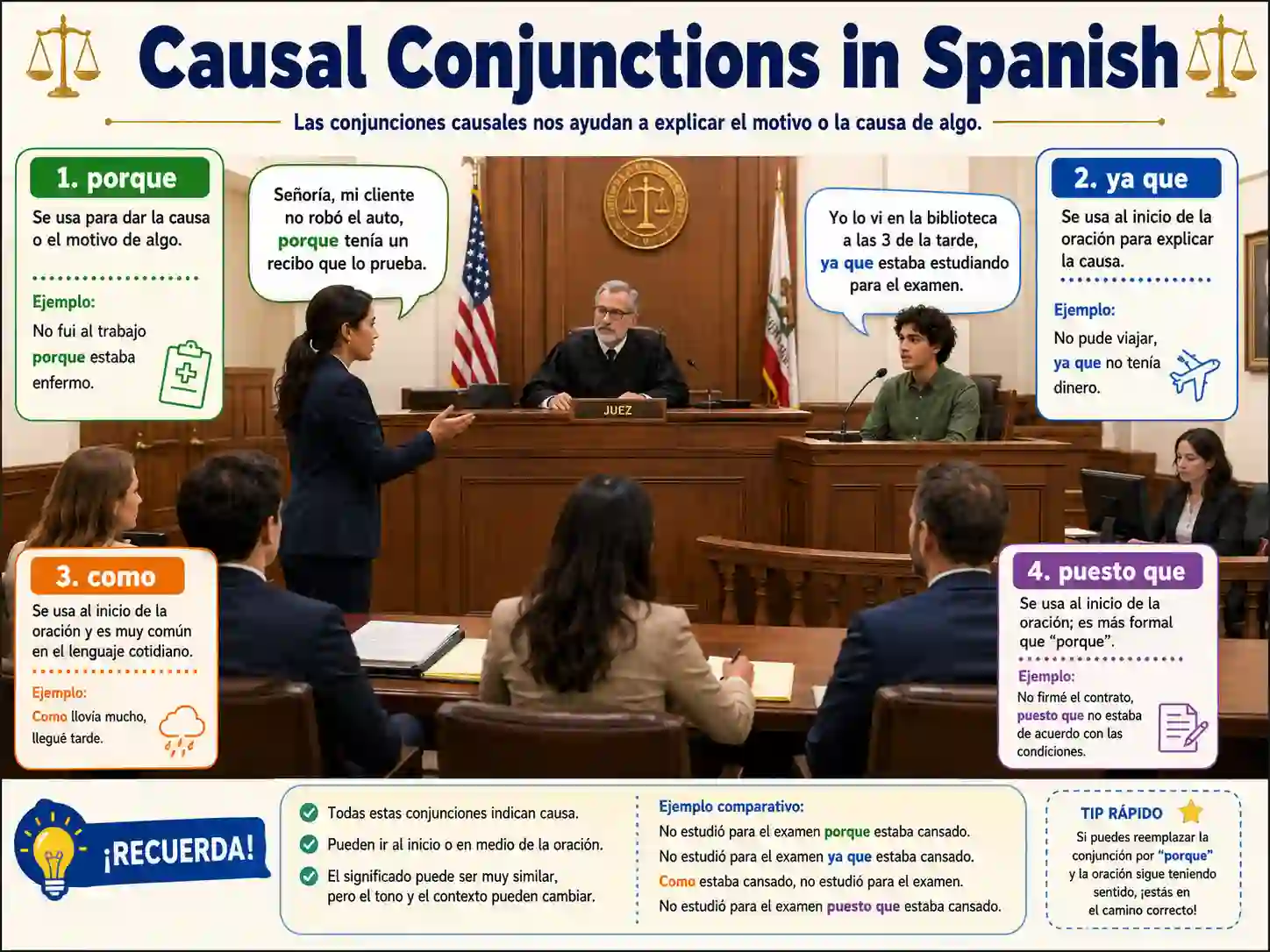
Why learn causal conjunctions with MundoDele?
Spanish causal conjunctions are easier to understand when they are taught as sentence logic, not as isolated word lists. MundoDele explains connectors such as porque, ya que, puesto que and dado que through clear examples, direct comparisons and practical grammar paths.
The key idea is simple: causal conjunctions explain the reason behind an action. This also helps learners separate cause from result: porque gives the reason, while por eso, así que and por lo tanto introduce the consequence.
How to use this page
Use this page after learning basic conjunctions and before comparing cause and result clauses. The central question is: does the clause explain why something happened? If yes, you need a causal conjunction such as porque, ya que or dado que.
Reason after the result
Porque usually introduces the reason after the main clause.
No fui porque estaba enfermo.
I did not go because I was sick.
Reason before the result
Como often introduces the reason at the beginning of the sentence.
Como estaba enfermo, no fui.
Since I was sick, I did not go.
Formal explanation
Ya que, puesto que and dado que are useful in explanations and formal writing.
Dado que no hay datos, no podemos decidir.
Given that there is no data, we cannot decide.
Main causal conjunctions in Spanish
Causal conjunctions introduce a reason, explanation or cause. Some are neutral and conversational; others are more formal or analytical.
| Spanish conjunction | English meaning | Example | Style / use |
|---|---|---|---|
| porque | because | No fui porque estaba cansado. | Most common causal conjunction. |
| ya que | since / as | Ya que tienes tiempo, ayúdame. | Reason assumed or known. |
| puesto que | since / given that | Puesto que no hay acuerdo, seguimos mañana. | Formal or written explanation. |
| dado que | given that | Dado que es urgente, empezamos hoy. | Formal, analytical, report-like. |
| como | since / as | Como llovía, nos quedamos en casa. | Reason placed at the beginning. |
| pues | since / because | No salimos, pues era tarde. | Explanatory; more written or regional in this use. |
| debido a que | due to the fact that | Se canceló debido a que llovía. | Formal cause. |
| a causa de que | because of the fact that | No pudimos salir a causa de que la calle estaba cortada. | Cause, often negative or problem-related. |
| gracias a que | thanks to the fact that | Llegamos a tiempo gracias a que salimos temprano. | Positive cause or helpful factor. |
Porque: because
Porque is the most common causal conjunction in Spanish. It introduces the reason for the main statement.
| Spanish example | English meaning | Reason introduced by porque |
|---|---|---|
| No fui porque estaba enfermo. | I did not go because I was sick. | estaba enfermo |
| Estudio español porque quiero viajar. | I study Spanish because I want to travel. | quiero viajar |
| Compramos agua porque hacía calor. | We bought water because it was hot. | hacía calor |
| No entendí porque hablaba muy rápido. | I did not understand because he/she was speaking very fast. | hablaba muy rápido |
Por qué, porque, porqué and por que
These forms look similar, but they have different functions. For causal conjunctions, the most important form is porque without accent and written as one word.
| Form | Function | Spanish example | English meaning |
|---|---|---|---|
| por qué | Question: why? | ¿Por qué estudias español? | Why do you study Spanish? |
| porque | Answer: because | Estudio español porque me gusta. | I study Spanish because I like it. |
| porqué | Noun: the reason | No entiendo el porqué. | I do not understand the reason. |
| por que | Less common sequence: for which / that | Esta es la razón por que luchamos. | This is the reason for which we fight. |
Ya que, puesto que and dado que
Ya que, puesto que and dado que often introduce a reason that is known, assumed or used as the basis for a conclusion. They are especially useful in explanations and formal writing.
| Conjunction | Spanish example | English meaning | Style / nuance |
|---|---|---|---|
| ya que | Ya que estás aquí, podemos empezar. | Since you are here, we can start. | Known or visible reason. |
| ya que | No salimos, ya que hacía frío. | We did not go out, since it was cold. | Neutral explanation. |
| puesto que | Puesto que no hay respuesta, enviamos otro mensaje. | Since there is no answer, we send another message. | More formal than porque. |
| dado que | Dado que el problema es urgente, actuamos hoy. | Given that the problem is urgent, we act today. | Formal, analytical or report-like. |
Como: since / as
Como can be a causal conjunction when it means “since” or “as”. In this use, it usually comes at the beginning of the sentence.
| Spanish example | English meaning | Position | Meaning |
|---|---|---|---|
| Como estaba lloviendo, nos quedamos en casa. | Since it was raining, we stayed at home. | Beginning | Cause before result. |
| Como no tenía dinero, no compré nada. | Since I did not have money, I did not buy anything. | Beginning | Reason explains the result. |
| Como era tarde, tomamos un taxi. | As it was late, we took a taxi. | Beginning | Contextual reason. |
Be careful: como can also mean “as”, “like” or “how” in other contexts. For manner use, see Modal Conjunctions in Spanish.
Debido a que, a causa de que and gracias a que
These expressions introduce causes with a stronger explanatory tone. Debido a que is formal and neutral, a causa de que often points to a problem or negative cause, and gracias a que highlights a positive cause.
| Expression | Spanish example | English meaning | Nuance |
|---|---|---|---|
| debido a que | El vuelo se retrasó debido a que había niebla. | The flight was delayed due to the fact that there was fog. | Formal cause. |
| a causa de que | No pudimos entrar a causa de que la puerta estaba cerrada. | We could not enter because the door was closed. | Cause of a problem. |
| gracias a que | Llegamos a tiempo gracias a que salimos temprano. | We arrived on time thanks to the fact that we left early. | Positive helpful cause. |
| debido a + noun | El partido se canceló debido a la lluvia. | The match was cancelled due to the rain. | Use with noun, not full clause. |
Cause vs result: porque vs por eso
Causal conjunctions and consecutive connectors are closely related, but they do opposite jobs. Porque introduces the cause. Por eso, así que and por lo tanto introduce the result.
| Function | Spanish example | English meaning | Connector logic |
|---|---|---|---|
| Cause | No fui porque estaba enfermo. | I did not go because I was sick. | Porque introduces the reason. |
| Result | Estaba enfermo, por eso no fui. | I was sick; that is why I did not go. | Por eso introduces the consequence. |
| Cause | Compré agua porque hacía calor. | I bought water because it was hot. | Reason after the action. |
| Result | Hacía calor, así que compré agua. | It was hot, so I bought water. | Consequence after the situation. |
Related page: Consecutive Conjunctions in Spanish.
Word order and commas
Causal clauses can come before or after the main clause. Porque often follows the main clause, while como, ya que, puesto que and dado que often work well at the beginning.
| Order | Spanish example | English meaning | Note |
|---|---|---|---|
| Main clause first | No salimos porque llovía. | We did not go out because it was raining. | Very common with porque. |
| Cause first | Como llovía, no salimos. | Since it was raining, we did not go out. | Common with causal como. |
| Formal cause first | Dado que no hay datos, no podemos decidir. | Given that there is no data, we cannot decide. | Common in formal explanation. |
| Cause after main clause | No podemos decidir, ya que faltan datos. | We cannot decide, since data is missing. | Neutral explanatory style. |
Everyday, neutral and formal causal connectors
The connector you choose changes the tone. Porque is the safest everyday form, while dado que and puesto que sound more formal.
| Connector | Register | Best use | Example |
|---|---|---|---|
| porque | Everyday / neutral | General explanations | No fui porque estaba cansado. |
| ya que | Neutral / slightly formal | Known or contextual reasons | Ya que estás aquí, empezamos. |
| puesto que | Formal | Written explanations and arguments | Puesto que no hay acuerdo, seguimos mañana. |
| dado que | Formal / analytical | Reports, essays and structured reasoning | Dado que es urgente, actuamos hoy. |
| debido a que | Formal | Administrative, technical or explanatory contexts | Se canceló debido a que llovía. |
Practice exercises: causal conjunctions
Try to answer before opening the solutions. These exercises focus on reason connectors, porque vs por eso and causal word order.
Exercise 1: choose the connector
- No fui ___ estaba enfermo. = because
- ___ llovía, nos quedamos en casa. = since / as
- ___ no hay datos, no podemos decidir. = given that
- Llegamos a tiempo ___ salimos temprano. = thanks to the fact that
Show answers
1. porque
2. Como
3. Dado que
4. gracias a que
Exercise 2: porque or por eso?
- No salí ___ estaba cansado.
- Estaba cansado, ___ no salí.
- Compré agua ___ hacía calor.
- Hacía calor, ___ compré agua.
Show answers
1. porque
2. por eso
3. porque
4. por eso / así que
Exercise 3: translate into English
- No entendí porque hablaba muy rápido.
- Como era tarde, tomamos un taxi.
- Dado que el tema es importante, lo revisamos otra vez.
- El vuelo se canceló debido a que había niebla.
Show answers
1. I did not understand because he/she was speaking very fast.
2. Since it was late, we took a taxi.
3. Given that the topic is important, we review it again.
4. The flight was cancelled because / due to the fact that there was fog.
Typical mistakes with Spanish causal conjunctions
- Confusing porque and por qué: porque means “because”; por qué means “why?”.
- Confusing cause and result: porque gives the reason; por eso gives the result.
- Using como in the wrong position: causal como usually appears at the beginning: Como llovía, no salimos.
- Using formal connectors in casual speech too often: dado que and puesto que are useful, but porque is more natural in everyday speech.
- Confusing debido a and debido a que: use debido a with a noun and debido a que with a clause.
- Forgetting that gracias a que is positive: use it when the cause is helpful or favourable.
Related grammar topics
Spanish Conjunctions
Learn how conjunctions connect causes, results, conditions, contrast, time and manner.
Consecutive Conjunctions
Compare cause with result: porque vs por eso.
Conditional Conjunctions
Study si, con tal de que, a condición de que and a menos que.
Concessive Conjunctions
Study aunque, a pesar de que, pese a que and si bien.
Modal Conjunctions
Compare causal como with modal como.
Spanish Tenses
Review present, past and future forms used in explanations.
Where to go next
After causal conjunctions, continue with consecutive conjunctions. This helps you understand the full cause-result relationship in Spanish: porque gives the reason, while por eso gives the consequence.
Learn Spanish grammar with MundoDele
If causal conjunctions feel confusing, this lesson can help you practise porque, ya que, puesto que, dado que, como, debido a que, cause-result logic and real explanation sentences in a clear and structured way.
FAQ: causal conjunctions in Spanish
What are causal conjunctions in Spanish?
Causal conjunctions introduce a reason or cause. Examples include porque, ya que, puesto que, dado que, como, pues and debido a que.
What does porque mean in Spanish?
Porque means “because”. It introduces the reason for an action or statement: No fui porque estaba enfermo.
What is the difference between porque and por qué?
Porque means “because”. Por qué means “why?” and is used in questions.
What is the difference between porque and por eso?
Porque introduces the cause or reason. Por eso introduces the result or consequence.
What does dado que mean?
Dado que means “given that”. It is often used in formal or analytical explanations.
When does como mean since in Spanish?
Como can mean “since” or “as” when it introduces a reason, especially at the beginning of a sentence: Como llovía, no salimos.

About MundoDele
MundoDele connects online Spanish courses, DELE preparation, Business Spanish and cultural context into a personal Spanish learning platform.
Grammar pages are designed to explain Spanish clearly, with practical examples, real sentence logic and connected learning paths.