
Spanish Future Tense: Will in Spanish
Learn how the Spanish future tense is formed and used. This guide explains regular future endings, irregular future stems, ir a + infinitive, future probability, time markers, future vs future perfect and common examples such as hablaré, comerás, viviremos, tendré, hará and dirán.
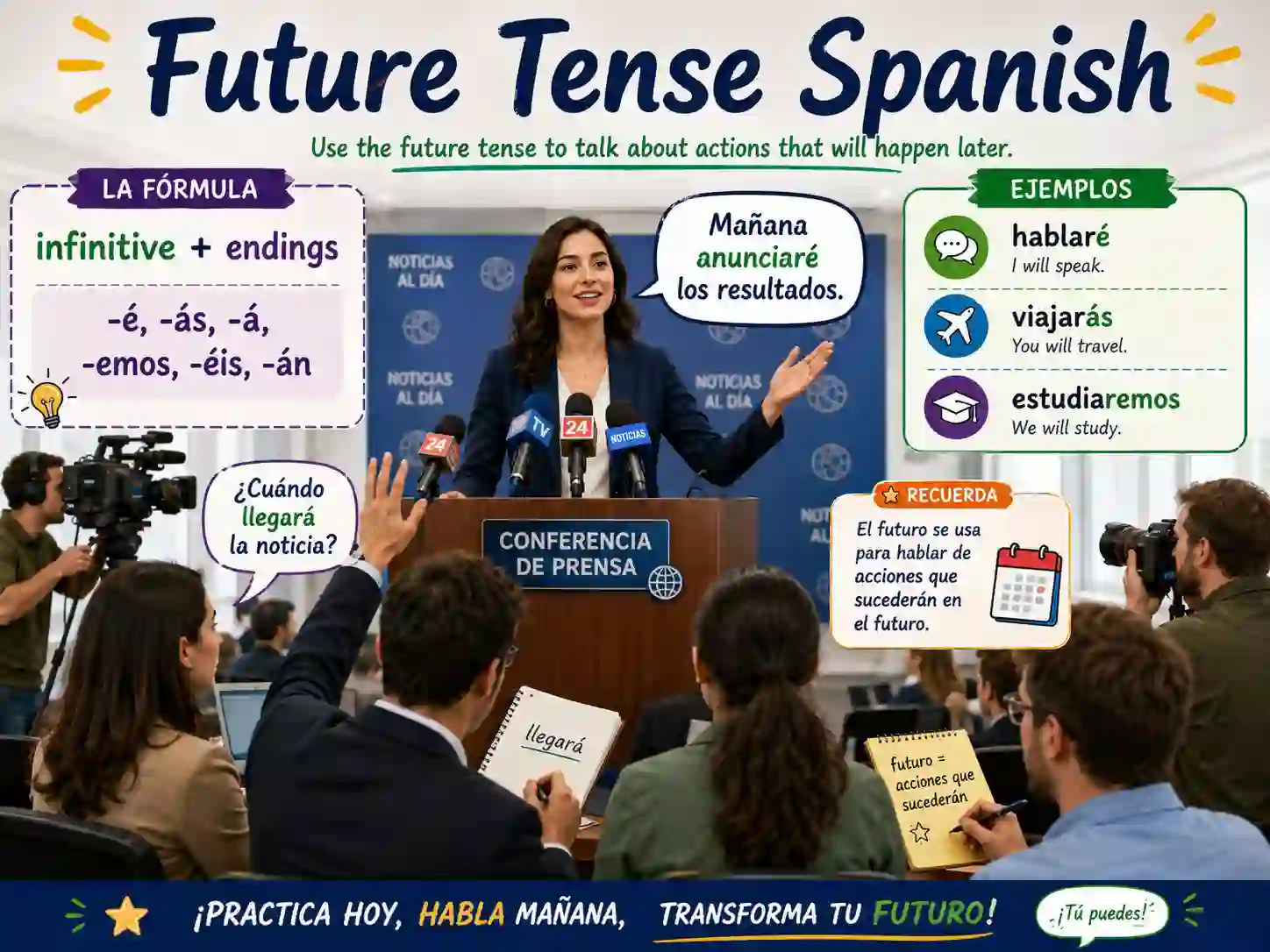
Why the Spanish future tense matters
The future tense is essential for plans, predictions, promises, expectations and assumptions. It lets you say viajaré “I will travel”, terminaremos “we will finish”, lo haré “I will do it” and ¿Dónde estará? “Where could he/she be?”. It also connects directly with the future perfect and the conditional, which use related forms and stems.
How to use this page
Use this page after learning present tense and regular verb endings. The future tense is structurally simple because most verbs keep the infinitive and take the same endings.
Use the full verb form: hablar, comer, vivir.
Add -é, -ás, -á, -emos, -éis, -án.
Common verbs use special stems: tendré, podré, haré, diré, vendré.
The core idea: will + verb
Future action
The future tense often says what will happen later.
Mañana estudiaré español.
Tomorrow I will study Spanish.
Prediction or promise
Use the future for predictions, promises and planned results.
Todo saldrá bien.
Everything will turn out well.
Probability or conjecture
Spanish can use the future to guess about the present.
¿Dónde estará?
Where could he/she be?
Spanish future tense endings
| Subject | Ending | Hablar | Comer | Vivir |
|---|---|---|---|---|
| yo | -é | hablaré | comeré | viviré |
| tú | -ás | hablarás | comerás | vivirás |
| él / ella / usted | -á | hablará | comerá | vivirá |
| nosotros / nosotras | -emos | hablaremos | comeremos | viviremos |
| vosotros / vosotras | -éis | hablaréis | comeréis | viviréis |
| ellos / ellas / ustedes | -án | hablarán | comerán | vivirán |
Regular future tense forms
Regular future forms are built from the infinitive. The same endings are used for -ar, -er and -ir verbs.
| Infinitive | Future form | Example sentence | English meaning |
|---|---|---|---|
| hablar | hablaré | Hablaré con ella mañana. | I will speak with her tomorrow. |
| comer | comerás | Comerás mejor después. | You will eat better later. |
| vivir | viviremos | Viviremos cerca del mar. | We will live near the sea. |
| estudiar | estudiarán | Ellos estudiarán más. | They will study more. |
Irregular future stems
Many common verbs use irregular stems in the future tense. The endings are still regular, but the stem changes.
| Infinitive | Irregular stem | Future example | English meaning |
|---|---|---|---|
| tener | tendr- | tendré | I will have. |
| venir | vendr- | vendrás | You will come. |
| salir | saldr- | saldrá | He/she will leave. |
| poner | pondr- | pondremos | We will put. |
| poder | podr- | podré | I will be able to. |
| saber | sabr- | sabrán | They will know. |
| querer | querr- | querré | I will want. |
| hacer | har- | haremos | We will do / make. |
| decir | dir- | diré | I will say. |
| haber | habr- | habrá | There will be / will have. |
These irregular stems also appear in the conditional: tendré / tendría, haré / haría, diré / diría.
Main uses of the Spanish future tense
The future tense can express future action, prediction, promise, formal planning and probability.
| Use | Spanish example | English meaning | Grammar logic |
|---|---|---|---|
| Future action | Mañana estudiaré. | Tomorrow I will study. | Action placed after the present moment. |
| Prediction | Todo saldrá bien. | Everything will turn out well. | Speaker predicts a future result. |
| Promise | Te llamaré esta noche. | I will call you tonight. | Speaker commits to a future action. |
| Formal plan | La reunión empezará a las nueve. | The meeting will start at nine. | Scheduled or formal future event. |
| Probability in the present | Estará en casa. | He/she is probably at home. | Conjecture about the present. |
| Question of conjecture | ¿Qué será eso? | What could that be? | The speaker wonders about something now. |
Future tense vs ir a + infinitive
Spanish often uses ir a + infinitive for near future, intention or planned action. The simple future is common for predictions, formal statements, promises and more distant or abstract future meanings.
| Form | Structure | Example | English meaning | Typical use |
|---|---|---|---|---|
| Simple future | infinitive + future ending | Estudiaré mañana. | I will study tomorrow. | Prediction, promise, formal future. |
| Ir a + infinitive | voy a + infinitive | Voy a estudiar mañana. | I am going to study tomorrow. | Plan, intention, near future. |
| Simple future | future ending | La conferencia empezará a las diez. | The conference will start at ten. | Formal scheduled statement. |
| Ir a + infinitive | vamos a + infinitive | Vamos a comer ahora. | We are going to eat now. | Immediate or planned action. |
Common future time markers
Future forms often appear with time expressions that point beyond the present.
| Time marker | Spanish example | English meaning |
|---|---|---|
| mañana | Mañana trabajaré. | Tomorrow I will work. |
| la próxima semana | La próxima semana viajaremos. | Next week we will travel. |
| el año que viene | El año que viene aprenderé más. | Next year I will learn more. |
| más tarde | Te llamaré más tarde. | I will call you later. |
| en el futuro | En el futuro habrá más opciones. | In the future there will be more options. |
Future tense vs future perfect
The simple future says what will happen. The future perfect says what will have happened before another future moment.
| Form | Structure | Example | English meaning |
|---|---|---|---|
| Future tense | future ending on main verb | Terminaré mañana. | I will finish tomorrow. |
| Future perfect | habré + past participle | Para mañana habré terminado. | By tomorrow I will have finished. |
| Future tense | future action | Llegaremos a las ocho. | We will arrive at eight. |
| Future perfect | completed before a future point | A las ocho ya habremos llegado. | By eight we will already have arrived. |
Detail page: Spanish Future Perfect.
Future tense vs conditional
The future and conditional are related because they often use the same irregular stems. The difference is meaning: the future says what will happen; the conditional says what would happen.
| Verb | Future | Conditional | Meaning contrast |
|---|---|---|---|
| hablar | hablaré | hablaría | I will speak / I would speak. |
| tener | tendré | tendría | I will have / I would have. |
| hacer | haré | haría | I will do / I would do. |
| decir | diré | diría | I will say / I would say. |
Detail page: Spanish Conditional.
Future tense for probability
Spanish can use the future tense to express probability, conjecture or uncertainty about the present. In English, this often sounds like “probably”, “must be” or “could be”.
| Spanish example | Literal future meaning | Probability meaning |
|---|---|---|
| Estará en casa. | He/she will be at home. | He/she is probably at home. |
| Serán las ocho. | It will be eight o’clock. | It is probably about eight o’clock. |
| ¿Dónde estará? | Where will he/she be? | Where could he/she be? |
| No sé; tendrá unos treinta años. | He/she will have about thirty years. | I do not know; he/she is probably about thirty. |
For probability about a completed past event, Spanish often uses the future perfect: Habrá salido — “He/she has probably left”.
Object pronouns with the future tense
With a conjugated future tense form, object pronouns usually go before the verb.
| Structure | Correct Spanish | Incorrect learner pattern | English meaning |
|---|---|---|---|
| Direct object pronoun | Lo compraré mañana. | Compraré lo mañana. | I will buy it tomorrow. |
| Indirect object pronoun | Le escribiré esta noche. | Escribiré le esta noche. | I will write to him/her tonight. |
| Double pronoun | Se lo diré después. | Diré se lo después. | I will tell it to him/her later. |
| Negation | No lo haré. | Lo no haré. | I will not do it. |
Related page: Spanish Pronoun Position.
Practice exercises: Spanish future tense
Try to answer before opening the solutions. These exercises focus on regular future forms, irregular stems and future meanings.
Exercise 1: form the regular future
- yo / hablar
- tú / comer
- ella / vivir
- nosotros / estudiar
Show answers
1. hablaré
2. comerás
3. vivirá
4. estudiaremos
Exercise 2: use irregular stems
- yo / tener
- tú / poder
- nosotros / hacer
- ellos / decir
Show answers
1. tendré
2. podrás
3. haremos
4. dirán
Exercise 3: choose the meaning
- Mañana trabajaré.
- ¿Dónde estará?
- Voy a estudiar esta noche.
- Para mañana habré terminado.
Show answers
1. Tomorrow I will work.
2. Where could he/she be?
3. I am going to study tonight.
4. By tomorrow I will have finished.
When to use the Spanish future tense
Use it for what will happen
Use the future tense for actions placed after the present moment.
Mañana hablaré con Ana.
Use it for commitments and expected results
The future can express promises, predictions and formal plans.
Te llamaré. · Todo saldrá bien.
Use it for probability about the present
Spanish often uses the future tense to guess about a current situation.
Estará ocupado.
Related grammar topics
Future Perfect
Learn habré hablado, habrás comido and habremos terminado.
Spanish Tenses
Place the future tense inside the full Spanish tense system.
Conditional
Compare hablaré “I will speak” with hablaría “I would speak”.
Irregular Verbs
Study irregular future stems such as tendr-, har-, dir- and podr-.
Regular Verbs
Review regular verb forms before adding future endings to infinitives.
Modal Verbs
Practise future forms such as podré, deberé, querré and tendré que.
Typical mistakes with the Spanish future tense
- Dropping the infinitive too early: regular verbs keep the infinitive: hablaré, comerás, viviremos.
- Forgetting accents: several endings need accents: -é, -ás, -á, -éis, -án.
- Using regular stems for common irregular verbs: say tendré, haré, diré, podré.
- Confusing future and future perfect: terminaré means “I will finish”; habré terminado means “I will have finished”.
- Using the future tense when ir a + infinitive is more natural: for near plans, voy a estudiar is often more conversational.
- Missing the probability meaning: Estará en casa can mean “He/she is probably at home”, not only “He/she will be at home”.
Where to go next
After the future tense, continue with the future perfect, conditional and irregular verbs. These pages explain the difference between hablaré, habré hablado and hablaría.
Want personal guidance?
If the Spanish future tense feels confusing, individual guidance can help you practise hablaré, comerás, viviremos, tendré, podré, haré, ir a + infinitive, future time markers and probability meanings.
FAQ: Spanish future tense
What is the Spanish future tense?
The Spanish future tense usually expresses what will happen. Examples include hablaré, comerás, viviremos and harán.
How do you form the future tense in Spanish?
For regular verbs, add -é, -ás, -á, -emos, -éis or -án to the infinitive.
What does hablaré mean?
Hablaré means “I will speak”. It is the first-person singular future form of hablar.
What are common irregular future forms?
Common irregular future forms include tendré, vendré, podré, sabré, haré, diré and habrá.
What is the difference between future tense and ir a + infinitive?
The future tense often expresses predictions, promises and formal future statements. Ir a + infinitive often expresses near future, intention or plans.
Can the Spanish future tense express probability?
Yes. The future tense can express probability or conjecture about the present. Estará en casa can mean “He/she is probably at home”.

MundoDele – Spanish learning for education, work and intercultural understanding
MundoDele connects online Spanish courses, DELE preparation, Business Spanish and cultural context into a personal Spanish learning platform.
Grammar pages are designed to explain Spanish clearly, with practical examples, real sentence logic and connected learning paths.