
Spanish Relative Determiners: Cuyo and Cuanto
Learn how Spanish relative determiners connect a noun with a relative clause — especially cuyo, cuya, cuyos, cuyas and formal cuanto, cuanta, cuantos, cuantas.
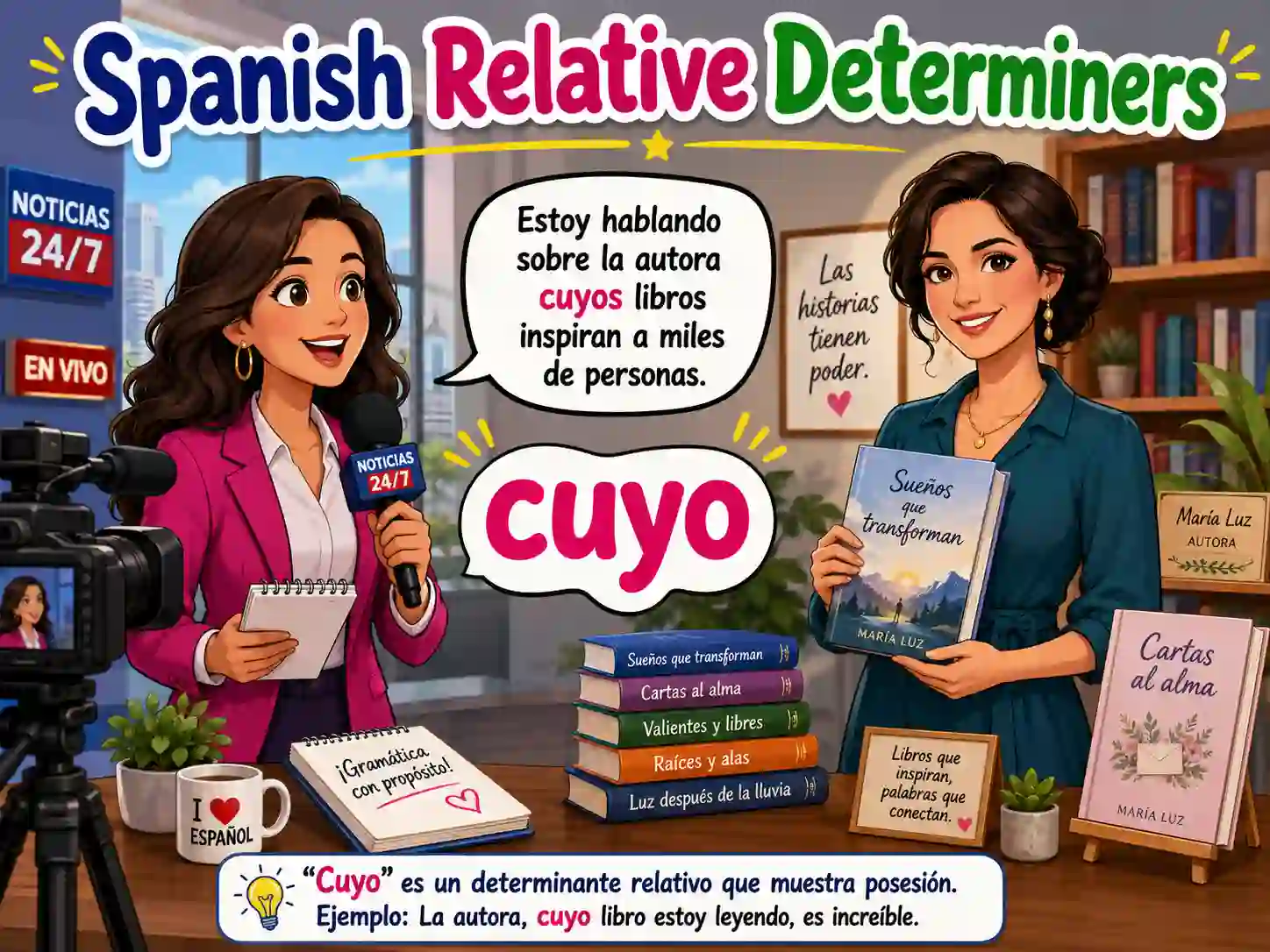
Why Spanish relative determiners matter
Relative determiners are more advanced than basic articles and quantifiers, but they are important for formal Spanish, written Spanish and precise sentence building. They help connect possession, relation and quantity across clauses. The central form is cuyo, which is often translated as “whose”, but it works differently from English because it agrees with the noun that follows it.
How to use this page
Use this page after learning articles, nouns, adjectives and relative pronouns. The main goal is to understand when a relative word behaves like a determiner before a noun.
In la autora cuyos libros son famosos, the noun after the determiner is libros.
Say cuyos libros because libros is masculine plural.
Cuyo comes before a noun. Relative pronouns such as que or el cual can stand without a following noun.
The core system: relative word + noun
Cuyo expresses relation or possession
Cuyo links a noun to a previous person, thing or idea.
el profesor cuya clase empieza tarde
Agreement follows the noun after it
Cuyo agrees with the following noun, not with the owner.
la autora cuyos libros son famosos
No article after cuyo
Spanish normally does not use el, la, los or las after cuyo.
cuyo hijo, not cuyo el hijo
Spanish relative determiners at a glance
Relative determiners are less common than articles or demonstratives, but they are useful in formal, academic and written Spanish.
| Relative determiner | Forms | Main meaning | Example | Grammar note |
|---|---|---|---|---|
| cuyo | cuyo, cuya, cuyos, cuyas | whose, of which | el escritor cuyos libros leo | Agrees with the noun after it. |
| cuanto | cuanto, cuanta, cuantos, cuantas | as much/many as; all that | lee cuantos libros puede | Formal or literary in many uses. |
| cuanto without accent | cuanto | relative quantity | gasta cuanto dinero tiene | No written accent in relative use. |
| cuánto with accent | cuánto, cuánta, cuántos, cuántas | how much, how many | ¿Cuántos libros tienes? | Interrogative or exclamative, not relative determiner use. |
Cuyo, cuya, cuyos, cuyas
Cuyo is the most important Spanish relative determiner. It connects two noun phrases and usually means “whose” or “of which”. It is common in formal writing, biographies, academic texts and precise descriptions.
| Form | Following noun | Example | English meaning |
|---|---|---|---|
| cuyo | masculine singular | el hombre cuyo hijo estudia español | the man whose son studies Spanish |
| cuya | feminine singular | la autora cuya novela ganó un premio | the author whose novel won a prize |
| cuyos | masculine plural | el profesor cuyos cursos son populares | the teacher whose courses are popular |
| cuyas | feminine plural | la empresa cuyas oficinas están en Madrid | the company whose offices are in Madrid |
Agreement with cuyo
The most important rule is that cuyo agrees with the noun that follows it. It does not agree with the person or thing that owns or is related to that noun.
la mujer cuyo hijo vive en Chile — cuyo agrees with hijo
la mujer cuya hija vive en Chile — cuya agrees with hija
la mujer cuyos hijos viven en Chile — cuyos agrees with hijos
la mujer cuyas hijas viven en Chile — cuyas agrees with hijas
In all four examples, the owner is the same: la mujer. The form changes only because the following noun changes.
No article after cuyo
In modern standard Spanish, cuyo is not followed by a definite article. It already works as a determiner before the noun.
| Correct | Incorrect | Reason |
|---|---|---|
| el autor cuyo libro leí | el autor cuyo el libro leí | Cuyo already determines libro. |
| la ciudad cuyas calles son antiguas | la ciudad cuyas las calles son antiguas | Do not add las after cuyas. |
| el profesor cuyos alumnos aprobaron | el profesor cuyos los alumnos aprobaron | Use cuyos alumnos, not cuyos los alumnos. |
Cuanto, cuanta, cuantos, cuantas
Cuanto can also function as a relative determiner, especially in formal or literary Spanish. It means “as much as”, “as many as” or “all that”. In everyday speech, Spanish often uses simpler structures such as todo lo que or todos los que, depending on the sentence.
| Form | Following noun | Example | Meaning |
|---|---|---|---|
| cuanto | masculine singular | gasta cuanto dinero tiene | he/she spends as much money as he/she has |
| cuanta | feminine singular | usa cuanta energía puede | he/she uses as much energy as possible |
| cuantos | masculine plural | lee cuantos libros encuentra | he/she reads as many books as he/she finds |
| cuantas | feminine plural | responde cuantas preguntas puede | he/she answers as many questions as possible |
Cuanto vs cuánto
Relative cuanto has no written accent. Interrogative or exclamative cuánto has an accent. This distinction is important in writing.
Lee cuantos libros puede. — He reads as many books as he can.
¿Cuántos libros lee? — How many books does he read?
Usa cuanta agua necesita. — She uses as much water as she needs.
¿Cuánta agua necesita? — How much water does she need?
Relative determiners vs relative pronouns
Relative determiners come before a noun. Relative pronouns replace or refer to a noun without directly determining another noun. This is the main difference between cuyo and forms such as que, quien or el cual.
| Type | Example | Explanation |
|---|---|---|
| Relative determiner | la autora cuyos libros leo | Cuyos comes before the noun libros. |
| Relative pronoun | la autora que leo | Que does not determine a following noun. |
| Relative pronoun | la autora de la cual hablamos | La cual refers back to la autora. |
| Relative determiner | el país cuya economía crece | Cuya determines economía. |
Learn relative pronouns separately here: Spanish Relative Pronouns.
When to use Spanish relative determiners
Use cuyo
Use cuyo when one noun is related to a previous noun.
el escritor cuyo libro ganó un premio
Use cuanto
Use cuanto forms for “as much/many as” in formal sentence patterns.
lee cuantos libros puede
Use accented cuánto
Use cuánto with an accent in questions and exclamations.
¿Cuántas clases tienes?
Related grammar topics
Spanish Determiners
Understand how determiners introduce, specify, quantify or connect nouns.
Relative Pronouns
Compare cuyo with relative pronouns such as que, quien and el cual.
Spanish Nouns
Review gender and number because cuyo agrees with the noun that follows.
Spanish Adjectives
Compare cuyo agreement with adjective agreement in noun phrases.
Spanish Quantifiers
Connect cuanto forms with Spanish quantity and amount expressions.
Spanish Articles
Review why cuyo does not normally take an article after it.
Typical mistakes with Spanish relative determiners
- Making cuyo agree with the owner: cuyo agrees with the following noun, not with the person or thing before it.
- Adding an article after cuyo: say cuyo hijo, not cuyo el hijo.
- Using que when possession must be precise: cuyo is the direct relative determiner for “whose”.
- Confusing cuanto and cuánto: relative cuanto has no accent; question word cuánto has an accent.
- Overusing cuyo in casual speech: it is correct, but often sounds formal; simpler structures are common in everyday conversation.
Where to go next
After relative determiners, continue with relative pronouns, nouns and quantifiers. These topics explain the surrounding grammar system: clauses, noun agreement and quantity.
Want personal guidance?
If Spanish relative structures feel confusing, individual guidance can help you practise cuyo, relative pronouns, noun agreement and formal sentence patterns clearly.
FAQ: Spanish relative determiners
What are Spanish relative determiners?
Spanish relative determiners introduce a noun inside a relative clause. The most important forms are cuyo, cuya, cuyos, cuyas and formal cuanto forms.
What does cuyo mean in Spanish?
Cuyo usually means “whose” or “of which”. It links a noun to a previous person, thing or idea: la autora cuyos libros son famosos.
How does cuyo agree in Spanish?
Cuyo agrees with the noun that follows it: cuyo hijo, cuya hija, cuyos hijos, cuyas hijas.
Do you use an article after cuyo?
No. Standard Spanish says cuyo hijo, cuya casa, cuyos libros, cuyas ideas, without el, la, los or las after cuyo.
What is the difference between cuanto and cuánto?
Cuanto without accent can be a relative quantity form. Cuánto with accent is used in questions and exclamations: ¿Cuántos libros tienes?
Are relative determiners the same as relative pronouns?
No. Relative determiners come before a noun, as in cuyos libros. Relative pronouns such as que, quien or el cual do not determine a following noun in the same way.

MundoDele – Spanish learning for education, work and intercultural understanding
MundoDele connects online Spanish courses, DELE preparation, Business Spanish and cultural context into a personal Spanish learning platform.
Grammar pages are designed to explain Spanish clearly, with practical examples, real sentence logic and connected learning paths.