
Spanish Compound Tenses: Haber + Past Participle
Learn how Spanish compound tenses are formed with the auxiliary verb haber and the past participle. This guide explains the present perfect, pluperfect, future perfect, conditional perfect, compound subjunctive forms, the rare preterite anterior, compound infinitive and compound gerund.
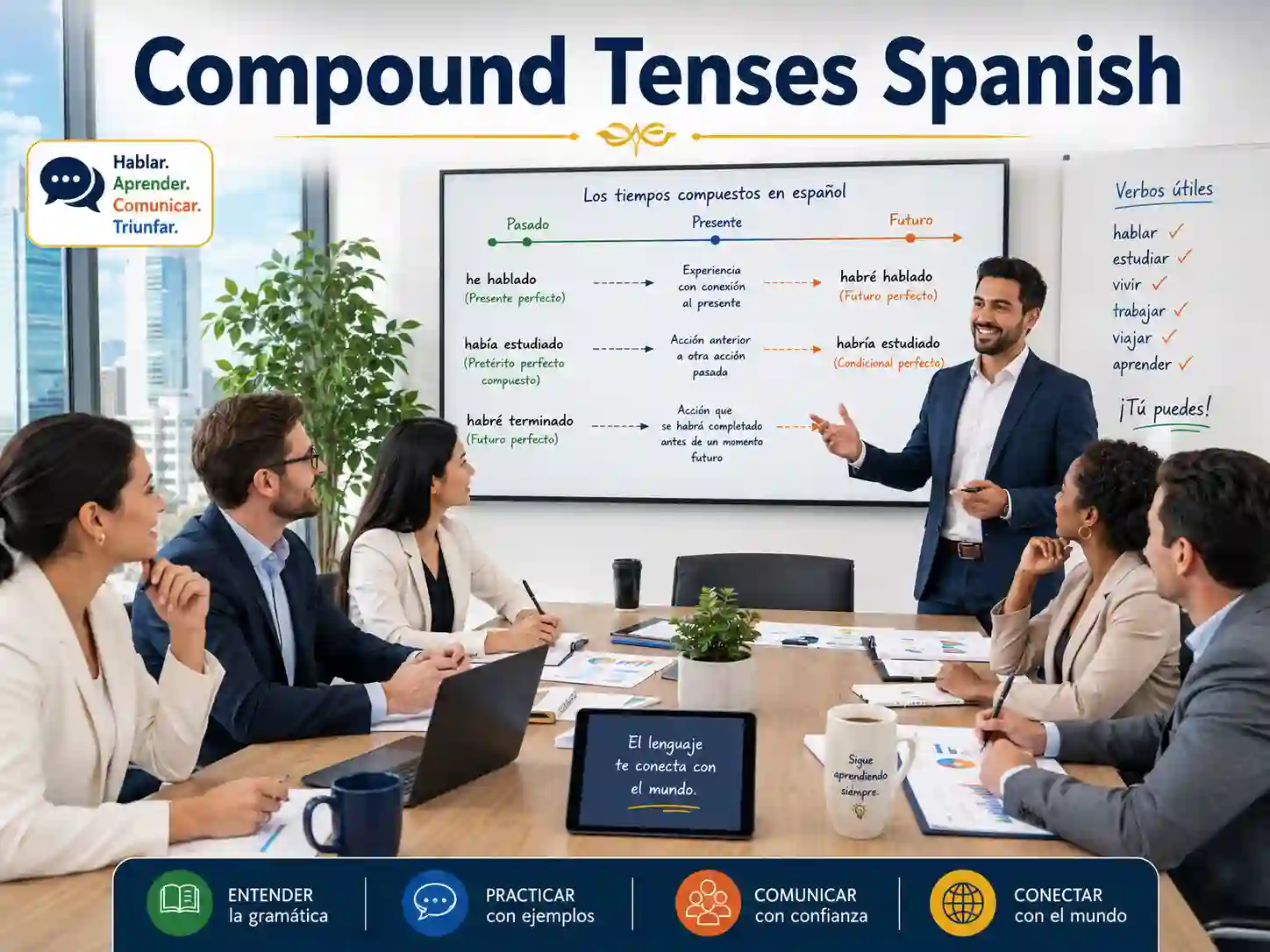
Why Spanish compound tenses matter
Compound tenses allow Spanish to speak about completed actions in relation to another moment: he estudiado “I have studied”, había terminado “I had finished”, habremos llegado “we will have arrived”. They are important for narration, time relationships, advanced conversation, written Spanish and subjunctive clauses.
How to use this page
Use this page after learning haber, the past participle and the basic simple tenses. Compound tenses are easier when you see them as one repeated structure.
he for present perfect, había for pluperfect, habré for future perfect, habría for conditional perfect.
Use forms such as hablado, comido, vivido, hecho, visto, escrito.
In compound tenses with haber, the participle normally does not change: ella ha comprado, ellos han comprado.
The core structure: haber + past participle
Auxiliary haber
Haber carries the tense, mood and person.
he, había, habré, habría, haya
Past participle
The main verb appears as a past participle.
hablado, comido, vivido, hecho, visto
One verbal unit
Haber and the participle work together as one compound tense.
He terminado.
I have finished.
Spanish compound tenses at a glance
| Compound tense | Haber form | Example | English meaning | Main use |
|---|---|---|---|---|
| Present perfect | he, has, ha, hemos, habéis, han | He hablado. | I have spoken. | Completed action connected to the present. |
| Pluperfect | había, habías, había, habíamos, habíais, habían | Había terminado. | I had finished. | Action completed before another past moment. |
| Preterite anterior | hube, hubiste, hubo, hubimos, hubisteis, hubieron | Hube terminado. | I had finished. | Rare, literary, after expressions such as cuando or apenas. |
| Future perfect | habré, habrás, habrá, habremos, habréis, habrán | Habré llegado. | I will have arrived. | Completed action before a future point; also probability about the past. |
| Conditional perfect | habría, habrías, habría, habríamos, habríais, habrían | Habría llamado. | I would have called. | Hypothetical completed action. |
| Present perfect subjunctive | haya, hayas, haya, hayamos, hayáis, hayan | Espero que haya llegado. | I hope he/she has arrived. | Completed action in a subjunctive clause. |
| Past perfect subjunctive | hubiera/hubiese forms | Si hubiera sabido... | If I had known... | Hypothetical or prior action in subjunctive contexts. |
Present perfect: he hablado
The Spanish present perfect uses the present tense of haber plus the past participle. It often expresses a completed action with relevance to the present.
| Subject | Haber | Example with hablar | English meaning |
|---|---|---|---|
| yo | he | he hablado | I have spoken. |
| tú | has | has hablado | You have spoken. |
| él / ella / usted | ha | ha hablado | He/she/you formal has spoken. |
| nosotros | hemos | hemos hablado | We have spoken. |
| vosotros | habéis | habéis hablado | You all have spoken. |
| ellos / ustedes | han | han hablado | They / you all have spoken. |
Regional use varies: in much of Spain, the present perfect is very common for recent past events. In many Latin American varieties, the simple preterite is often preferred in contexts where English might use “have done”.
Pluperfect: había hablado
The pluperfect uses the imperfect tense of haber plus the past participle. It describes an action completed before another moment in the past.
| Subject | Haber | Example | English meaning |
|---|---|---|---|
| yo | había | había terminado | I had finished. |
| tú | habías | habías terminado | You had finished. |
| él / ella / usted | había | había terminado | He/she/you formal had finished. |
| nosotros | habíamos | habíamos terminado | We had finished. |
| vosotros | habíais | habíais terminado | You all had finished. |
| ellos / ustedes | habían | habían terminado | They / you all had finished. |
Cuando llegué, ellos ya habían salido.
When I arrived, they had already left.
Future perfect and conditional perfect
The future perfect and conditional perfect use future or conditional forms of haber plus the past participle. They are common in advanced written and spoken Spanish.
| Tense | Haber forms | Example | English meaning | Use |
|---|---|---|---|---|
| Future perfect | habré, habrás, habrá, habremos, habréis, habrán | Para mañana habremos terminado. | By tomorrow we will have finished. | Completed before a future moment. |
| Future perfect of probability | habrá, habrán | Habrá salido. | He/she has probably left. | Guess or probability about a past event. |
| Conditional perfect | habría, habrías, habría, habríamos, habríais, habrían | Habría llamado, pero no tenía tu número. | I would have called, but I did not have your number. | Hypothetical completed action. |
| Conditional perfect in if-logic | habría forms | Lo habría hecho. | I would have done it. | Result of an unreal condition. |
Compound subjunctive tenses
Spanish also has compound subjunctive forms. They use subjunctive forms of haber plus the past participle.
| Form | Haber pattern | Example | English meaning | Typical context |
|---|---|---|---|---|
| Present perfect subjunctive | haya, hayas, haya, hayamos, hayáis, hayan | Espero que haya llegado. | I hope he/she has arrived. | Completed action with present/future relevance in a subjunctive clause. |
| Past perfect subjunctive with hubiera | hubiera, hubieras, hubiera, hubiéramos, hubierais, hubieran | Si hubiera estudiado más... | If I had studied more... | Unreal past condition. |
| Past perfect subjunctive with hubiese | hubiese, hubieses, hubiese, hubiésemos, hubieseis, hubiesen | Si hubiese sabido... | If I had known... | Alternative form, often more formal or literary in some contexts. |
Hubiera and hubiese are usually interchangeable in the past perfect subjunctive, although regional and stylistic preferences vary.
Compound infinitive and compound gerund
Spanish also uses non-finite compound forms with haber. These are not conjugated tenses, but they are important in advanced sentence structure.
| Form | Structure | Example | English meaning | Use |
|---|---|---|---|---|
| Compound infinitive | haber + past participle | Gracias por haber venido. | Thank you for having come. | Action completed before another reference point. |
| Compound gerund | habiendo + past participle | Habiendo terminado el trabajo, salió. | Having finished the work, he/she left. | Formal or written sequence of actions. |
These forms connect to non-finite verbs: Spanish Non-finite Verb Forms.
Regular and irregular past participles
Regular past participles end in -ado for -ar verbs and -ido for -er and -ir verbs. Many common verbs have irregular participles.
| Verb | Past participle | Compound example | English meaning |
|---|---|---|---|
| hablar | hablado | he hablado | I have spoken. |
| comer | comido | has comido | You have eaten. |
| vivir | vivido | han vivido | They have lived. |
| hacer | hecho | he hecho | I have done / made. |
| ver | visto | había visto | I had seen. |
| escribir | escrito | habremos escrito | We will have written. |
| abrir | abierto | han abierto | They have opened. |
| decir | dicho | habría dicho | He/she would have said. |
Learn the form in detail here: Past Participle in Spanish.
The past participle usually does not agree with the subject
In Spanish compound tenses with haber, the past participle usually stays in the masculine singular form. It does not normally change for gender or number.
| Correct compound tense | Incorrect learner pattern | Explanation |
|---|---|---|
| Ella ha comprado el libro. | Ella ha comprada el libro. | With haber, use comprado. |
| Ellas han terminado. | Ellas han terminadas. | The participle does not agree with the feminine plural subject. |
| Los documentos han llegado. | Los documentos han llegados. | The participle remains llegado. |
Do not confuse compound tenses with adjective-like participles after estar or passive structures with ser, where agreement can occur: la puerta está cerrada, las cartas fueron escritas.
Practice exercises: Spanish compound tenses
Try to answer before opening the solutions. These exercises focus on choosing haber, forming the participle and recognizing the tense.
Exercise 1: form the present perfect
- yo / hablar
- tú / comer
- ella / vivir
- nosotros / terminar
Show answers
1. he hablado
2. has comido
3. ha vivido
4. hemos terminado
Exercise 2: choose the compound tense
- Cuando llegué, ella ya ___ salido.
- Para mañana nosotros ___ terminado.
- Si yo ___ sabido, habría llamado.
- Espero que ellos ___ llegado bien.
Show answers
1. había salido
2. habremos terminado
3. hubiera sabido / hubiese sabido
4. hayan llegado
Exercise 3: correct the mistake
- Ella ha comprada el coche.
- Ellos han vistos la película.
- Yo he escribido la carta.
- Nosotros hemos hacido el trabajo.
Show answers
1. Ella ha comprado el coche.
2. Ellos han visto la película.
3. Yo he escrito la carta.
4. Nosotros hemos hecho el trabajo.
When to use Spanish compound tenses
Use the present perfect for completed actions connected to now
Use he hablado, has comido, han llegado when the completed action is relevant to the present.
Hoy he trabajado mucho.
Use the pluperfect for a past-before-past action
Use había + participle when one past action happened before another past event.
Ya había salido cuando llamaste.
Use future and conditional perfect for advanced time logic
Use habré or habría + participle for future completion, probability or unreal past results.
Habría venido, pero estaba enfermo.
Related grammar topics
Haber and Hay
Understand why haber is the auxiliary verb used in compound tenses.
Past Participle
Learn regular and irregular participles such as hablado, comido, hecho and visto.
Auxiliary Verbs
Study how auxiliary verbs help form complex verbal structures.
Spanish Tenses
Place compound tenses inside the wider Spanish tense system.
Spanish Verbs
Review Spanish verb categories, conjugation and non-finite forms.
Irregular Verbs
Many common compound tenses use irregular participles from irregular verbs.
Typical mistakes with Spanish compound tenses
- Changing the participle for gender or number: say ellas han comprado, not ellas han compradas.
- Using tener instead of haber: Spanish compound tenses use haber, not tener.
- Forgetting irregular participles: say he hecho, he visto, he escrito, not he hacido, he veído, he escribido.
- Separating haber and the participle incorrectly: the compound form works as one verbal unit.
- Confusing present perfect and preterite use: regional usage varies, especially between Spain and Latin America.
- Confusing hay with auxiliary haber: hay means “there is/there are”; he hablado uses auxiliary haber.
Where to go next
After compound tenses, continue with haber, the past participle and the Spanish tense system. These pages explain the building blocks behind he hablado, había terminado and haya llegado.
Want personal guidance?
If Spanish compound tenses feel confusing, individual guidance can help you practise he hablado, había comido, habré terminado, habría venido, haya llegado, irregular participles and tense choice in real sentences.
FAQ: Spanish compound tenses
What are Spanish compound tenses?
Spanish compound tenses are verb forms made with a conjugated form of haber plus a past participle, such as he hablado, había comido and habremos terminado.
How do you form compound tenses in Spanish?
Choose the correct form of haber and add the past participle. For example: he hablado, habías comido, habrán vivido.
Does the past participle agree in Spanish compound tenses?
With compound tenses formed with haber, the past participle usually does not agree with the subject or object. Say ellas han comprado, not ellas han compradas.
What is the Spanish present perfect?
The Spanish present perfect uses the present tense of haber plus a past participle: he hablado, has comido, han vivido.
What is the Spanish pluperfect?
The Spanish pluperfect uses the imperfect of haber plus a past participle: había hablado, habías comido, habían vivido. It describes an action completed before another past moment.
What are common irregular past participles in compound tenses?
Common irregular participles include hecho, visto, dicho, escrito, abierto, puesto, vuelto, roto and muerto.

MundoDele – Spanish learning for education, work and intercultural understanding
MundoDele connects online Spanish courses, DELE preparation, Business Spanish and cultural context into a personal Spanish learning platform.
Grammar pages are designed to explain Spanish clearly, with practical examples, real sentence logic and connected learning paths.