
Coordinating Conjunctions in Spanish
Learn how Spanish coordinating conjunctions connect words, phrases and clauses of the same grammatical level. This guide explains y, e, o, u, ni, pero, sino, sino que, mas, ya...ya, bien...bien and the difference between coordinating and subordinating conjunctions.
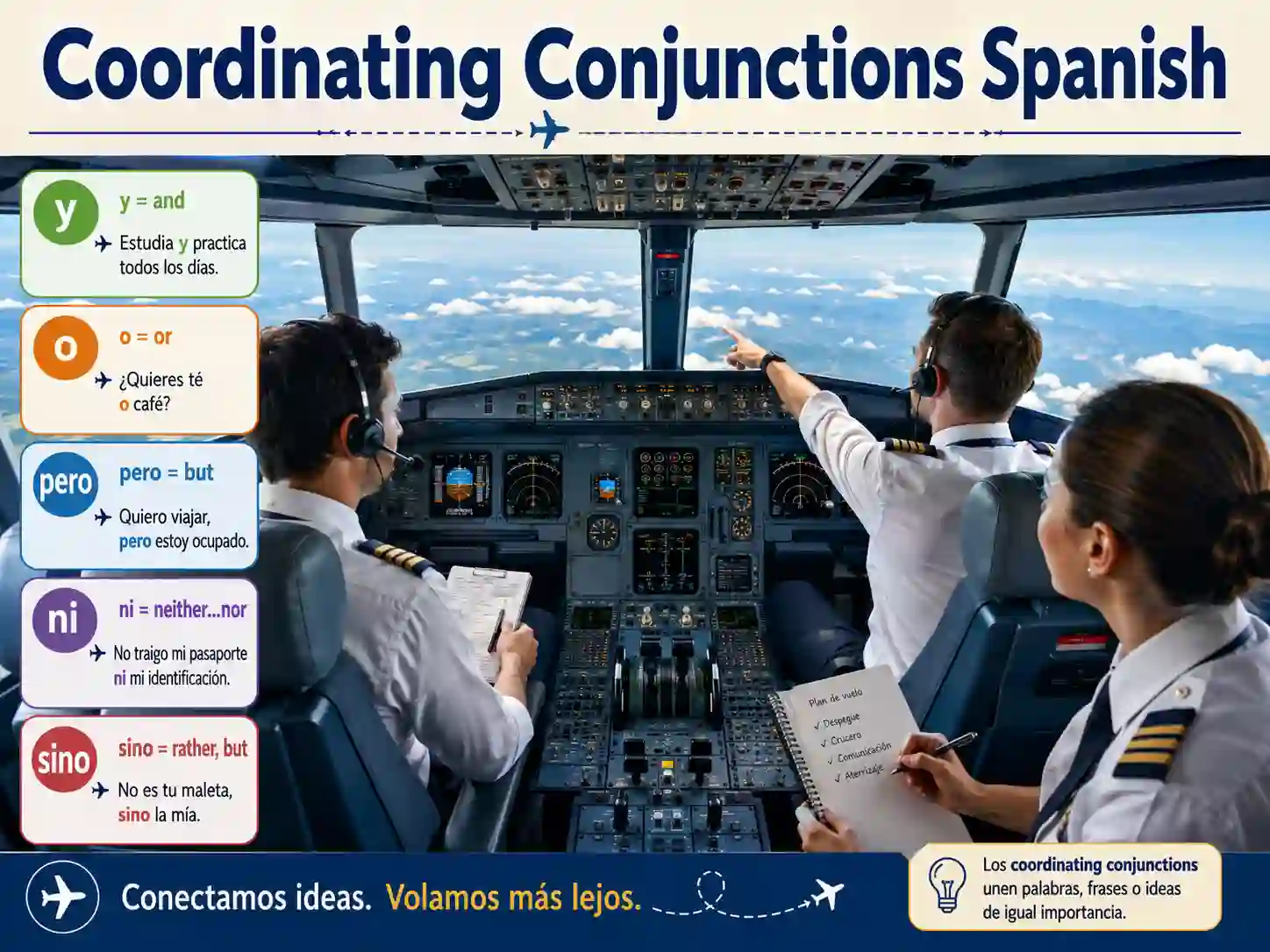
Why learn coordinating conjunctions with MundoDele?
Coordinating conjunctions are small words, but they control the basic rhythm of Spanish sentences. MundoDele explains them through sentence logic: addition, choice, negation, contrast and correction.
The key idea is simple: coordinating conjunctions connect equal parts. They do not usually make one clause dependent on another. This makes them different from subordinating conjunctions such as porque, para que or cuando.
How to use this page
Use this page as the main overview for coordinating conjunctions. First learn the simple connectors: y, o, ni, pero. Then study the sound changes y → e and o → u, and finally compare pero, sino and sino que.
Addition
Use y or e to add equal elements.
Café y pan.
Coffee and bread.
Choice
Use o or u to present alternatives.
Agua o vino.
Water or wine.
Contrast
Use pero, sino or sino que for contrast and correction.
No es caro, sino barato.
It is not expensive, but cheap.
What are coordinating conjunctions in Spanish?
Coordinating conjunctions connect elements that have the same grammatical level. They can connect nouns, adjectives, verbs, phrases or full clauses.
| Function | Spanish example | English meaning | What is connected? |
|---|---|---|---|
| Addition | Café y pan. | Coffee and bread. | Noun + noun. |
| Choice | ¿Té o café? | Tea or coffee? | Noun + noun. |
| Negative addition | No quiero café ni té. | I want neither coffee nor tea. | Negative noun alternatives. |
| Contrast | Es pequeño, pero cómodo. | It is small, but comfortable. | Adjective + adjective. |
| Correction | No es caro, sino barato. | It is not expensive, but cheap. | Corrected adjective. |
Main Spanish coordinating conjunctions
The most important Spanish coordinating conjunctions express addition, choice, negative addition, contrast and correction.
| Conjunction | English meaning | Example | Function |
|---|---|---|---|
| y | and | Juan y Ana. | Addition. |
| e | and | Padres e hijos. | Addition before an i sound. |
| o | or | Agua o vino. | Choice or alternative. |
| u | or | Siete u ocho. | Choice before an o sound. |
| ni | nor / neither | No quiero café ni té. | Negative addition. |
| pero | but | Es caro, pero bueno. | Contrast. |
| sino | but rather | No es caro, sino barato. | Correction after negation. |
| sino que | but rather / but instead | No vino, sino que llamó. | Correction with a conjugated verb. |
| mas | but | Quería ir, mas no pudo. | Literary or formal contrast. |
Y and e: and
Y means “and”. It changes to e before words that begin with an i sound, usually written i- or hi-. This avoids repeating the same sound.
| Form | Spanish example | English meaning | Rule |
|---|---|---|---|
| y | Café y pan. | Coffee and bread. | Normal form. |
| y | Madrid y Barcelona. | Madrid and Barcelona. | Normal form. |
| e | Padres e hijos. | Parents and children. | Before an i sound. |
| e | Español e inglés. | Spanish and English. | Before inglés. |
| y | Agua y hielo. | Water and ice. | Hielo begins with a ye sound, not a pure i sound. |
O and u: or
O means “or”. It changes to u before words that begin with an o sound, usually written o- or ho-.
| Form | Spanish example | English meaning | Rule |
|---|---|---|---|
| o | Té o café. | Tea or coffee. | Normal form. |
| o | Hoy o mañana. | Today or tomorrow. | Normal form. |
| u | Siete u ocho. | Seven or eight. | Before an o sound. |
| u | Mujer u hombre. | Woman or man. | Before silent h + o sound. |
| u | Uno u otro. | One or the other. | Before otro. |
Ni: nor / neither
Ni connects negative elements. It can mean “nor”, “neither” or “not even”, depending on the sentence.
| Structure | Spanish example | English meaning | Use |
|---|---|---|---|
| no...ni... | No quiero café ni té. | I want neither coffee nor tea. | Negative addition. |
| ni...ni... | Ni Juan ni Ana vinieron. | Neither Juan nor Ana came. | Double negative pair. |
| ni siquiera | Ni siquiera llamó. | He/she did not even call. | Emphatic negative. |
| ni idea | No tengo ni idea. | I have no idea at all. | Idiomatic negative expression. |
Pero, sino and sino que
English “but” can correspond to pero, sino or sino que. The difference is important. Use pero for contrast. Use sino to correct a negative statement. Use sino que when the correction contains a conjugated verb.
| Connector | Spanish example | English meaning | Rule |
|---|---|---|---|
| pero | Es caro, pero bueno. | It is expensive, but good. | Contrast without correcting a negated idea. |
| pero | Quiero ir, pero no puedo. | I want to go, but I cannot. | Opposition between two clauses. |
| sino | No es caro, sino barato. | It is not expensive, but cheap. | Corrects a negative statement. |
| sino | No quiero café, sino té. | I do not want coffee, but tea. | Replaces one element with another. |
| sino que | No vino, sino que llamó. | He/she did not come, but called. | Correction with conjugated verb. |
| sino que | No estudia mucho, sino que aprende rápido. | He/she does not study a lot, but learns quickly. | Corrects with a full clause. |
Distributive coordinating structures
Spanish also uses paired structures to present alternating or distributed possibilities. These are more common in formal, literary or structured language than in basic everyday speech.
| Structure | English idea | Spanish example | Use |
|---|---|---|---|
| ya...ya... | now...now / whether...or | Ya ríe, ya llora. | Alternating actions or states. |
| bien...bien... | either...or | Bien por correo, bien en persona. | Formal alternatives. |
| sea...sea... | whether...or | Sea hoy, sea mañana, debemos hacerlo. | Structured alternatives. |
| ora...ora... | now...now | Ora canta, ora calla. | Literary or old-fashioned style. |
Coordinating vs subordinating conjunctions
Coordinating conjunctions connect equal elements. Subordinating conjunctions introduce dependent clauses. This distinction is one of the most important points in Spanish sentence structure.
| Type | Spanish example | English meaning | Logic |
|---|---|---|---|
| Coordinating | Quiero café y pan. | I want coffee and bread. | Connects equal nouns. |
| Coordinating | Estudio, pero estoy cansado. | I study, but I am tired. | Connects two coordinated clauses. |
| Subordinating | No fui porque estaba enfermo. | I did not go because I was sick. | The reason clause depends on the main clause. |
| Subordinating | Te llamaré cuando llegue. | I will call you when I arrive. | The time clause depends on the main clause. |
Related page: Subordinating Conjunctions in Spanish.
Punctuation with coordinating conjunctions
Spanish does not automatically require a comma before every coordinating conjunction. Use punctuation when the sentence needs clarity, contrast or separation between clauses.
| Pattern | Spanish example | Note |
|---|---|---|
| No comma in simple lists | Compré pan, queso y fruta. | Normal list. |
| Comma before contrast | Quería ir, pero no podía. | Common before pero between clauses. |
| Comma before correction | No quiero café, sino té. | Common before sino. |
| Comma with full correction clause | No vino, sino que llamó. | Common before sino que. |
Practice exercises: coordinating conjunctions
Try to answer before opening the solutions. These exercises focus on y/e, o/u, ni, pero, sino and sino que.
Exercise 1: choose y or e
- Español ___ inglés.
- Café ___ pan.
- Padres ___ hijos.
- Agua ___ hielo.
Show answers
1. e
2. y
3. e
4. y
Exercise 2: choose o or u
- Té ___ café.
- Siete ___ ocho.
- Uno ___ otro.
- Hoy ___ mañana.
Show answers
1. o
2. u
3. u
4. o
Exercise 3: pero, sino or sino que?
- Quiero ir, ___ no puedo.
- No quiero café, ___ té.
- No vino, ___ llamó.
- Es difícil, ___ útil.
Show answers
1. pero
2. sino
3. sino que
4. pero
Typical mistakes with Spanish coordinating conjunctions
- Using y before an i sound: say español e inglés, not español y inglés.
- Using o before an o sound: say siete u ocho, not siete o ocho.
- Confusing pero and sino: pero contrasts; sino corrects after negation.
- Using sino before a full conjugated clause: use sino que: No vino, sino que llamó.
- Confusing coordinating and subordinating conjunctions: y, o and pero coordinate; porque, cuando and para que subordinate.
- Overusing commas in simple lists: Spanish usually does not need a comma before y in a simple list.
Related grammar topics
Spanish Conjunctions
Learn how conjunctions connect words, phrases and clauses in Spanish.
Subordinating Conjunctions
Compare coordinating conjunctions with dependent-clause connectors.
Conjunctions with Que
Study que, porque, para que, aunque and related structures.
Causal Conjunctions
Study porque, ya que, puesto que and dado que.
Concessive Conjunctions
Compare pero with subordinating contrast connectors such as aunque.
Spanish Grammar
Return to the complete Spanish grammar overview.
Where to go next
After coordinating conjunctions, continue with subordinating conjunctions and conjunctions with que. This helps you understand the difference between equal sentence parts and dependent clauses.
Learn Spanish grammar with MundoDele
If Spanish coordinating conjunctions feel confusing, this lesson can help you practise y, e, o, u, ni, pero, sino, sino que and real Spanish sentence patterns in a clear and structured way.
FAQ: coordinating conjunctions in Spanish
What are coordinating conjunctions in Spanish?
Coordinating conjunctions connect words, phrases or clauses of the same grammatical level. Examples include y, o, ni, pero, sino and sino que.
What is the difference between y and e in Spanish?
Y means “and”. It changes to e before a pure i sound, as in español e inglés or padres e hijos.
What is the difference between o and u in Spanish?
O means “or”. It changes to u before an o sound, as in siete u ocho or uno u otro.
What is the difference between pero and sino?
Pero expresses contrast. Sino corrects a negative statement: No quiero café, sino té.
When do you use sino que?
Use sino que when the correction after a negative statement contains a conjugated verb: No vino, sino que llamó.
What is the difference between coordinating and subordinating conjunctions?
Coordinating conjunctions connect equal elements, such as y, o and pero. Subordinating conjunctions introduce dependent clauses, such as porque, cuando and para que.

About MundoDele
MundoDele connects online Spanish courses, DELE preparation, Business Spanish and cultural context into a personal Spanish learning platform.
Grammar pages are designed to explain Spanish clearly, with practical examples, real sentence logic and connected learning paths.