
Ser and Estar in Spanish: Two Verbs for “To Be”
Learn how ser and estar work as Spanish verbs — from identity, origin and profession to location, state and progressive forms such as estoy aprendiendo español.
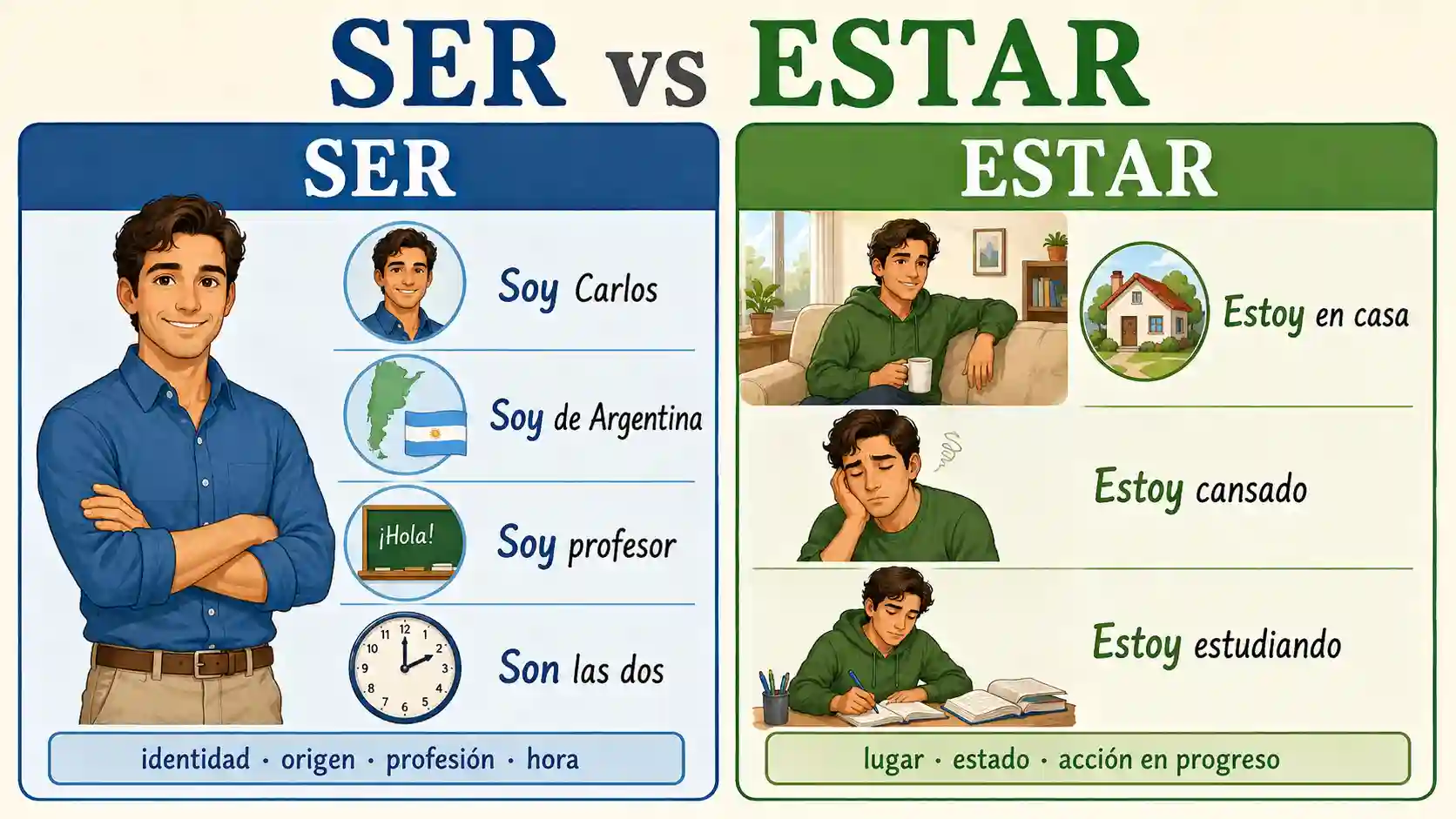
Why ser and estar matter
Ser and estar are among the most frequent verbs in Spanish. They are needed for basic sentences, personal information, places, descriptions, states, time expressions and progressive verb forms. The difficulty is not that one means “permanent” and the other means “temporary”. The real difference is function: what job the verb is doing in the sentence.
How to use this page
Use this page as the main verb lesson for ser and estar. Start with conjugation, then learn the core functions, and finally connect them with hay, adjectives and progressive forms.
Start with soy, eres, es, somos, son and estoy, estás, está, estamos, están.
Use ser for identity and classification; use estar for location, state and condition.
Compare hay for existence, estar + gerund for ongoing action, and adjective meaning with ser or estar.
The core system: identity, location and state
Ser: identity and classification
Use ser to say what someone or something is.
Soy profesor. · Es una ciudad grande. · Son estudiantes.
Estar: location
Use estar to say where a specific person, place or thing is.
Estoy en casa. · Madrid está en España. · Los libros están en la mesa.
Estar: state and condition
Use estar for states, conditions and results.
Estoy cansado. · La puerta está abierta. · El café está frío.
Present tense of ser and estar
Both ser and estar are highly irregular verbs. Their present-tense forms should be learned early because they appear in very basic Spanish sentences.
| Subject | Ser | Example with ser | Estar | Example with estar |
|---|---|---|---|---|
| yo | soy | Soy estudiante. | estoy | Estoy en casa. |
| tú | eres | Eres amable. | estás | Estás ocupado. |
| él/ella/usted | es | Es de Chile. | está | Está en la oficina. |
| nosotros | somos | Somos amigos. | estamos | Estamos listos. |
| vosotros | sois | Sois estudiantes. | estáis | Estáis aquí. |
| ellos/ellas/ustedes | son | Son profesores. | están | Están en clase. |
When to use ser
Use ser when the sentence identifies, classifies or defines someone or something. It often answers the question “what is it?”, “who is it?”, “where is it from?” or “what kind of thing is it?”.
| Use | Example | Meaning |
|---|---|---|
| Identity | Soy Ana. | I am Ana. |
| Profession or role | Es profesor. | He is a teacher. |
| Origin | Somos de Argentina. | We are from Argentina. |
| Nationality | Ella es mexicana. | She is Mexican. |
| Material | La mesa es de madera. | The table is made of wood. |
| Ownership | El libro es de Marta. | The book is Marta’s. |
| Time | Son las tres. | It is three o’clock. |
| Event location | La reunión es en la oficina. | The meeting is in the office. |
When to use estar
Use estar when the sentence expresses location, a state, a condition, a result or an action in progress. It often answers “where is it?”, “how is it right now?” or “what is happening?”.
| Use | Example | Meaning |
|---|---|---|
| Location | Estoy en casa. | I am at home. |
| Specific place | Madrid está en España. | Madrid is in Spain. |
| Physical state | Estoy cansado. | I am tired. |
| Emotional state | Está contenta. | She is happy. |
| Resulting state | La puerta está cerrada. | The door is closed. |
| Condition | El café está frío. | The coffee is cold. |
| Progressive form | Estamos estudiando. | We are studying. |
| Temporary arrangement | Estoy de vacaciones. | I am on vacation. |
Estar vs hay: location and existence
Learners often confuse estar and hay. Use hay to introduce something or say that something exists. Use estar to locate something specific or already known.
Hay un hotel en esta calle. — There is a hotel on this street.
El hotel está en esta calle. — The hotel is on this street.
Hay una farmacia cerca. — There is a pharmacy nearby.
La farmacia está cerca. — The pharmacy is nearby.
Learn this contrast in detail here: Hay in Spanish.
Estar with the gerund
Estar is also used with the Spanish gerund to describe an action in progress. In this structure, estar is conjugated and the gerund stays unchanged.
Estoy aprendiendo español. — I am learning Spanish.
Estás leyendo. — You are reading.
Estamos trabajando. — We are working.
Están hablando. — They are speaking.
Learn the gerund form here: Spanish Gerund.
Ser and estar with adjectives
This page focuses on ser and estar as verbs. With adjectives, the choice can change the meaning: es aburrido can describe a boring person or thing, while está aburrido describes someone who is bored.
Es listo. — He is clever.
Está listo. — He is ready.
Es rico. — It is rich / he is rich.
Está rico. — It tastes good.
Learn this adjective-focused topic here: Ser or Estar with Adjectives.
When to use ser and estar
Use ser
Use ser to identify, classify or define someone or something.
Soy estudiante. · Es una ciudad grande.
Use estar
Use estar to locate something or describe its state or condition.
Estoy aquí. · La puerta está abierta.
Use hay
Use hay to say that something exists or is available.
Hay una mesa. · Hay muchas preguntas.
Related grammar topics
Ser or Estar with Adjectives
Learn how adjective meaning changes with ser and estar.
Hay in Spanish
Learn “there is” and “there are” and the difference between hay and estar.
Haber and Hay
Understand haber as an auxiliary verb and hay as an impersonal form.
Highly Irregular Verbs
Connect ser and estar with other highly irregular Spanish verbs.
Spanish Gerund
Learn forms such as hablando, comiendo and estoy estudiando.
Prepositions of Place
Practise phrases used with estar: en, cerca de, delante de, al lado de.
Typical mistakes with ser and estar
- Using only permanence as a rule: the better question is the function of the verb: identity, location, state, result or progressive action.
- Using ser for location: say estoy en casa, not soy en casa.
- Using estar for identity: say soy estudiante, not estoy estudiante.
- Confusing hay and estar: say hay un hotel to introduce it, but el hotel está aquí to locate it.
- Forgetting adjective meaning changes: es listo and está listo do not mean the same thing.
Where to go next
After this page, continue with adjective meaning, hay for existence and the gerund for progressive forms.
Want personal guidance?
If ser, estar and hay feel confusing, individual guidance can help you practise identity, location, state, existence and progressive forms in real Spanish sentences.
FAQ: Ser and estar in Spanish
What is the difference between ser and estar?
Ser is used for identity, classification, origin, profession, material, ownership and time. Estar is used for location, state, condition, result and progressive forms.
When do you use ser in Spanish?
Use ser to say what someone or something is: soy estudiante, es de México, son las tres.
When do you use estar in Spanish?
Use estar for location, state and condition: estoy en casa, la puerta está abierta, estamos cansados.
Do you use ser or estar for location?
Use estar for the location of people, places and things: Madrid está en España. Event location is commonly expressed with ser: la reunión es en la oficina.
What is the difference between hay and estar?
Use hay to say that something exists or to introduce it. Use estar to locate something specific: hay un hotel, but el hotel está aquí.
How do you use estar with the gerund?
Use a conjugated form of estar plus the gerund to describe an action in progress: estoy estudiando, estamos aprendiendo, están trabajando.

MundoDele – Spanish learning for education, work and intercultural understanding
MundoDele connects online Spanish courses, DELE preparation, Business Spanish and cultural context into a personal Spanish learning platform.
Grammar pages are designed to explain Spanish clearly, with practical examples, real sentence logic and connected learning paths.