
Preterite vs Imperfect in Spanish
Learn the difference between the Spanish preterite and imperfect. This guide compares hablé and hablaba, explains completed actions, background, descriptions, repeated habits, interrupted actions, time markers and story structure.
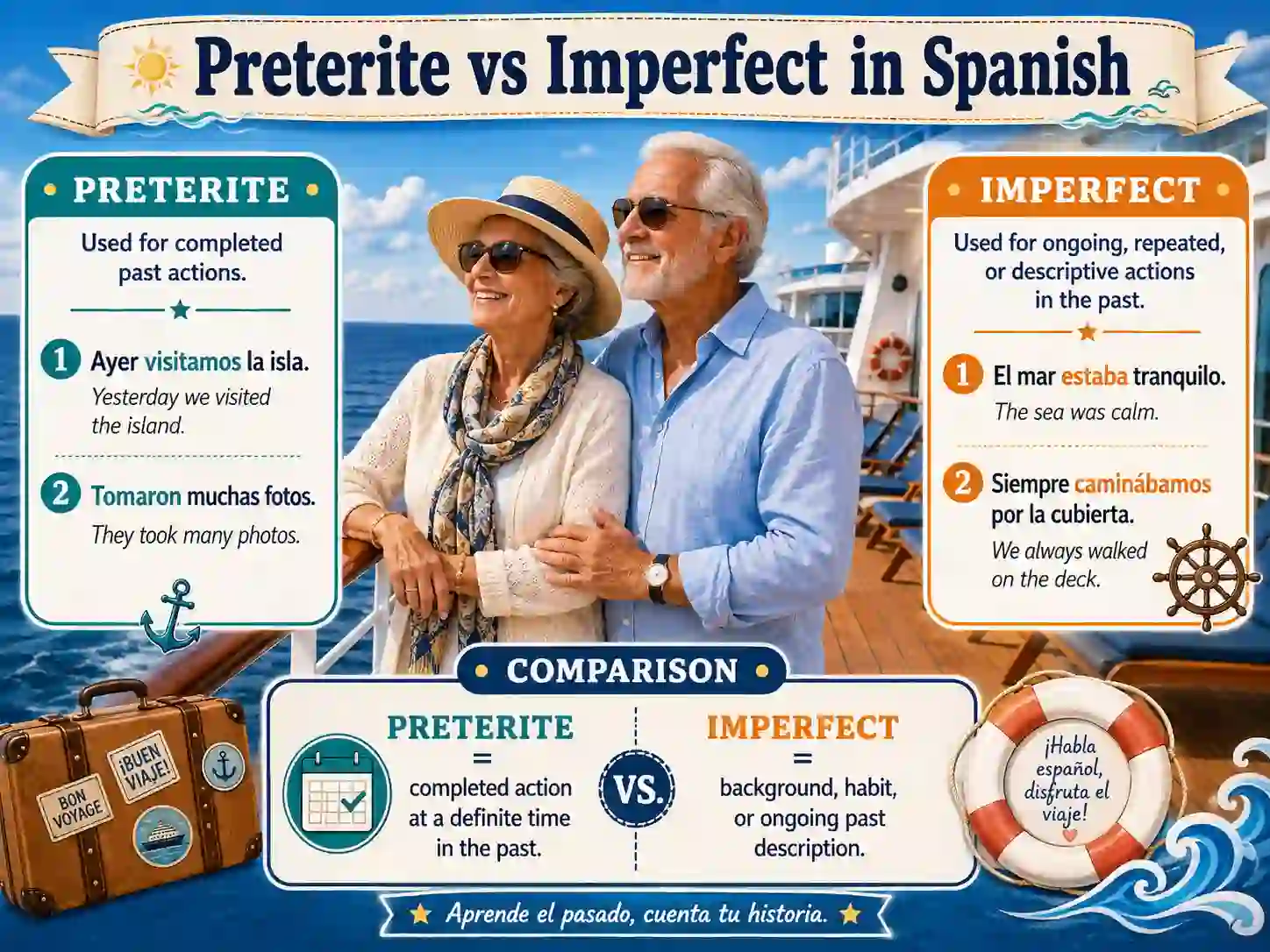
Why this difference matters
The preterite and imperfect are both past tenses, but they do different jobs. The preterite moves the story forward with completed events. The imperfect gives the background, describes situations and shows repeated or ongoing past actions. This contrast is central to natural Spanish narration.
How to choose between them
First ask whether the verb is presenting a finished event or describing a past situation. Finished event usually means preterite. Background, habit, description or ongoing situation usually means imperfect.
Preterite
Use it for completed actions and story events.
Ayer compré un libro.
Yesterday I bought a book.
Imperfect
Use it for background, habits and descriptions.
Cuando era niño, leía mucho.
When I was a child, I used to read a lot.
Together
The imperfect sets the scene; the preterite interrupts or advances the story.
Dormía cuando sonó el teléfono.
I was sleeping when the phone rang.
Core contrast: hablé vs hablaba
| Form | Example | English meaning | Main idea |
|---|---|---|---|
| Preterite | Hablé con Ana. | I spoke with Ana. | A completed event. |
| Imperfect | Hablaba con Ana. | I was speaking / used to speak with Ana. | An ongoing or repeated past situation. |
| Preterite | Viví en Madrid dos años. | I lived in Madrid for two years. | A completed period viewed as a whole. |
| Imperfect | Vivía en Madrid. | I lived / was living in Madrid. | Background or past situation. |
Preterite: completed past actions
The preterite presents an action as completed. It is often used with clear past time markers such as ayer, anoche, el lunes, en 2020 or la semana pasada.
| Infinitive | Preterite example | English meaning | Why preterite? |
|---|---|---|---|
| hablar | Hablé con Ana ayer. | I spoke with Ana yesterday. | Completed event in a finished past time. |
| comer | Comimos a las dos. | We ate at two o’clock. | Specific completed action. |
| vivir | Viví en Chile tres años. | I lived in Chile for three years. | Completed period viewed as a whole. |
| llegar | Llegaron tarde. | They arrived late. | Arrival is a completed event. |
Detail page: Spanish Preterite.
Imperfect: background, habits and descriptions
The imperfect describes what things were like, what was happening, what someone used to do or what was repeated in the past.
| Infinitive | Imperfect example | English meaning | Why imperfect? |
|---|---|---|---|
| ser | Era muy tranquilo. | He was very quiet. | Description. |
| vivir | Vivíamos en Madrid. | We lived / were living in Madrid. | Background situation. |
| estudiar | Estudiaba todos los días. | I used to study every day. | Repeated habit. |
| llover | Llovía mucho. | It was raining a lot. | Background weather. |
Detail page: Spanish Imperfect.
Decision table: which tense should you choose?
| Question | Choose | Example | Reason |
|---|---|---|---|
| Is it a completed event? | Preterite | Ayer compré un libro. | The action is finished and specific. |
| Is it background or description? | Imperfect | La casa era grande. | The sentence describes what things were like. |
| Is it a repeated habit? | Imperfect | De niño jugaba al fútbol. | Repeated past action. |
| Did it interrupt an ongoing action? | Preterite for the interrupting event | Dormía cuando llamó mi madre. | Dormía is ongoing; llamó interrupts. |
| Is a completed period viewed as a whole? | Preterite | Viví en México dos años. | The period is closed and counted as one completed block. |
| Is it an age, time, weather or state? | Imperfect | Tenía diez años y hacía frío. | Background state or description. |
Time markers and signal words
Time markers can help, but they are not automatic rules. They often show whether the sentence describes a repeated situation or a completed event.
| Often with preterite | Example | Often with imperfect | Example |
|---|---|---|---|
| ayer | Ayer trabajé mucho. | siempre | Siempre trabajaba mucho. |
| anoche | Anoche cenamos tarde. | todos los días | Todos los días cenábamos juntos. |
| el lunes | El lunes fui al médico. | de niño | De niño iba mucho al parque. |
| de repente | De repente empezó a llover. | mientras | Mientras estudiaba, escuchaba música. |
| una vez | Una vez viajé solo. | normalmente | Normalmente viajábamos en tren. |
Story logic: background and event
In stories, the imperfect often sets the scene and the preterite moves the story forward. This combination is one of the most important patterns in Spanish narration.
| Background in imperfect | Event in preterite | Full sentence | English meaning |
|---|---|---|---|
| Dormía | sonó el teléfono | Dormía cuando sonó el teléfono. | I was sleeping when the phone rang. |
| Llovía mucho | salimos | Llovía mucho cuando salimos. | It was raining a lot when we went out. |
| Vivíamos en Madrid | conocimos a Laura | Vivíamos en Madrid cuando conocimos a Laura. | We were living in Madrid when we met Laura. |
| Era tarde | decidimos volver | Era tarde, así que decidimos volver. | It was late, so we decided to return. |
Same verb, different meaning
Some verbs change meaning depending on whether they are used in the preterite or imperfect. The verb itself is the same, but the speaker’s perspective changes.
| Verb | Preterite | Meaning | Imperfect | Meaning |
|---|---|---|---|---|
| conocer | Conocí a Ana. | I met Ana. | Conocía a Ana. | I knew Ana. |
| saber | Supe la verdad. | I found out the truth. | Sabía la verdad. | I knew the truth. |
| querer | Quise ayudar. | I tried / wanted to help. | Quería ayudar. | I wanted to help. |
| poder | Pude hacerlo. | I managed to do it. | Podía hacerlo. | I was able to do it / could do it. |
| tener | Tuve un problema. | I had / got a problem as an event. | Tenía un problema. | I had a problem as a state. |
Typical imperfect background types
The imperfect is very common with descriptions, age, time, weather, emotions, physical states and repeated habits.
| Background type | Spanish example | English meaning |
|---|---|---|
| Description | La ciudad era tranquila. | The city was quiet. |
| Age | Tenía diez años. | I was ten years old. |
| Time | Eran las ocho. | It was eight o’clock. |
| Weather | Hacía frío. | It was cold. |
| Emotion or state | Estaba cansado. | I was tired. |
| Habit | Íbamos al parque los domingos. | We used to go to the park on Sundays. |
Completed period vs ongoing background
Duration alone does not automatically mean imperfect. If the speaker presents a period as completed and bounded, Spanish often uses the preterite. If the period is background or ongoing from the story’s viewpoint, Spanish often uses the imperfect.
| Preterite | Meaning | Imperfect | Meaning |
|---|---|---|---|
| Viví en Madrid dos años. | I lived in Madrid for two years. | Vivía en Madrid cuando lo conocí. | I was living in Madrid when I met him. |
| Trabajé allí tres meses. | I worked there for three months. | Trabajaba allí en 2020. | I was working there in 2020. |
| Estudié español durante un año. | I studied Spanish for one year. | Estudiaba español por las noches. | I used to study Spanish at night. |
Practice exercises: preterite vs imperfect
Try to answer before opening the solutions. These exercises focus on completed events, background, habits and interrupted actions.
Exercise 1: choose the tense
- Ayer ___ con Ana. hablar
- Cuando era niño, ___ mucho. leer
- Mientras ___, sonó el teléfono. dormir
- El año pasado ___ a México. viajar
Show answers
1. hablé
2. leía
3. dormía
4. viajé
Exercise 2: explain the choice
- La casa era grande.
- Compré la casa en 2020.
- Todos los domingos íbamos al parque.
- De repente empezó a llover.
Show answers
1. Imperfect: description.
2. Preterite: completed event in a specific past time.
3. Imperfect: repeated habit.
4. Preterite: sudden completed event that moves the story forward.
Exercise 3: choose the meaning
- Conocí a Marta.
- Conocía a Marta.
- Supe la respuesta.
- Sabía la respuesta.
Show answers
1. I met Marta.
2. I knew Marta.
3. I found out the answer.
4. I knew the answer.
Typical mistakes with preterite and imperfect
- Using the preterite for every past action: not every past sentence needs the preterite. Background and habits often need the imperfect.
- Thinking duration always means imperfect: viví en Madrid dos años uses the preterite because the period is completed.
- Forgetting story structure: use imperfect for the scene and preterite for events that move the story forward.
- Using imperfect with clear one-time events: ayer compré un libro is a completed event.
- Ignoring meaning changes: conocí can mean “I met”; conocía means “I knew”.
- Translating English mechanically: English “was” can be preterite or imperfect depending on the Spanish meaning.
Related grammar topics
Preterite
Learn completed past actions such as hablé, comí and viví.
Imperfect
Study descriptions, habits and ongoing past situations such as hablaba and vivía.
Present Perfect vs Preterite
Compare he comido and comí with time markers and present relevance.
Pluperfect
Learn había comido and past-before-past meaning.
Spanish Tenses
Place preterite and imperfect inside the full Spanish tense system.
Spanish Verbs
Review conjugation, regular verbs and irregular verb forms.
Where to go next
After this comparison, study the preterite and imperfect separately. Then continue with the pluperfect and present perfect comparisons to understand how Spanish organizes past time.
Want personal guidance?
If Spanish past tenses feel confusing, individual guidance can help you practise hablé, hablaba, comí, comía, story structure, descriptions, habits, interrupted actions and real tense choices.
FAQ: preterite vs imperfect in Spanish
What is the difference between preterite and imperfect in Spanish?
The preterite presents a past action as a completed event. The imperfect describes background, habits, repeated actions, ongoing situations or what things were like in the past.
When do you use the Spanish preterite?
Use the preterite for completed actions, one-time events and closed past periods, such as ayer compré un libro or viví en México dos años.
When do you use the Spanish imperfect?
Use the imperfect for descriptions, age, time, weather, emotions, repeated habits and ongoing past actions, such as era tarde, tenía diez años or estudiaba todos los días.
What does hablaba mean?
Hablaba can mean “I was speaking”, “he/she was speaking”, “I used to speak” or “he/she used to speak”, depending on context.
What does hablé mean?
Hablé means “I spoke”. It presents the action as a completed past event.
Can the same sentence use both preterite and imperfect?
Yes. Spanish often uses the imperfect for the background and the preterite for the event: Dormía cuando sonó el teléfono.

MundoDele – Spanish learning for education, work and intercultural understanding
MundoDele connects online Spanish courses, DELE preparation, Business Spanish and cultural context into a personal Spanish learning platform.
Grammar pages are designed to explain Spanish clearly, with practical examples, real sentence logic and connected learning paths.