
Spanish Present Perfect: He Hablado, He Comido
Learn how the Spanish present perfect works. This guide explains haber + past participle, regular and irregular participles, present relevance, experience, recent results, open time frames, regional usage and the difference between he comido, comí and había comido.
Why the Spanish present perfect matters
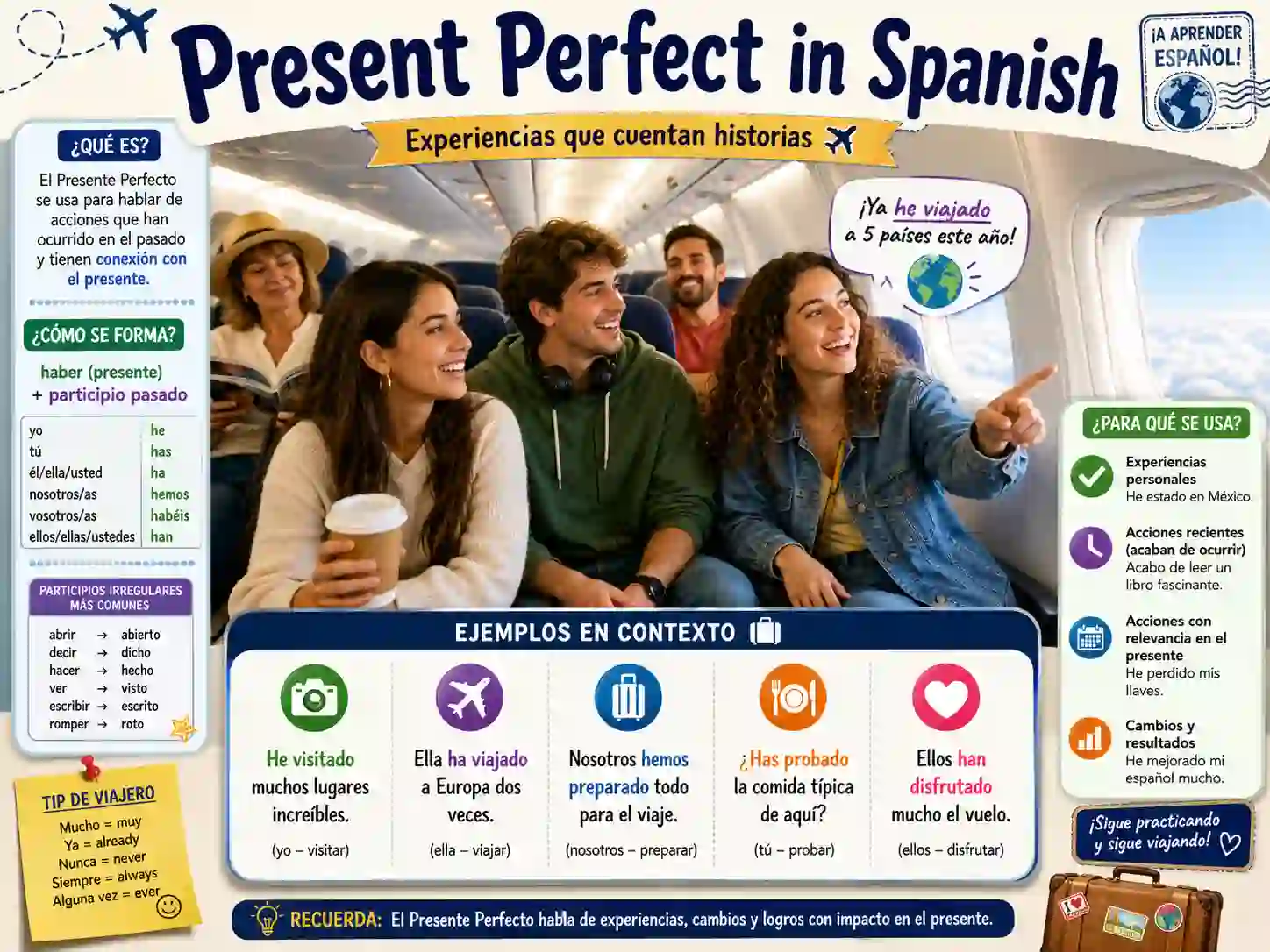
The present perfect connects a completed action to the present. It is useful for saying what has happened today, this week, this year, recently or in someone’s life experience: he visto esa película, hemos terminado el curso, ¿has estado en México?.
How to use this page
Use this page after learning the past participle and before comparing the present perfect with the preterite. The key is not only the form, but the connection between the completed action and the present.
Use he, has, ha, hemos, habéis, han.
Use forms such as hablado, comido, vivido, hecho, visto and escrito.
Say he terminado when the completed action still matters now.
The core structure: haber + past participle
Present-tense haber
The auxiliary verb is haber in the present tense.
he, has, ha, hemos, habéis, han
Past participle
The main verb appears as a past participle.
hablado, comido, vivido, hecho, visto
Present connection
The action is complete, but it is connected to now.
He perdido las llaves.
I have lost the keys.
Spanish present perfect forms
| Subject | Haber | Example with hablar | English meaning |
|---|---|---|---|
| yo | he | he hablado | I have spoken. |
| tú | has | has hablado | You have spoken. |
| él / ella / usted | ha | ha hablado | He/she/you formal has spoken. |
| nosotros / nosotras | hemos | hemos hablado | We have spoken. |
| vosotros / vosotras | habéis | habéis hablado | You all have spoken. |
| ellos / ellas / ustedes | han | han hablado | They / you all have spoken. |
Regular participles: hablado, comido, vivido
Regular past participles use -ado for -ar verbs and -ido for -er and -ir verbs.
| Infinitive | Past participle | Present perfect | English meaning |
|---|---|---|---|
| hablar | hablado | he hablado | I have spoken. |
| comer | comido | has comido | You have eaten. |
| vivir | vivido | hemos vivido | We have lived. |
| terminar | terminado | han terminado | They have finished. |
Irregular participles in the present perfect
Many common verbs have irregular past participles. The auxiliary haber stays regular, but the participle changes.
| Infinitive | Irregular participle | Present perfect | English meaning |
|---|---|---|---|
| hacer | hecho | he hecho | I have done / made. |
| ver | visto | has visto | You have seen. |
| decir | dicho | ha dicho | He/she has said. |
| escribir | escrito | hemos escrito | We have written. |
| abrir | abierto | han abierto | They have opened. |
| poner | puesto | he puesto | I have put. |
| volver | vuelto | has vuelto | You have returned. |
| romper | roto | ha roto | He/she has broken. |
Learn participles here: Past Participle in Spanish.
Main uses of the Spanish present perfect
The present perfect is used for completed actions that are connected to the present moment, current time frames, experience and recent results.
| Use | Spanish example | English meaning | Grammar logic |
|---|---|---|---|
| Present result | He perdido las llaves. | I have lost the keys. | The result matters now. |
| Current time frame | Hoy he estudiado mucho. | Today I have studied a lot. | Hoy is still the current day. |
| Life experience | ¿Has estado en México? | Have you been to Mexico? | The experience is relevant now. |
| Recent completed action | Ya hemos terminado. | We have already finished. | The completed action is relevant now. |
| Open period | Este año he viajado mucho. | This year I have travelled a lot. | The year is still open. |
Common present perfect time markers
Present perfect time markers often point to an unfinished current period or a present-relevant experience.
| Time marker | Spanish example | English meaning |
|---|---|---|
| hoy | Hoy he trabajado mucho. | Today I have worked a lot. |
| esta semana | Esta semana hemos aprendido mucho. | This week we have learned a lot. |
| este mes | Este mes he leído dos libros. | This month I have read two books. |
| este año | Este año han viajado mucho. | This year they have travelled a lot. |
| ya | Ya he terminado. | I have already finished. |
| todavía no | Todavía no hemos visto la película. | We have not seen the movie yet. |
| alguna vez | ¿Has probado la paella alguna vez? | Have you ever tried paella? |
Present perfect vs preterite
The present perfect connects a completed action to the present. The preterite places a completed action in a finished past time.
| Present perfect | Meaning | Preterite | Meaning |
|---|---|---|---|
| Hoy he comido tarde. | Today I have eaten late. | Ayer comí tarde. | Yesterday I ate late. |
| He visto esa película. | I have seen that movie. | Vi esa película en 2020. | I saw that movie in 2020. |
| Hemos terminado. | We have finished. | Terminamos el viernes. | We finished on Friday. |
| ¿Has estado en Chile? | Have you been to Chile? | Estuve en Chile el año pasado. | I was in Chile last year. |
Full comparison: Present Perfect vs Preterite in Spanish.
Present perfect vs pluperfect
The present perfect connects a completed action to the present. The pluperfect connects a completed action to another past moment.
| Present perfect | English meaning | Pluperfect | English meaning |
|---|---|---|---|
| He terminado. | I have finished. | Había terminado. | I/he/she had finished. |
| Ya hemos comido. | We have already eaten. | Ya habíamos comido cuando llegaste. | We had already eaten when you arrived. |
| Han salido. | They have left. | Habían salido antes de las ocho. | They had left before eight. |
Detail page: Spanish Pluperfect.
Regional usage: Spain and Latin America
Usage varies across the Spanish-speaking world. In much of Spain, the present perfect is very common with current time frames such as hoy and esta mañana. In many Latin American varieties, speakers often use the preterite in similar contexts.
| Context | Common in Spain | Common in many Latin American varieties | Meaning |
|---|---|---|---|
| Today | Hoy he comido tarde. | Hoy comí tarde. | Today I ate late. |
| This morning | Esta mañana he hablado con Ana. | Esta mañana hablé con Ana. | This morning I spoke with Ana. |
| Already finished | Ya he terminado. | Ya terminé. | I have already finished / I already finished. |
| Life experience | ¿Has estado en Perú? | ¿Has estado en Perú? / ¿Estuviste en Perú? | Have you been to Peru? |
Negation and object pronouns with the present perfect
Negation and object pronouns go before the auxiliary haber. They do not go between haber and the past participle.
| Structure | Correct Spanish | Incorrect learner pattern | English meaning |
|---|---|---|---|
| Negation | No he terminado. | He no terminado. | I have not finished. |
| Direct object pronoun | Lo he visto. | He lo visto. | I have seen it. |
| Indirect object pronoun | Le he escrito. | He le escrito. | I have written to him/her. |
| Double pronoun | Se lo he dicho. | He se lo dicho. | I have told it to him/her. |
Related page: Spanish Pronoun Position.
The past participle does not usually agree
In compound tenses with haber, the past participle normally stays in the masculine singular form. It does not agree with the subject.
| Correct form | Incorrect form | Explanation |
|---|---|---|
| Ella ha comprado el libro. | Ella ha comprada el libro. | Use comprado after haber. |
| Ellas han llegado tarde. | Ellas han llegadas tarde. | The participle does not agree with the feminine plural subject. |
| Los documentos han llegado. | Los documentos han llegados. | The participle remains llegado. |
Practice exercises: Spanish present perfect
Try to answer before opening the solutions. These exercises focus on forming haber + participle, using irregular participles and choosing present perfect meanings.
Exercise 1: form the present perfect
- yo / hablar
- tú / comer
- ella / vivir
- nosotros / terminar
Show answers
1. he hablado
2. has comido
3. ha vivido
4. hemos terminado
Exercise 2: use irregular participles
- yo / hacer
- tú / ver
- nosotros / decir
- ellos / escribir
Show answers
1. he hecho
2. has visto
3. hemos dicho
4. han escrito
Exercise 3: translate into English
- Hoy he estudiado mucho.
- ¿Has estado en México?
- No hemos terminado todavía.
- Se lo he dicho.
Show answers
1. Today I have studied a lot.
2. Have you been to Mexico?
3. We have not finished yet.
4. I have told it to him/her.
Typical mistakes with the Spanish present perfect
- Using tener instead of haber: say he hablado, not tengo hablado.
- Conjugating the main verb: say he comido, not he como.
- Changing the participle for gender or number: say ellas han comprado, not ellas han compradas.
- Forgetting irregular participles: use he hecho, he visto, he escrito, not he hacido, he veído, he escribido.
- Putting pronouns in the wrong place: say lo he visto, not he lo visto.
- Using the present perfect with closed past markers: in standard learner Spanish, use ayer comí, not usually ayer he comido.
Related grammar topics
Present Perfect vs Preterite
Compare he comido with comí using time markers and present relevance.
Preterite
Learn completed past actions such as hablé, comí and viví.
Pluperfect
Learn había hablado and past-before-past meaning.
Compound Tenses
See how haber + past participle works across Spanish tenses.
Haber and Hay
Understand auxiliary haber and how it forms compound tenses.
Past Participle
Learn forms such as hablado, comido, hecho, visto and escrito.
Where to go next
After the present perfect, continue with the present-perfect-vs-preterite comparison and the pluperfect. These pages explain how Spanish separates present relevance, finished past time and past-before-past meaning.
Want personal guidance?
If the Spanish present perfect feels confusing, individual guidance can help you practise he hablado, has comido, hemos vivido, irregular participles, time markers, present relevance and the difference between present perfect and preterite.
FAQ: Spanish present perfect
What is the Spanish present perfect?
The Spanish present perfect is a compound tense formed with the present tense of haber plus a past participle, such as he hablado, has comido and hemos vivido.
How do you form the present perfect in Spanish?
Use he, has, ha, hemos, habéis or han plus the past participle.
What does he hablado mean?
He hablado means “I have spoken”. It is formed with he plus the past participle hablado.
When do you use the present perfect in Spanish?
Use the present perfect for completed actions connected to the present, current time frames, life experience and recent results.
What is the difference between present perfect and preterite?
The present perfect connects a completed action to now: he comido. The preterite places a completed action in a finished past time: comí ayer.
Does the participle agree in the present perfect?
No. With haber, the past participle normally stays invariable: ella ha comprado, ellos han comprado.

MundoDele – Spanish learning for education, work and intercultural understanding
MundoDele connects online Spanish courses, DELE preparation, Business Spanish and cultural context into a personal Spanish learning platform.
Grammar pages are designed to explain Spanish clearly, with practical examples, real sentence logic and connected learning paths.