
MundoDele Grammar · Spanish Tenses
Spanish Imperfect Tense: Hablaba, Comía, Vivía
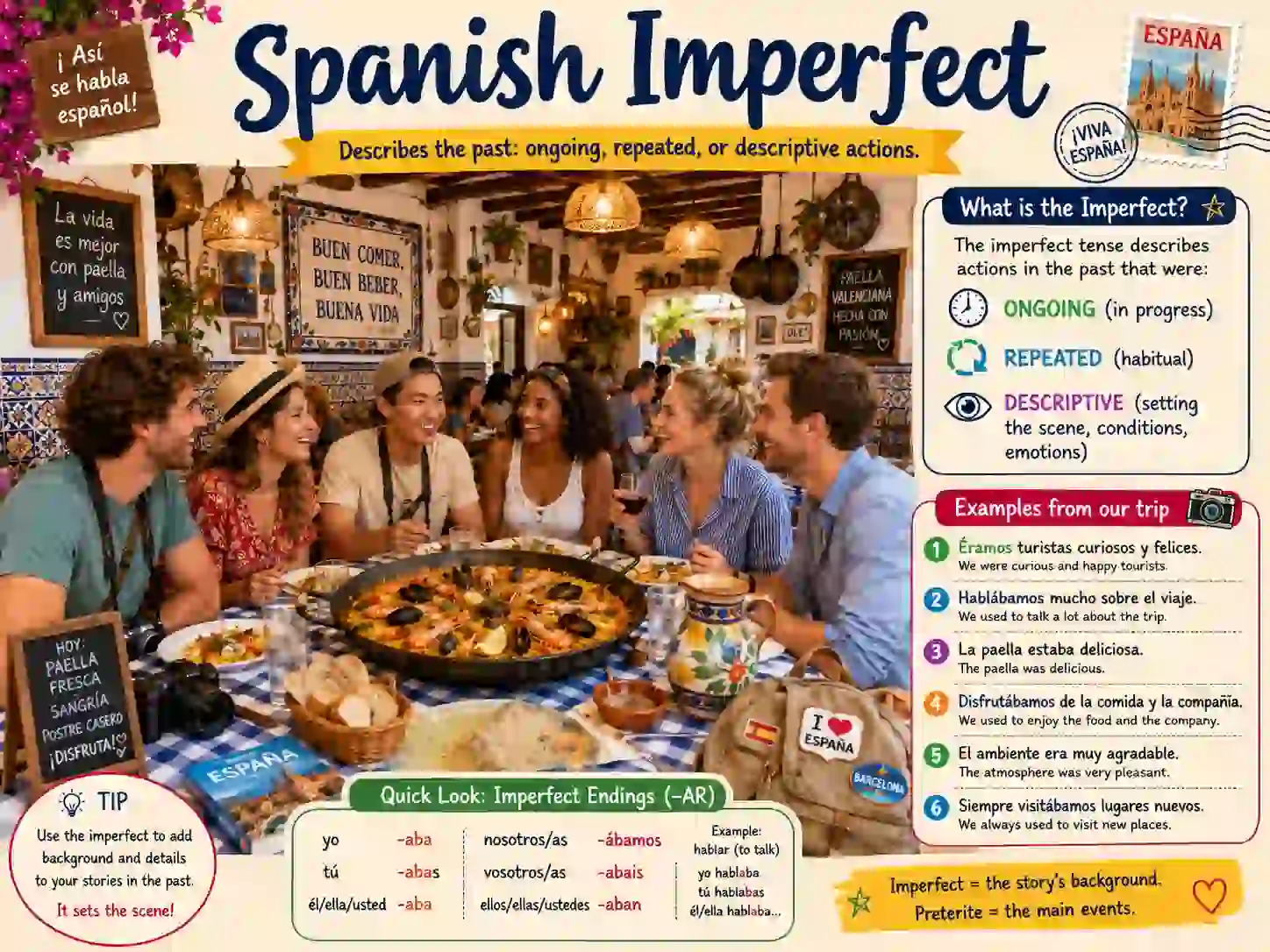
Learn how the Spanish imperfect tense works: regular -aba and -ía endings, the irregular forms era, iba and veía, and the most important uses: background, descriptions, habits, age, time, weather and ongoing past actions.
Quick answer
- Use the imperfect for background: Era tarde y llovía.
- Use it for habits: De niño jugaba al fútbol.
- Use it for ongoing past actions: Dormía cuando llamaste.
- -ar verbs use -aba: hablaba, hablabas, hablábamos.
- -er/-ir verbs use -ía: comía, vivía, comíamos.
- Main irregular forms: era, iba, veía.
Learning goal
Why the Spanish imperfect matters
The imperfect is essential for telling stories naturally. It sets the scene, describes people and places, gives age and time, expresses weather, and shows what someone used to do or was doing: era tarde, hacía frío, vivíamos en Madrid, estudiaba todos los días.
The key is not only time. The imperfect tells the listener that you are describing a past situation, habit or background rather than presenting one completed event.
How to study
How to use this page
Use this page after learning basic present-tense verb endings and before studying deeper past-tense comparisons. The imperfect is not mainly about when something happened. It is about how the speaker views the past: as background, description, habit or ongoing situation.
Use -aba for -ar verbs and -ía for -er and -ir verbs.
The key irregular forms are era, iba and veía.
Say cuando era niño, vivía en Madrid, jugaba todos los días.
Core meaning
The core idea: what things were like or used to be
Background
The imperfect sets the scene in the past.
Era tarde y llovía.
It was late and it was raining.
Habit
The imperfect shows what someone used to do repeatedly.
De niño jugaba al fútbol.
As a child, I used to play football.
Ongoing past
The imperfect can describe what was happening.
Dormía cuando llamaste.
I was sleeping when you called.
Forms
Spanish imperfect endings
Regular imperfect forms are predictable. For -ar verbs, remove -ar and add the -aba endings. For -er and -ir verbs, remove the ending and add the -ía endings.
| Subject | Hablar | Comer | Vivir | English meaning |
|---|---|---|---|---|
| yo | hablaba | comía | vivía | I spoke / used to speak / was speaking. |
| tú | hablabas | comías | vivías | You spoke / used to speak / were speaking. |
| él / ella / usted | hablaba | comía | vivía | He/she/you formal spoke / was speaking. |
| nosotros / nosotras | hablábamos | comíamos | vivíamos | We spoke / used to speak / were speaking. |
| vosotros / vosotras | hablabais | comíais | vivíais | You all spoke / used to speak / were speaking. |
| ellos / ellas / ustedes | hablaban | comían | vivían | They / you all spoke / were speaking. |
Irregular forms
The three main irregular imperfect verbs
The imperfect is one of the friendliest Spanish past tenses because there are very few irregular forms. The most important irregular verbs are ser, ir and ver.
| Subject | Ser | Ir | Ver |
|---|---|---|---|
| yo | era | iba | veía |
| tú | eras | ibas | veías |
| él / ella / usted | era | iba | veía |
| nosotros / nosotras | éramos | íbamos | veíamos |
| vosotros / vosotras | erais | ibais | veíais |
| ellos / ellas / ustedes | eran | iban | veían |
Examples: Era tarde = it was late. Íbamos al parque = we used to go to the park. Veía la televisión = I was watching television.
Uses
Main uses of the Spanish imperfect
The imperfect is used for background, description, age, time, weather, emotions, physical states, repeated habits and ongoing past actions.
| Use | Spanish example | English meaning | Grammar logic |
|---|---|---|---|
| Description | La ciudad era tranquila. | The city was quiet. | Describes what something was like. |
| Habit | Todos los días caminaba al colegio. | Every day I used to walk to school. | Repeated past action. |
| Ongoing action | Leía cuando llegaste. | I was reading when you arrived. | Action in progress in the past. |
| Age | Tenía diez años. | I was ten years old. | Past state. |
| Time | Eran las ocho. | It was eight o’clock. | Background time. |
| Weather | Hacía frío y llovía. | It was cold and it was raining. | Background setting. |
Imperfect for habits and repeated actions
Use the imperfect when an action happened regularly or repeatedly in the past. English often translates this as “used to” or “would” in the habitual sense.
| Spanish example | English meaning | Signal |
|---|---|---|
| De niño jugaba al fútbol. | As a child, I used to play football. | de niño |
| Siempre desayunábamos juntos. | We always used to have breakfast together. | siempre |
| Iba al parque todos los domingos. | I used to go to the park every Sunday. | todos los domingos |
| Normalmente estudiaba por la noche. | I normally studied at night. | normalmente |
Imperfect for background and descriptions
The imperfect often describes the background of a story. It tells the reader or listener what the situation was like before the main events happen.
| Background type | Spanish example | English meaning |
|---|---|---|
| Person description | Mi abuelo era muy amable. | My grandfather was very kind. |
| Place description | El pueblo era pequeño. | The village was small. |
| Emotional state | Estábamos felices. | We were happy. |
| Physical state | Tenía hambre. | I was hungry. |
| Weather | Hacía mucho calor. | It was very hot. |
| Time | Era medianoche. | It was midnight. |
Story logic
Imperfect in stories: scene and interruption
The imperfect often sets up the ongoing situation. The preterite then introduces the completed event that interrupts or advances the story.
| Imperfect background | Preterite event | Full sentence | English meaning |
|---|---|---|---|
| Dormía | sonó el teléfono | Dormía cuando sonó el teléfono. | I was sleeping when the phone rang. |
| Caminábamos por la calle | empezó a llover | Caminábamos por la calle cuando empezó a llover. | We were walking down the street when it started to rain. |
| Vivía en Sevilla | conocí a Marta | Vivía en Sevilla cuando conocí a Marta. | I was living in Seville when I met Marta. |
Full comparison: Preterite vs Imperfect in Spanish.
Comparison
Imperfect vs preterite
The preterite presents a completed event. The imperfect describes background, habits or ongoing past situations.
| Imperfect | Meaning | Preterite | Meaning |
|---|---|---|---|
| Vivía en Madrid. | I lived / was living in Madrid. | Viví en Madrid dos años. | I lived in Madrid for two years. |
| Leía cuando llamaste. | I was reading when you called. | Leí el libro ayer. | I read the book yesterday. |
| Todos los días estudiaba. | I used to study every day. | Estudié tres horas. | I studied for three hours. |
| La casa era grande. | The house was big. | Compré la casa. | I bought the house. |
Imperfect forms that change meaning against the preterite
With some verbs, the imperfect expresses a state, while the preterite can present a change, discovery or completed event.
| Verb | Imperfect | Meaning | Preterite contrast |
|---|---|---|---|
| conocer | Conocía a Ana. | I knew Ana. | Conocí a Ana = I met Ana. |
| saber | Sabía la verdad. | I knew the truth. | Supe la verdad = I found out the truth. |
| poder | Podía hacerlo. | I could / was able to do it. | Pude hacerlo = I managed to do it. |
| querer | Quería ayudar. | I wanted to help. | Quise ayudar = I tried / wanted to help as an event. |
Signals
Common imperfect time markers
These expressions often appear with the imperfect because they point to repeated actions, habits or background.
| Time marker | Spanish example | English meaning |
|---|---|---|
| siempre | Siempre llegaba temprano. | He/she always arrived early. |
| normalmente | Normalmente cenábamos a las ocho. | We normally had dinner at eight. |
| todos los días | Todos los días caminaba al trabajo. | Every day I walked to work. |
| de niño | De niño leía muchos cuentos. | As a child, I used to read many stories. |
| mientras | Mientras cocinaba, escuchaba música. | While I was cooking, I listened to music. |
Practice
Practice exercises: Spanish imperfect
Try to answer before opening the solutions. These exercises focus on regular endings, irregular forms and imperfect use.
Exercise 1: form the imperfect
- yo / hablar
- tú / comer
- ella / vivir
- nosotros / estudiar
Show answers
1. hablaba
2. comías
3. vivía
4. estudiábamos
Exercise 2: irregular imperfect forms
- yo / ser
- tú / ir
- nosotros / ver
- ellos / ser
Show answers
1. era
2. ibas
3. veíamos
4. eran
Exercise 3: choose the use
- Tenía diez años.
- Todos los días jugábamos.
- Hacía frío.
- Dormía cuando llamaste.
Show answers
1. Age / past state.
2. Repeated habit.
3. Weather / background.
4. Ongoing past action.
Typical mistakes
Typical mistakes with the Spanish imperfect
- Using the preterite for every past sentence: background, habits and descriptions often need the imperfect.
- Forgetting accents: forms such as comía, vivía, veía and teníamos need accents.
- Using -aba for all verbs: -ar verbs use -aba, but -er and -ir verbs use -ía.
- Forgetting the three irregular forms: learn era, iba and veía early.
- Thinking duration always means imperfect: viví en Madrid dos años uses preterite when the period is completed.
- Translating English mechanically: English “was” may require era, estaba, fue or estuvo depending on meaning.
Related grammar
Related grammar topics
Preterite vs Imperfect
Compare hablé and hablaba with clear story examples.
Preterite
Learn completed past actions such as hablé, comí and viví.
Pluperfect
Learn había hablado and past-before-past meaning.
Spanish Tenses
Place the imperfect inside the full Spanish tense system.
Regular Verbs
Review regular verb endings before comparing past-tense forms.
Irregular Verbs
Study irregular verb patterns across Spanish tenses.
Next step
Where to go next
After the imperfect, continue with the preterite and the full preterite-vs-imperfect comparison. These pages explain how Spanish separates completed events from background, habits and descriptions.
Personal guidance
Want help with the imperfect?
Individual guidance can help you practise hablaba, comía, vivía, era, iba, veía, habits, descriptions, background, interrupted actions and the difference between imperfect and preterite.
FAQ
FAQ: Spanish imperfect tense
What is the Spanish imperfect tense?
The Spanish imperfect is a past tense used for background, descriptions, habits, repeated actions and ongoing past situations. Examples include hablaba, comía, vivía, era, iba and veía.
How do you form the imperfect in Spanish?
For regular -ar verbs, use endings such as -aba, -abas, -ábamos and -aban. For regular -er and -ir verbs, use endings such as -ía, -ías, -íamos and -ían.
What does hablaba mean?
Hablaba can mean “I was speaking”, “he/she was speaking”, “I used to speak” or “he/she used to speak”, depending on context.
What are the irregular imperfect verbs in Spanish?
The main irregular imperfect verbs are ser, ir and ver: era, iba and veía.
When do you use the imperfect instead of the preterite?
Use the imperfect for background, descriptions, habits, repeated actions and ongoing past situations. Use the preterite for completed events.
Is age imperfect in Spanish?
Yes. Age in the past is normally expressed with the imperfect: tenía diez años, “I was ten years old”.
Is the imperfect used for weather in Spanish?
Yes. Weather in the past is usually background information, so Spanish often uses the imperfect: hacía frío, llovía, hacía sol.

MundoDele – Spanish learning for education, work and intercultural understanding
MundoDele connects online Spanish courses, DELE preparation, Business Spanish and cultural context into a personal Spanish learning platform.
Grammar pages are designed to explain Spanish clearly, with practical examples, real sentence logic and connected learning paths.