
Spanish Adjectives as Adverbs: Hablar Claro, Trabajar Duro & More
Learn when Spanish adjectives can act like adverbs, why forms such as hablar claro, trabajar duro and jugar limpio stay invariable, and when -mente is the better choice.
Why learn adjectives as adverbs with MundoDele?
MundoDele teaches these forms as real Spanish usage, not as a mechanical exception. You learn which expressions sound natural, when the adjective stays fixed, and when a regular -mente adverb sounds clearer or more formal.
How do Spanish adjectives work as adverbs?
A normal adjective describes a noun and agrees with it. But in some expressions, a masculine singular adjective describes the verb action instead. In that case, it behaves like an adverb and stays invariable.
1. The adjective describes the action
In expressions like hablar claro, claro describes how someone speaks.
Ella habla claro.
She speaks clearly.
2. The form usually stays masculine singular
When the adjective functions as an adverb, it does not agree with the subject.
Ellas trabajan duro.
They work hard.
3. Some expressions are very common
Many adjective-as-adverb forms appear in fixed or semi-fixed expressions.
jugar limpio · pisar fuerte · hablar bajo · pensar rápido
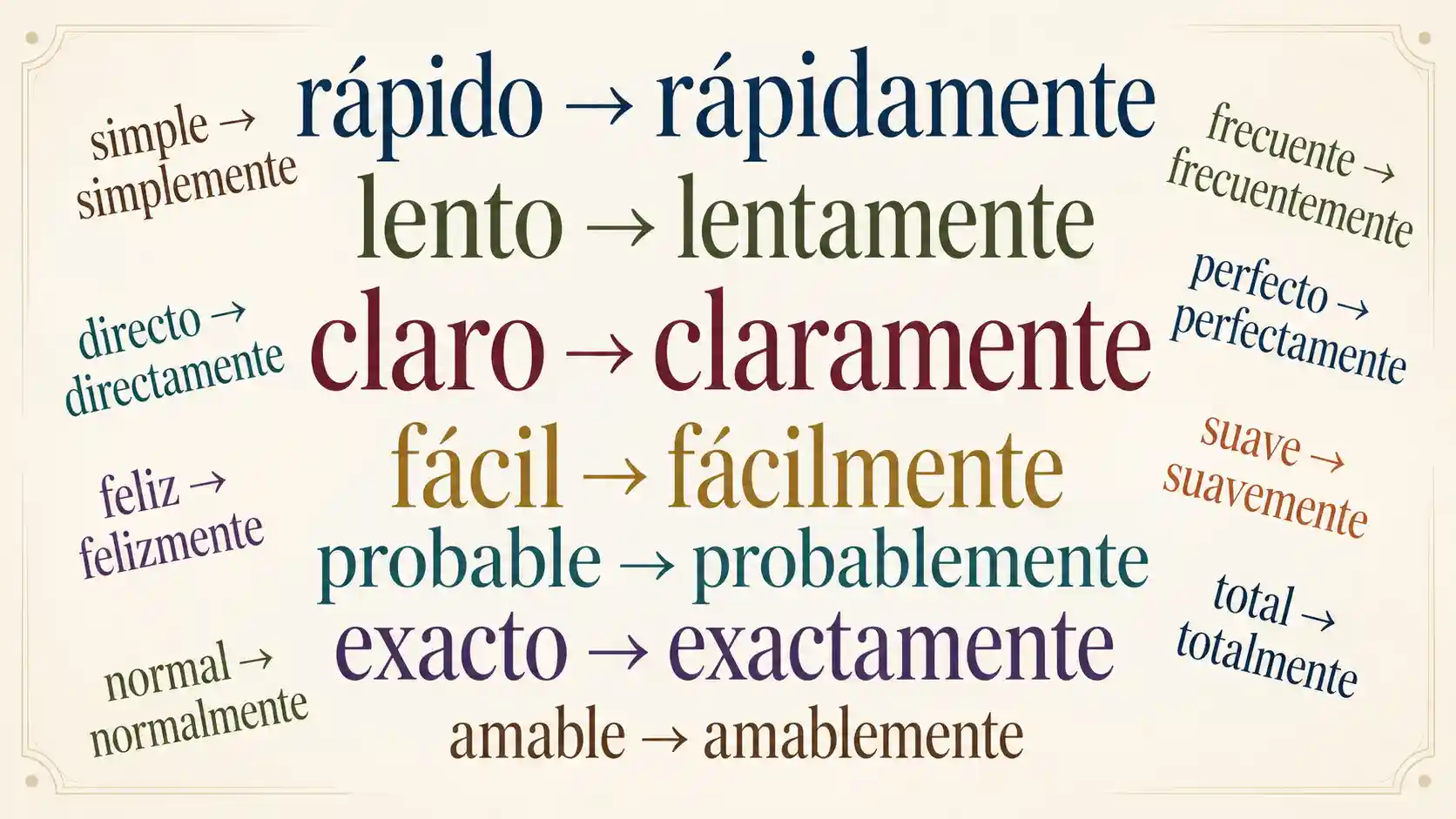
4. -mente is often more explicit
Many adjectives can form adverbs with -mente, especially in formal or precise writing.
claro → claramente · rápido → rápidamente
5. Meaning can change slightly
The short adjective form can sound more direct, natural or idiomatic than the -mente form.
Habla claro.
Speak clearly / be clear.
6. Not every adjective works this way
You cannot freely use every adjective as an adverb. Some combinations are natural, others sound wrong.
trabajar duro is natural; many invented combinations are not.
Common mistakes with adjectives as adverbs
- Making the adverb agree: say Ella habla claro, not Ella habla clara when you mean “clearly”.
- Using adjective-as-adverb everywhere: many cases need a normal -mente adverb.
- Confusing noun description and action description: La respuesta es clara describes the answer; habla claro describes speaking.
- Overformalizing casual expressions: trabajar duro often sounds more natural than a heavier alternative.
- Ignoring regional and register differences: some short adverbial forms are more conversational or idiomatic.
Exercises: Spanish adjectives as adverbs
Try the tasks first. The answers are hidden so you can check yourself after practicing.
Exercise 1: Choose adjective or adverbial use
Decide whether the highlighted word describes a noun/person or the action. Write “adjective” or “adverbial adjective”.
- La explicación es clara.
- Ana habla claro.
- Los chicos trabajan duro.
- La mesa es dura.
Show answer key
- adjective
- adverbial adjective
- adverbial adjective
- adjective
Exercise 2: Correct the agreement mistake
Rewrite the sentence so the adjective-as-adverb stays in the correct fixed form.
- Ella habla clara.
- Las jugadoras juegan limpias.
- Mis amigas trabajan duras.
- María piensa rápida.
Show answer key
- Ella habla claro.
- Las jugadoras juegan limpio.
- Mis amigas trabajan duro.
- María piensa rápido.
Exercise 3: Choose the natural expression
Complete each sentence with a natural short adverbial adjective: claro, duro, limpio, bajo.
- Por favor, habla más ___.
- Tenemos que trabajar ___.
- En este equipo jugamos ___.
- Habla ___, el bebé duerme.
Show answer key
- Por favor, habla más claro.
- Tenemos que trabajar duro.
- En este equipo jugamos limpio.
- Habla bajo, el bebé duerme.
Exercise 4: Use -mente when it fits better
Turn the adjective into a regular -mente adverb. Use the feminine form of the adjective before adding -mente when needed.
- rápido → ___
- claro → ___
- natural → ___
- fácil → ___
Show answer key
- rápidamente
- claramente
- naturalmente
- fácilmente
Related Spanish grammar
Want personal guidance?
If Spanish adjectives, adverbs and natural expressions feel confusing, individual guidance can help you use them correctly in real speaking and writing.
FAQ: Spanish adjectives as adverbs
Can Spanish adjectives be used as adverbs?
Yes. Some Spanish adjectives can function like adverbs in common expressions, for example hablar claro or trabajar duro.
Do adjective-adverbs agree with the subject?
No. When an adjective functions as an adverb, it usually stays in the masculine singular form, as in Ellas hablan claro.
What is the difference between claro and claramente?
Claro in hablar claro is short and idiomatic. Claramente is a regular -mente adverb and can sound more explicit or formal.
Can every Spanish adjective work as an adverb?
No. Many adjective-as-adverb forms are fixed or idiomatic. Some combinations sound natural, while others do not.
Is trabajar duro correct?
Yes. Trabajar duro is a common and natural Spanish expression meaning “to work hard”.

MundoDele – Spanish learning for education, work and intercultural understanding
MundoDele connects online Spanish courses, DELE preparation, Business Spanish and cultural context into a personal Spanish learning platform.
Travel and culture content help you understand Spanish not as abstract grammar, but as language used in real situations, conversations and written communication.