
Seville Bullring Tour – La Maestranza Tickets, Culture & Visitor Guide
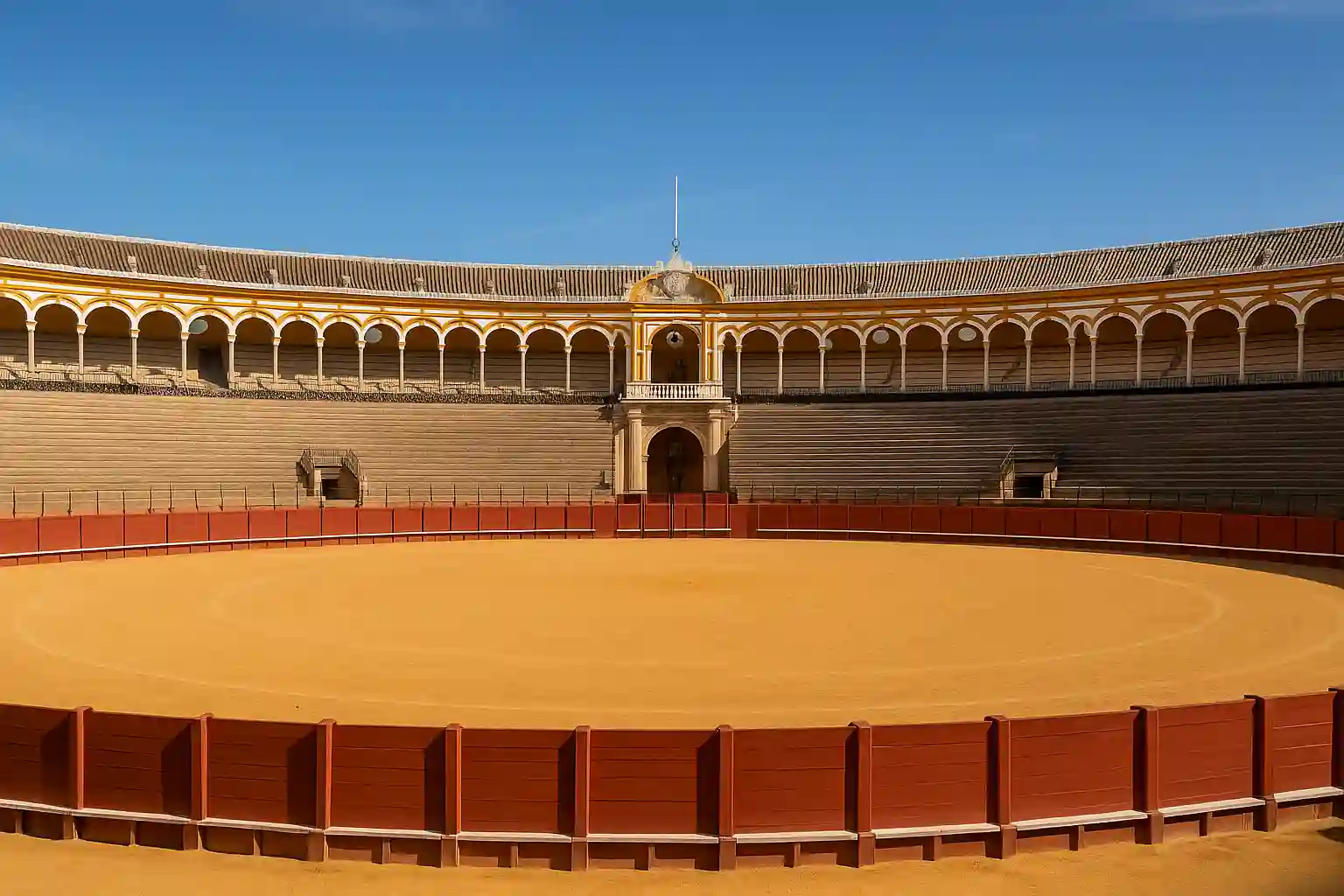
Quick answer: La Maestranza is worth visiting if you want to understand Seville beyond postcards. The visit is strongest as an architectural, historical and cultural tour — not as a recommendation to attend a bullfight. Plan around 60–75 minutes for the bullring and museum, preferably in the morning or late afternoon, then combine it with the Guadalquivir riverfront, Torre del Oro, Triana or tapas in El Arenal.
Best for
Architecture, Spanish culture, history, ethical reflection, Seville identity.
Time needed
45–60 minutes self-guided; 60–75 minutes guided; 2–3 hours with nearby tapas or river walk.
Best time
Morning for cooler temperatures; late afternoon for riverfront light and tapas afterwards.
Tickets, discounts and free entry
- Cultural visit / museum visit: the best option for most travelers. It gives access to the bullring visit route and museum without attending a bullfight.
- Reduced tickets: usually available for seniors, pensioners, students, youth and children in specific age groups. Bring ID or proof of status.
- Children: official categories start from age 7 on the price page; younger children may be treated differently, so check the current official booking page before going.
- Free or special entry: do not rely on old blog mentions of free Wednesday access. Free conditions, if offered, can change. Check the official page shortly before your visit.
- Guided tours: useful if you want context about the architecture, ritual vocabulary, museum objects and the ethical debate. Third-party guided tours often cost more than the official cultural visit.
- Bullfight tickets: these are separate from the museum visit. Attending an actual corrida is a different ethical and emotional decision and is not necessary to understand the monument.
Bullring tours with automatic GetYourGuide images
What you can see inside La Maestranza
The cultural visit usually shows the bullring as both a building and a ritual machine. You are not only looking at an arena; you are walking through a space designed for spectacle, hierarchy, movement, danger and public attention.
The arena and stands
The ruedo is the circular sand arena where the corrida takes place. From the stands you understand the geometry of the building: sightlines, shade and sun, social hierarchy and how the audience surrounds the action.
The museum
The museum displays costumes, posters, paintings, photographs and historic objects. It is useful even for visitors who do not support bullfighting, because it shows how deeply the practice entered visual culture.
The chapel
The Capilla de los Toreros is one of the most revealing spaces: before a bullfight, matadors traditionally pass through a Catholic devotional space. It shows the mixture of ritual, fear, faith and public performance.
Patio de Caballos and internal spaces
Depending on the route and schedule, visits may include the horse patio, inner corridors and areas connected to the preparation of the spectacle. Access can change on event days.
Puerta del Príncipe
The Prince’s Gate is the symbolic exit of triumph. For bullfighting culture it represents the highest public recognition: a matador carried out through this gate has achieved exceptional status.
The building itself
The yellow-and-white exterior, covered galleries, irregular oval form and late-Baroque identity make the monument part of the visual grammar of Seville, especially in the Arenal district.
Architecture: what makes the bullring special?
La Maestranza is not a single-architect, single-decade monument. Its history is slow, layered and unusually Sevillian. The Real Maestranza began replacing temporary wooden bullrings with a permanent stone building around the mid-18th century, and the construction process stretched across roughly 120 years before completion in 1881.
Several architects and master builders shaped the building. The early stone project was associated with Francisco Sánchez de Aragón, later construction stages involved Pedro de San Martín and Vicente de San Martín, and later reforms included figures such as Aníbal González. This explains why the building feels coherent but not mechanically uniform: it grew through phases rather than appearing as one finished plan.
Architecturally, its importance lies in the combination of late-Baroque Sevillian identity, unusual oval geometry, covered seating, ceremonial gates, white-and-ochre color language and its integration into El Arenal, the old port district between the Cathedral and the Guadalquivir.
The philosophy of bullfighting: art, ritual and controversy
To understand bullfighting in Seville, it helps to separate three layers: the physical act, the cultural language and the ethical problem. The physical act involves violence and the death of the bull in the traditional Spanish corrida. That is why the practice is strongly criticized today and why many travelers prefer to visit the building without attending an actual fight.
The cultural language is different. Defenders of bullfighting have traditionally described it as a ritual of courage, rhythm, control and exposure to death. The matador is not understood only as an athlete, but as a performer whose value lies in stillness, timing, composure and the ability to create form under danger. Critics answer that aesthetic language cannot erase animal suffering.
This tension is exactly why La Maestranza is culturally important. It is not a neutral monument. It forces visitors to see how beauty, violence, religion, class, public spectacle and local identity can be tied together in one place.
MundoDele reading: You do not have to approve of bullfighting to understand why it mattered. A thoughtful visit asks better questions: What did Seville celebrate? What did it turn into art? What does it now question? And how does a city preserve a monument connected to a practice many people no longer accept?
Where bullfighting appears in culture, books and music
- Literature: Ernest Hemingway helped internationalize the image of Spanish bullfighting through The Sun Also Rises and Death in the Afternoon. His writing treated the corrida as a ritual of courage, style, fear and mortality.
- Painting and visual culture: Goya and Picasso both engaged with bullfighting imagery. Posters, engravings and museum objects show how the bullring became part of Spain’s visual identity.
- Music and opera: Bizet’s Carmen, set in Seville, made the bullfighter figure internationally recognizable through Escamillo and the famous “Toreador” motif.
- Flamenco and popular song: the worlds of bullfighting and flamenco often overlapped socially and emotionally: bravery, loss, public performance, mourning and intensity are shared motifs, even when the art forms are different.
- Local identity: in Seville, the Maestranza is connected to the April Fair, the Arenal neighborhood, religious brotherhoods, local tabernas and an older urban culture where horse, church, port and spectacle were intertwined.
When was bullfighting at its height?
Modern professional bullfighting took shape in the 18th century, especially through the shift from aristocratic horseback spectacle to foot-based matador performance. Figures associated with Ronda and Seville shaped the technical and stylistic schools of modern bullfighting.
Its broad cultural high point came later, especially from the late 19th into the early 20th century, when bullfighting was deeply visible in newspapers, posters, cafés, literature, painting and public urban life. Seville, Madrid and Ronda became symbolic reference points, while Andalusia remained one of the strongest regions of the tradition.
Today, bullfighting continues in parts of Spain, Portugal, southern France and some Spanish-speaking countries, but public attitudes are divided and generational support has weakened in many places.
Best time to visit and how long to stay
Best time of day
Morning is best in warm months. Late afternoon is best if you want to continue to Torre del Oro, the riverfront or tapas in El Arenal.
How long to plan
60–75 minutes for a guided cultural visit. Add 30–45 minutes for photos and museum reading if you are especially interested in architecture or cultural history.
Busy days
Event days, Feria de Abril, San Miguel season and spring weekends can be busier or have reduced visiting hours. Cultural visits can close earlier on bullfight days.
Rain or cold?
Yes, it can still be worth it. Much of the visit includes covered or indoor spaces. On rainy days the museum and architecture become a practical alternative to fully outdoor sightseeing.
Is it suitable for children, seniors or sensitive visitors?
- Children: the building is easy to visit physically, but the topic may raise questions about animal suffering. For younger children, explain beforehand that this is a historical and cultural place, not a simple entertainment stop.
- Seniors: the visit is generally manageable, but check accessibility if mobility is limited. Seating and shaded areas help, but event-day crowds can be tiring.
- Animal-sensitive visitors: avoid actual bullfights if the topic is distressing. The museum visit is less graphic, but it still explains a violent tradition.
- Architecture-focused visitors: the tour can be worthwhile even without interest in bullfighting, because the building is one of Seville’s major late-Baroque civic monuments.
What to do nearby
The bullring sits in El Arenal, between the Cathedral area and the Guadalquivir river. That makes it easy to combine with several classic Seville stops.
Torre del Oro and the riverfront
Walk five minutes south to Torre del Oro, then continue along the Guadalquivir. This is the easiest and most natural post-visit route, especially near sunset.
Triana Bridge and Triana
Cross Puente de Triana for ceramics, tapas and a more neighborhood-based Seville atmosphere. This works well after a late-afternoon bullring visit.
Cathedral, Giralda and Alcázar
The Cathedral area is roughly 10–12 minutes away on foot. The bullring pairs well with a broader historic-center day if you pace it carefully.
Archivo de Indias
A good cultural pairing: the bullring reflects public ritual and spectacle; the Archivo de Indias reflects Seville’s imperial and transatlantic role.
Hospital de la Caridad
A quieter Baroque site nearby, useful if you want religious art and charity history without the crowds of the Cathedral.
El Arenal streets
Calle Adriano, Antonia Díaz and the streets around the arena connect taurine culture, brotherhoods, tapas bars and old port identity.
Combine it with another Seville tour
Good places to eat nearby
El Arenal is one of Seville’s strongest food areas: old taverns, bullfighting bars, seafood, tapas, abacerías and newer restaurants sit close to the river and the historic center.
Bar El Baratillo
A classic choice very close to La Maestranza. Good if you want the local connection between tapas, Arenal and bullfighting atmosphere.
Casa Pepe Hillo
A taurine-themed tapas bar on Calle Adriano with traditional dishes such as carrillada, croquetas, pescaíto, cola de toro and fried aubergine with salmorejo and honey.
Mercado del Arenal
A flexible choice if you prefer informal food, market atmosphere or mixed small plates instead of a full restaurant meal.
Bodega / tapas route in El Arenal
For a more local route, walk toward Casa Moreno, Bodeguita Antonio Romero or traditional bars around Calle Arfe and Calle Harinas. Reserve if going on a weekend night.
Spanish learner tip: bullring and architecture vocabulary
If you are learning Spanish, La Maestranza is useful because it combines architecture, local identity and highly specific cultural vocabulary. You do not need to use these words to support bullfighting; you can use them to understand signs, guides and local conversation.
| Spanish | English | Useful phrase |
|---|---|---|
| la plaza de toros | bullring | La plaza de toros está en El Arenal. |
| el ruedo | arena | El ruedo está cubierto de albero. |
| el tendido | seating section / stands | El tendido de sombra suele ser más caro. |
| la barrera | front barrier seating | Las localidades de barrera están cerca del ruedo. |
| el burladero | protective barrier | El torero se refugia detrás del burladero. |
| la capilla | chapel | La capilla muestra la dimensión religiosa del ritual. |
| la fachada | façade | La fachada blanca y amarilla es muy sevillana. |
| el arco | arch | La puerta tiene un gran arco. |
| la galería cubierta | covered gallery | La galería cubierta da sombra al público. |
| el traje de luces | matador’s embroidered costume | El museo conserva antiguos trajes de luces. |
FAQ
Is the bullring visit the same as attending a bullfight?
Can I visit if I am against bullfighting?
What should I combine the bullring with?
Is the visit good in bad weather?
Is it suitable for children?
Where is the bullring located?
Source note: Ticket categories and opening hours should always be checked on the official Plaza de Toros de Sevilla visit page before booking. Architecture and history are based on the Real Maestranza construction history and Visit Sevilla’s monument profile. Cultural context is informed by standard histories of bullfighting and by the monument’s own museum/visit framing.