
Córdoba & Carmona Day Trip from Seville – Mezquita, Al-Andalus Culture & Spanish-Arabic Heritage
Quick Answer: Is a Córdoba Day Trip from Seville Worth It?
Yes — especially if you want to understand Andalusia beyond Seville. Córdoba was one of the great cities of medieval Al-Andalus, and the Mezquita-Catedral is one of the most important monuments in Spain.
The best version of the trip gives you enough time for the Mezquita-Catedral, the Jewish Quarter, the Roman Bridge, a simple Cordoban lunch and, if included, a shorter stop in Carmona. If you want depth, Córdoba alone deserves a full day.
Tour Options, Tickets & Transport from Seville
- Organized day tour: The easiest option if you want transport, guide commentary and a fixed route. Many tours combine Córdoba with Carmona, which gives variety but reduces free time in Córdoba.
- Independent train trip: Best for travelers who want more time in Córdoba. High-speed trains from Sevilla-Santa Justa make Córdoba easy as a full-day visit, but you need to book your own Mezquita-Catedral ticket and plan the route yourself.
- Rental car: Useful if you want to include Carmona, Medina Azahara or smaller villages, but less useful inside Córdoba’s historic center because much of the old city is pedestrian and parking can be inconvenient.
- Mezquita-Catedral ticket logic: Official admission includes the main monument. The free Monday–Saturday early visit is useful for budget travelers, but it is short, quiet, and not ideal if you want a slower cultural visit with audio guide or explanation.
Why Córdoba Was So Important Then — and Why It Still Matters Today
Córdoba was not just another Andalusian city. Under Islamic rule it became the capital of Al-Andalus and later the seat of the Caliphate of Córdoba. In the 10th century, it was one of the major urban centers of medieval Europe: a place of administration, scholarship, craftsmanship, religious life and long-distance cultural exchange.
The city’s importance came from its position between the Guadalquivir valley, North Africa and the wider Mediterranean. Córdoba connected political power, trade, agriculture, religious learning and refined urban life. The Mezquita-Catedral still makes that visible: it began as a great mosque, was expanded under successive rulers, and later became a cathedral after the Christian conquest.
Today Córdoba matters for a different reason. It is a living heritage city where visitors can still read the layers of Roman, Islamic, Jewish and Christian history in one compact center. The historic center, the Mezquita-Catedral and Medina Azahara nearby show how power, faith, language, architecture and daily life overlapped in Andalusia.
What You Must See During the Excursion
If time is limited, prioritize these places in Córdoba:
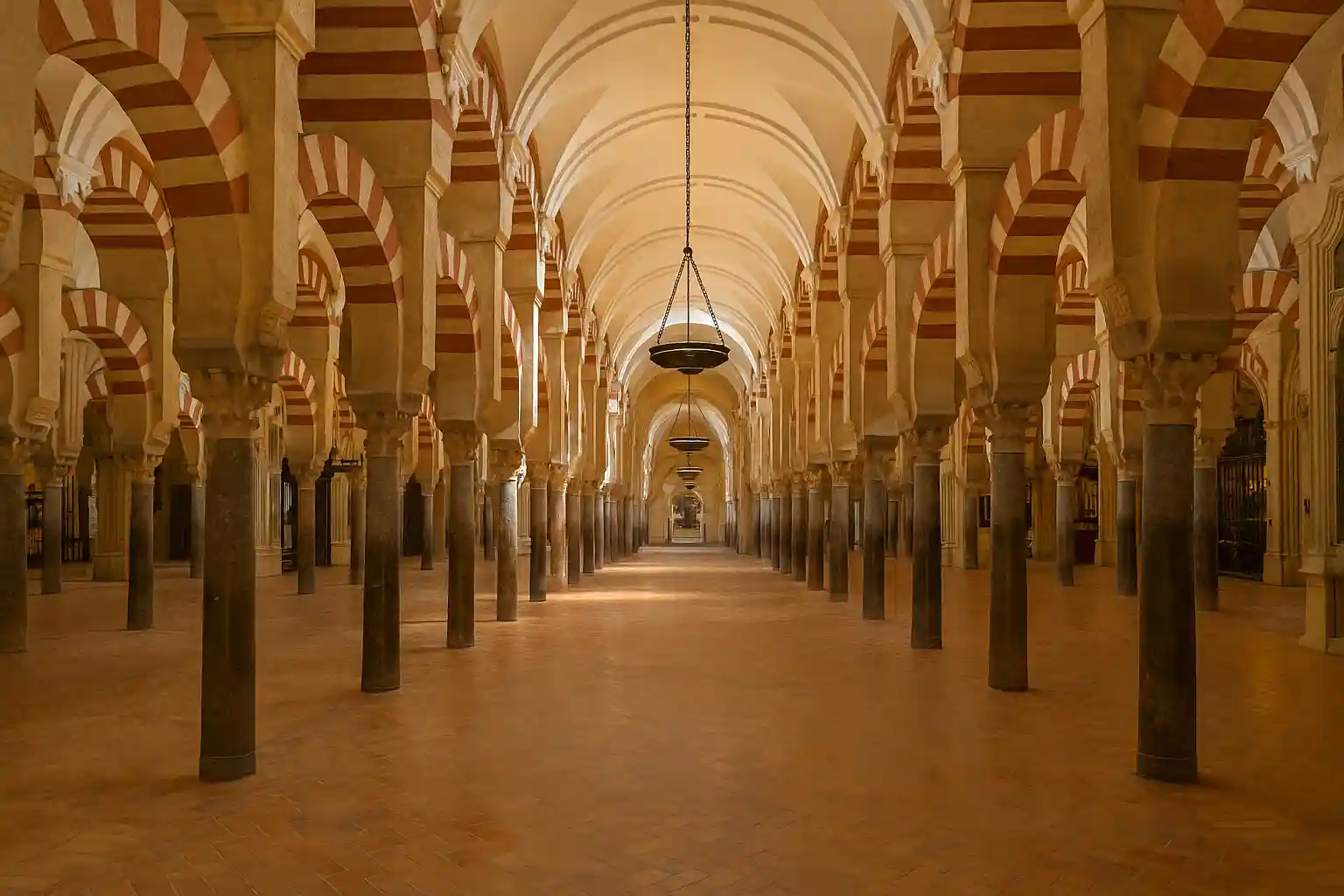
- Mezquita-Catedral: The essential stop. Do not rush it. Walk slowly through the forest of red-and-white arches, then compare the Islamic prayer hall with the later Christian cathedral inserted into the center.
- Patio de los Naranjos: The courtyard of orange trees is part of the experience, not just an entrance space. It helps you understand water, shade and transition in Islamic and Andalusian architecture.
- Mihrab and maqsura area: The most refined part of the former mosque, with rich decoration and a strong sense of sacred orientation.
- Jewish Quarter: White lanes, small patios, flower pots and the synagogue area show Córdoba’s medieval urban fabric beyond the monument itself.
- Roman Bridge and river view: Cross or at least walk onto the bridge to see the historic center from the Guadalquivir side.
- Alcázar de los Reyes Cristianos: Add this if time allows. The gardens and fortress connect Córdoba to later Christian power and royal presence.
The Moorish Influence: Architecture, Water, Shade and Urban Life
The Moorish and Andalusí influence in Córdoba is not limited to decoration. It appears in the way spaces are organized: courtyards, water channels, gardens, shaded transitions, narrow streets and interior life behind modest facades. The city teaches you that architecture in hot climates is also climate intelligence.
The Mezquita-Catedral’s double arches, reused columns, geometric rhythm and filtered light create a space that feels almost endless. The Patio de los Naranjos shows another principle: shade, water and trees make the city livable. In the Jewish Quarter, the same logic appears on a smaller domestic scale — patios, white walls, plants and quiet interiors.
Spanish and Arabic: A Small Language Walk Through Córdoba
Spanish is a Romance language, while Arabic is a Semitic language, so they are not “sister languages.” Their connection comes mainly through history: centuries of Arabic and Hispano-Arabic presence in Al-Andalus left many loanwords in Spanish, especially in food, agriculture, water management, architecture, science and administration.
| Spanish word | Arabic / Hispano-Arabic origin | Meaning for travelers |
|---|---|---|
| aceite | from Arabic/Hispano-Arabic roots related to az-zayt | olive oil — central to Andalusian cooking |
| azúcar | from Arabic sukkar through Hispano-Arabic | sugar — useful for pastries and sweets |
| alcalde | from Arabic qāḍī, judge | mayor — a word from administrative life |
| alcázar | from Arabic al-qaṣr, palace or fortress | fortified palace — common in Andalusian city names |
| ojalá | from Hispano-Arabic wa šá lláh | “hopefully” — one of the most beautiful everyday Spanish words |
| acequia | from Arabic roots linked to irrigation channels | water channel — important in gardens and agriculture |
| almohada | Arabic-origin word in Spanish | pillow — everyday vocabulary with historical depth |
| albahaca | Arabic-origin word in Spanish | basil — food and market vocabulary |
Spanish learner tip: In Andalusia, many Arabic-origin Spanish words begin with al- because Arabic uses al as a definite article. That is why words such as alcázar, alcalde, albahaca and almohada feel like they belong to the same historical layer.
Try using this sentence during your visit: “Me interesa la influencia árabe en la arquitectura y en el vocabulario español.” It means: “I am interested in the Arabic influence on architecture and Spanish vocabulary.”
Food and Drink: What Córdoba Tastes Like
Córdoba’s food also reflects Andalusia’s layers: olive oil, almonds, bread, garlic, garden vegetables, slow-cooked meats and sweet pastries. The influence of Al-Andalus is not always a direct recipe line; it is often a shared taste for ingredients such as olive oil, citrus, almonds, honey, spices, irrigation-grown vegetables and sweets.
- Salmorejo cordobés: Cold tomato, bread, garlic and olive-oil cream, usually served with egg and jamón. Essential in Córdoba.
- Flamenquín: Rolled pork and ham, breaded and fried. Heavier, but very typical.
- Rabo de toro: Slow-cooked oxtail stew, linked to the city’s bullfighting tradition and old taberna culture.
- Berenjenas con miel: Fried eggplant with honey or cane syrup — a good bridge between savory and sweet Andalusian taste.
- Mazamorra: Older cold almond-and-bread cream, sometimes seen as a predecessor or relative of salmorejo.
- Pastel cordobés: Sweet pastry often filled with cabello de ángel, a classic local dessert.
- Montilla-Moriles wine: Local wine tradition, especially fino-style and generous wines.
- Café or mint tea after lunch: Good for slowing down after the Mezquita and before continuing through the old quarter.
Carmona: Why the Stop Can Still Make Sense
Carmona is not Córdoba’s equal in monument weight, but it works well as a short historical counterpoint. It sits on a hill between Seville and Córdoba, with Roman remains, Moorish fortification logic and a quiet old town that feels less crowded than Córdoba.
- Puerta de Sevilla: A strong city-gate and fortress complex that shows Carmona’s defensive position.
- Roman Necropolis: One of the most interesting archaeological stops if your tour includes it or you visit independently.
- Old town streets: White houses, churches, small bars and a slower rhythm than Seville or Córdoba.
- Parador viewpoint: Useful for seeing the plain and understanding why Carmona mattered strategically.
How to Plan the Day Without Losing the Meaning
The biggest mistake is treating Córdoba as a quick photo stop. The city needs a slower rhythm because the meaning is in the layers: mosque, cathedral, courtyard, river, Jewish Quarter, food, language and memory.
- If you book a group tour: Accept that you are getting an introduction. Focus on listening well, walking slowly inside the Mezquita-Catedral and using free time for one good local dish rather than chasing too many minor sights.
- If you travel independently: Go early, book the Mezquita-Catedral, leave time for lunch, and walk the Roman Bridge in late afternoon if possible.
- If you love history: Córdoba deserves a full day or overnight stay. Medina Azahara should be added on a second visit, not forced into an already full day unless you have a private tour.
- If you study Spanish: Use this trip as a vocabulary day: architecture, food, water, religion, city life and Arabic-origin words.
Suggested Itinerary
Morning departure from Seville, Carmona stop, arrival in Córdoba, guided Mezquita-Catedral visit, short walk through the Jewish Quarter, lunch or tapas, Roman Bridge view, return to Seville in the evening.
Early train to Córdoba, Mezquita-Catedral first, slow walk through the Jewish Quarter, salmorejo lunch in a taberna, Alcázar or Roman Bridge, coffee or pastry, evening train back to Seville.
Quick Logistics
Travel time: By high-speed train, Seville to Córdoba is usually under one hour. By coach or tour bus, the day is longer because of pickup, road travel and the Carmona stop.
How much time to allow: A full excursion takes around 9–11 hours from Seville. In Córdoba itself, allow at least 90 minutes for the Mezquita-Catedral and 2–3 additional hours for the Jewish Quarter, Roman Bridge, lunch and orientation.
Best season: March–May and September–November are the most comfortable. July and August can be extremely hot in Córdoba, so morning visits, shade and water become essential.
What to bring: Comfortable shoes, water, sun protection, a light layer for air-conditioned transport, charged phone, and some cash for smaller bars or local purchases.
FAQ
Why is Córdoba important for understanding Spain?
What Arabic-origin Spanish words are useful in Córdoba?
What should I eat during a Córdoba day trip?
Is Córdoba better as a day trip or overnight stay?
Should I include Carmona?
Is the Mezquita-Catedral free at any time?
This page is designed for travelers who want more than logistics. Córdoba is a place where architecture, language, food and memory meet. Visit the Mezquita-Catedral, but also listen for the words, tastes and city forms that still carry the legacy of Al-Andalus.