
Sagrada Família Travel Guide: Light, Stone & the City of Gaudí
What is the Sagrada Família and why is it worth visiting?
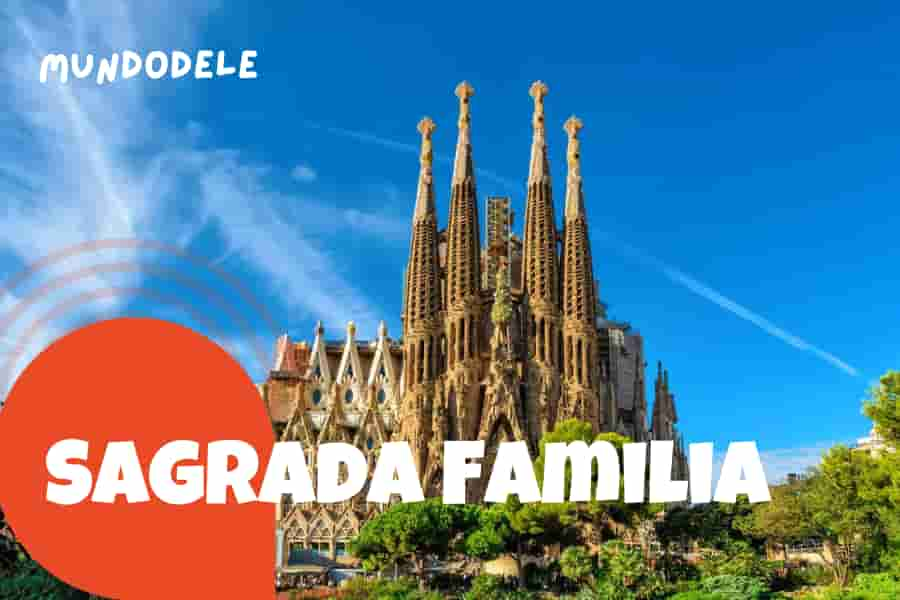
The Sagrada Família is Barcelona’s most famous basilica and Antoni Gaudí’s unfinished masterpiece. It is worth visiting because it combines architecture, light, symbolism and city history in one place: three expressive façades outside, a forest-like nave inside, and one of the clearest examples of how Gaudí turned nature, geometry and faith into built form.
Questions this page answers
- How do I visit the Sagrada Família in Barcelona?
- How long does a Sagrada Família visit take?
- Do I need timed tickets for the Sagrada Família?
- Which Sagrada Família tower should I choose?
- What is the best time to visit the Sagrada Família?
- What can I do near the Sagrada Família after my visit?
- Where can I eat near the Sagrada Família?
- What Spanish phrases do I need at the entrance?
Why this Sagrada Família guide is more useful than a standard monument page
You get the monument and the logistics
Not only history and architecture, but also timed-entry logic, tower choices, photography timing, nearby metro access, and how to structure the visit without stress.
You also get the area around the basilica
A Sagrada Família visit works much better when you know where to walk afterwards, where to eat, and which nearby sights fit naturally into the same route.
You learn travel Spanish in a real situation
The mini entrance conversation helps you ask for the right entrance, understand directions, and feel more confident at a security checkpoint or ticket line.
You can turn one stop into a fuller Gaudí day
With Park Güell, Sant Pau and Barcelona activity ideas, the page works as a compact mini-itinerary, not just a static article about one church.
Walk up from the Eixample grid and the Sagrada Família appears like a mountain. It is both a basilica and a building site, a work begun in 1882 that has taught generations of architects to think in curves, light, and stone that moves like water. Even if you have seen photos, the first steps onto the square tell you your expectations were too small.
A Short History
The commission began modestly: a neo-Gothic church for a spiritual association. When Antoni Gaudí took over in 1883, he rewrote the brief. Over four decades, he turned a conventional plan into a complex synthesis of geometry and theology. Nature informed every decision: catenary arches shaped by gravity, branching columns like trees, faceted stones that play with sun and shadow. When Gaudí died in 1926, only a fraction stood. Bombs, politics, and money slowed progress, but the idea endured. What you see now is a long conversation between Gaudí’s models and the craft of successive teams who learned to read them.
Three Façades, Three Moods
The Sagrada Família reads like a book with three covers. Each façade carries a mood and a moment—Nativity (hope and birth), Passion (suffering and stark truth), and Glory (the road home). You can understand the basilica by walking the perimeter before you go in.
Nativity Façade: Verdant, Crowded, Alive
The only façade completed in Gaudí’s lifetime is dense with ornament—birds perched on vines, angels tucked into niches, the Holy Family sheltered under a canopy that seems to grow from stone. It faces the rising sun and feels like spring: abundance, detail, life layered on life. Photographers love its shadows; historians love its fidelity to Gaudí’s hand.
Passion Façade: Hard Light, Sharp Edges
Josep Maria Subirachs’ mid–late 20th-century sculptures shock after the Nativity. Figures are angular, emaciated, and set in harsh planes of stone; columns lean like bones. At sunset the light carves their edges and the story is unmistakable. Subirachs divided opinion at first, but the contrast makes sense: Easter is not spring without Good Friday.
Glory Façade: The Grand Threshold
The largest and most complex entrance will be the visitor’s main approach in the long run: seven gates for the sacraments, a broad stairway symbolizing the ascent, and a program about the journey of the soul. Work continues in phases, and you read the future in scaffolds: a city still building its own parable.
Inside: A Forest of Light
Step from the façades into a nave that feels outdoors. Columns branch like trunks and lean slightly to carry load like living things. The ceiling is a canopy of hyperboloids—starry, porous, and engineered for air and acoustics. Morning light pours green-blue from the Nativity side; late light fires amber-red from the Passion side. You do not “look at” this interior. You stand, you turn, and you feel how color edits time.
Reading the Interior
- Columns: different stones mark different loads—Montjuïc sandstone, basalt, and granite. Capitals are not leaves, but geometry.
- Windows: color grading is intentional—cool for dawn, warm for dusk; the nave moves with the sun.
- Sound: the vaults diffuse echoes; choral music spreads like mist rather than beam.
Towers & Views
The silhouette of the Sagrada Família is a crown of towers—eventually eighteen. Twelve for the apostles, four for the evangelists, one for Mary, and the tallest for Christ. Elevators take visitors partway up select towers on the Nativity or Passion sides; stairs spiral down. Views cut across the Eixample grid to the sea and the hills. Bring a small bag and steady feet—landings are narrow, the stone close.
How to Visit
The basilica runs on timed tickets and careful flows. Decide first: do you want just the basilica, basilica + tower, or a guided visit that stitches stone into story? Morning visits favor cool light, afternoon favors the nave’s warm blaze. Sundays add services—beautiful, but with access limits.
Tickets & Options
- Timed entry tickets for basilica access with audio guide or guided visit options.
- Tower add-on: choose Nativity for softer views or Passion for sharper light and modern lines. Weather can affect openings.
- Combo tours link Park Güell and Sagrada—useful for first-timers with tight schedules.
Best Times & Photography
For interior color, aim for clear mornings or late afternoons. Overcast days gift even light for sculpture and façades. Tripods are a no; patience is a yes. Move your feet: small shifts make columns align and windows bloom.
Etiquette & Access
- It’s a working basilica—modest dress helps, especially during services.
- Silence around chapels; step aside for worshippers.
- Backpacks are checked; strollers park in designated zones; tower descents are stair-only.
Practical Planning
The Sagrada Família sits on spacious squares with shade and cafés nearby. Metro stops on lines L2 and L5 put you steps away. Allocate 90–120 minutes for the basilica; towers add 30–45 minutes. If you pair with Park Güell the same day, book morning for one, late afternoon for the other.
Quick Planner
- 60–90 min: façade loop, nave, short museum stop.
- +30–45 min: one tower, with elevator up and spiral stairs down.
- +20 min: museum models—Gaudí’s hanging chain studies explain the curves.
The Workshop & Museum
Downstairs, plaster models rebuilt after civil-war damage show Gaudí’s method: gravity-made forms, inverted like negatives to become soaring vaults. You see tools, shards of trencadís, and photos of generations of artisans at work. It’s the best room for understanding how analog logic became digital fabrication without losing the hand.
Geometry, Nature, Theology
Gaudí’s genius was to make structure carry meaning. Columns are not “tree-like” as décor—they branch because branching distributes loads. Light is not “pretty”—it tracks the day, the liturgical calendar, and the emotional arc from dawn to dusk. Letters carved into portals are not slogans— they’re scripts you read in sunlight. This is engineering as devotion.
Materials
Local stone, imported granites, and modern reinforced concrete coexist. Where Montjuïc stone once bore loads, denser stones now share the work; new pieces are CNC-cut then hand-finished, so edges remain alive. The goal is continuity, not imitation.
Music & Sound
The pipe organ—voiced for the nave’s long reverb—sounds different morning to evening. If you chance on a rehearsal, linger by a column base: the stone carries tone like a tree trunk humming in wind.
Around the Basilica
Streets radiate with cafés, bakeries, and viewpoints. For classic framing, step to Plaça de Gaudí on the Nativity side for reflections in the pond, then cross to Plaça de la Sagrada Família on the Passion side for evening silhouettes. If you still have energy afterwards, continue along Avinguda de Gaudí to the Recinte Modernista de Sant Pau, one of the easiest and best nearby extensions.
Families
Kids read the place as a puzzle—find the turtles at column bases, count fruit clusters on the towers, spot the soldier with the dice on the Passion façade. Ear defenders help sensitive ears during organ rehearsals; snacks are best outside on the squares.
Accessibility
Elevators bring visitors to key levels; staff coordinate priority queues. Tower descents are stairs-only, narrow, and not suitable for everyone. The nave floor is largely level; accessible restrooms are available. Audio guides offer multiple languages and easy pacing.
When to Go
- Mar–May: soft light, manageable lines—ideal for first visits.
- Jun: long hours; book towers early.
- Jul–Aug: peak demand—choose early or late slots and expect sun on façades.
- Sep–Oct: warm evenings, rich interior color.
- Nov–Feb: crisp skies, fewer crowds, powerful noon light in the nave.
Travel Ethos
The Sagrada Família is craft under stress: millions of hands, feet, and flashes each year. Keep space between you and the stone, be brief at railings, and lower voices. The basilica will outlast us if we move with care.
Pair with the Wider City
To read Gaudí whole, pair the basilica with Park Güell’s terrace and Casa Batlló’s flowing rooms. Beyond Gaudí, step into the Gothic Quarter’s Santa Maria del Mar for a contrasting Gothic nave, or climb to the bunkers at Turó de la Rovira for a city-wide frame of the towers. For planning the bigger loop—markets, sea, Modernisme—start here: Barcelona Guide.
Essential Checklist
- Timed ticket and tower slot, if adding views, on your phone.
- Small bag; water for outside queues; lens cloth for glass.
- Shoulders covered if attending services; quiet shoes for towers.
- Patience—the best photos come when you wait one more minute.
What to Do Near the Sagrada Família
Stroll along Avinguda de Gaudí
This elegant pedestrian avenue connects the Sagrada Família with the Recinte Modernista de Sant Pau. It is one of the easiest and most pleasant post-visit walks in the area.
Visit Sant Pau
If you still want architecture after Gaudí, Sant Pau is the best nearby continuation: colorful modernist pavilions, quieter atmosphere, and a very different face of Barcelona’s design heritage.
Pause at Plaça de Gaudí
The pond and greenery give you one of the classic outside views. It is especially good early in the day or when the basilica lights turn warmer in the evening.
Sit down and watch the façade light
One of the best things here is simply to slow down. Many visitors rush in and out, but the square itself is part of the experience.
Where to Eat Near the Sagrada Família
Kala
A good pick if you want a lighter stop before or after the visit. Useful for breakfast, brunch or coffee without turning the stop into a heavy lunch.
El Glop Gaudí
A solid nearby option if you want more traditional Catalan food rather than only tourist tapas. Good when you want a proper sit-down meal.
Madre Taberna Moderna
A practical terrace option on one of the area’s best walking streets. Good if you want to combine lunch or dinner with the Sant Pau walk.
Sagradas Tapas
A straightforward choice for tapas near the basilica. Good if you want something easy and recognizably Spanish after a long sightseeing block.
El Tastet de l'Artur
A good option if you want a more local lunch or dinner feel rather than a quick tourist snack. Useful when you want to extend the visit into a calmer meal.
Tip: for the most relaxed sequence, visit the basilica first, then walk toward Avinguda de Gaudí and choose a restaurant there on the way to Sant Pau.
GetYourGuide Activities Near the Sagrada Família
These activity cards are loaded directly from GetYourGuide and may change depending on availability, language and current offers.
5 Curiosities About the Sagrada Família
Construction started in 1882
The basilica is older than many visitors intuitively think. What people see today is the result of more than a century of slow, layered construction.
Gaudí saw only part of it completed
The architect died in 1926, long before the basilica approached its current form. The Nativity side is the part most closely tied to his lifetime.
The interior works like a stone forest
The tree-like effect is not decoration only. The branching columns are also structural logic, which is part of why the interior feels so organic.
The project imagines 18 symbolic towers
The final tower plan is not random decoration. The full symbolic program includes the apostles, evangelists, Mary and Christ.
The light changes the building every hour
Morning and late afternoon feel almost like two different churches inside. If light matters to you, your time slot changes the whole experience.
Mini Spanish Conversation: Finding the Entrance
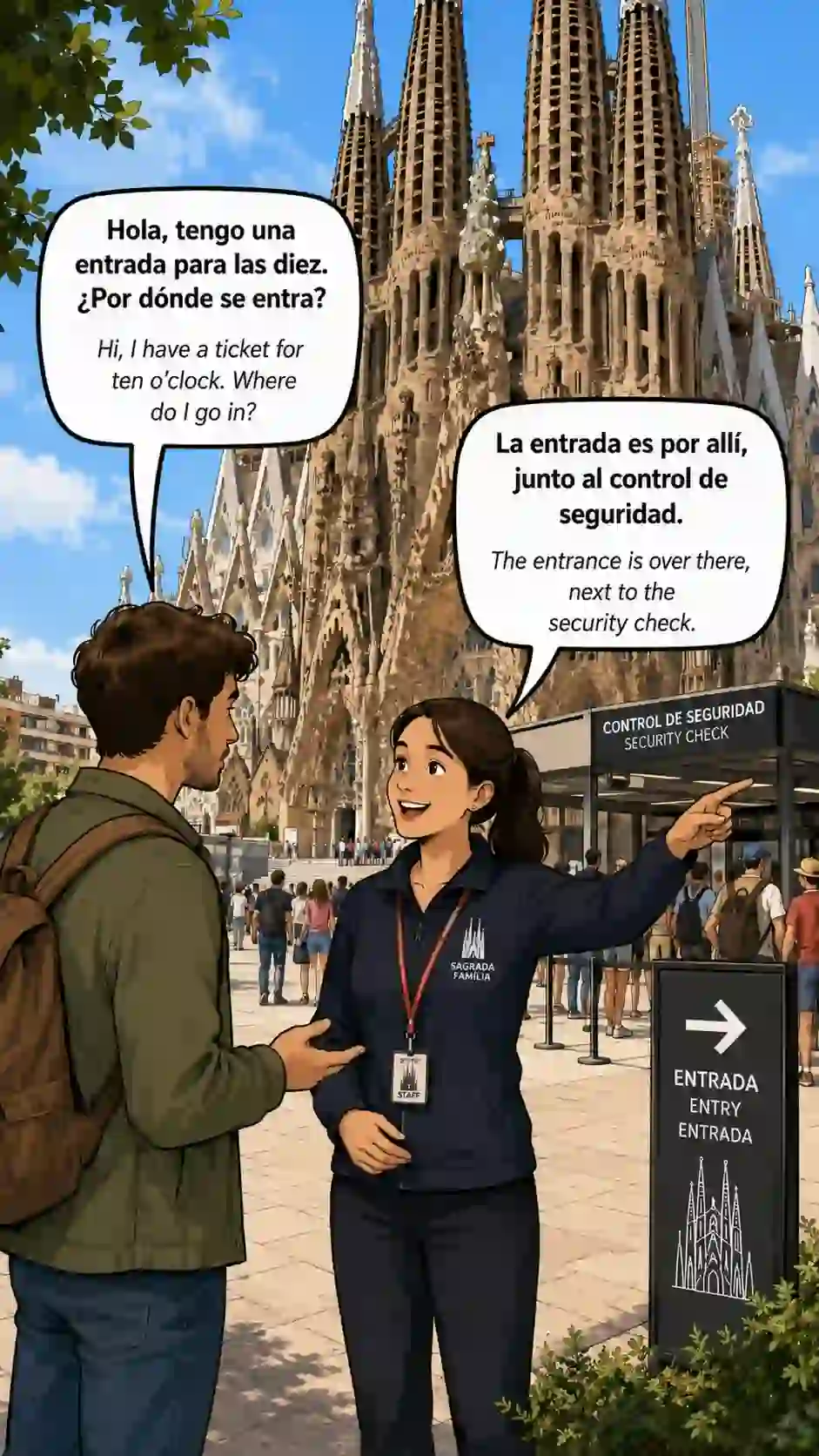
ticket / entrance
Which way / where exactly?
next to
security check
to have ready
on your phone
Extra useful phrases: ¿Hay una fila para entradas con horario? (Is there a line for timed tickets?) · ¿La audioguía está incluida? (Is the audio guide included?) · ¿Dónde empieza la visita de la torre? (Where does the tower visit start?)
Map: Sagrada Família and Nearby Stops
The map highlights the core visit area: the basilica, Plaça de Gaudí, Avinguda de Gaudí, Sant Pau and useful nearby food stops.
FAQ – Sagrada Família
How long should I plan for the Sagrada Família?
Do I need to book in advance?
Which tower should I choose?
What can I do near the Sagrada Família after my visit?
Where can I eat near the Sagrada Família?
Is it suitable for children?
Can I attend Mass?
What’s the best time for photos?
About MundoDele

MundoDele
MundoDele combines Spanish learning, travel culture and practical language situations for learners who want to understand Spain and Latin America through real places, real conversations and useful context.