
Spanish Pronunciation: Sounds, Letters & Speaking Practice
Learn the core rules of Spanish pronunciation: vowels, consonants, silent letters, rolled r, stress, accents and clear speaking rhythm.
Why learn Spanish pronunciation with MundoDele?
MundoDele teaches pronunciation as part of real communication. You do not only learn isolated sounds: you learn how Spanish rhythm, spelling and stress help you speak more clearly and understand native speakers better.
How does Spanish pronunciation work?
Spanish is not pronounced like English. The good news is that Spanish sound-spelling patterns are much more consistent. Once you know the main rules, new words become easier to read aloud.
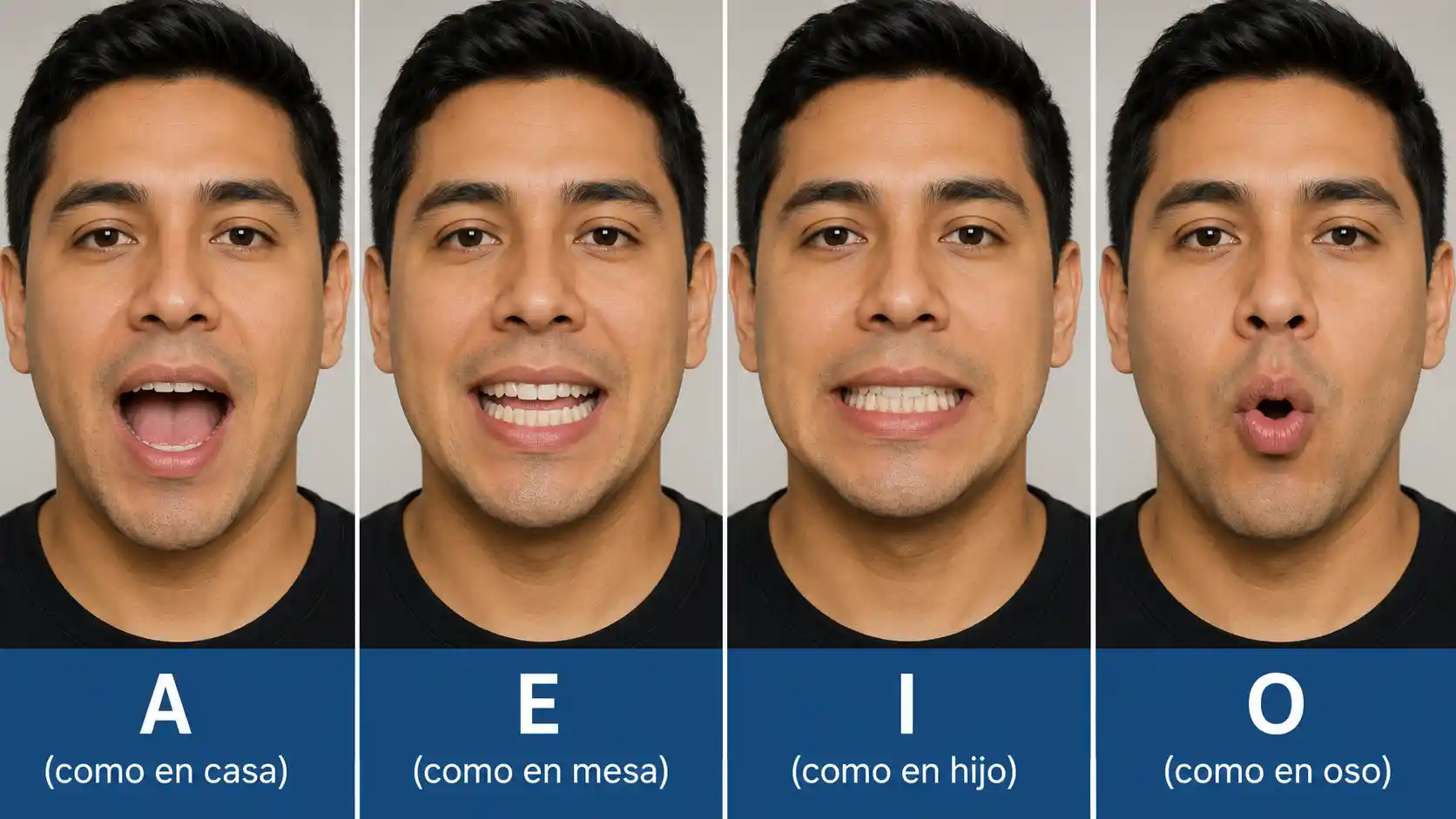
1. Spanish has five clear vowels
The vowels a, e, i, o, u are short and stable. They do not change as much as English vowels.
a in casa · e in mesa · i in sí
2. The letter h is silent
The Spanish h is normally not pronounced.
hola sounds like “ola” · hotel begins with a vowel sound.
3. j has a strong throat sound
The Spanish j is pronounced with a stronger sound than English h in many varieties.
jamón · jardín · José
4. r and rr are different
A single r can be tapped. Double rr is usually rolled.
pero = but · perro = dog
5. ll and y vary by region
In many Spanish-speaking regions, ll and y sound similar, but pronunciation varies.
llave · yo · calle
6. Stress and accents guide speech
Written accents show stress when the word does not follow the normal stress pattern.
canción · médico · teléfono
Common mistakes in Spanish pronunciation
- English-style vowels: keep Spanish vowels short and clear.
- Pronouncing h: remember that hola begins with a silent h.
- Ignoring rr: pero and perro are different words.
- Forgetting stress: stress can change how natural a word sounds.
- Expecting one universal accent: Spanish pronunciation varies across Spain and Latin America.
Exercises: Spanish pronunciation
Try the tasks first. The answers are hidden so you can check yourself after practicing.
Exercise 1: Read the vowels aloud
Read each group aloud slowly. Focus on keeping the Spanish vowel sound short and stable.
- casa · mapa · sala
- mesa · verde · leche
- vino · amigo · sí
- toro · poco · solo
- luna · uno · tú
Show practice notes
Keep the vowel quality stable. Avoid turning Spanish vowels into longer English-style diphthongs.
Exercise 2: Silent h or pronounced sound?
Decide whether the first letter is silent or pronounced. Then read the words aloud.
- hola
- hotel
- jamón
- hablar
- jardín
Show answer key
- hola — silent h
- hotel — silent h
- jamón — pronounced j
- hablar — silent h
- jardín — pronounced j
Exercise 3: r or rr?
Read each pair aloud and notice how the meaning changes when r becomes rr.
- pero / perro
- caro / carro
- coro / corro
- para / parra
Show practice notes
A single r is lighter. Double rr is stronger and usually rolled. These contrasts can change meaning.
Exercise 4: Mark the stressed syllable
Identify which syllable is stressed. Use the written accent if there is one.
- casa
- canción
- teléfono
- papel
Show answer key
- ca-sa
- can-ción
- te-lé-fo-no
- pa-pel
Related Spanish grammar basics
Want personal guidance?
Pronunciation improves fastest when you hear, repeat and receive feedback. Individual guidance can help you correct habits early and build natural speaking rhythm.
FAQ: Spanish pronunciation
Is Spanish pronunciation difficult?
Spanish pronunciation is usually manageable because spelling and sound are relatively consistent. The main challenges are vowels, r/rr, j, stress and regional variation.
Is the Spanish h always silent?
The letter h is normally silent in Spanish, as in hola and hablar.
What is the difference between r and rr?
A single r is lighter, while rr is stronger and usually rolled. The difference can change meaning, as in pero and perro.
Do all Spanish speakers pronounce ll the same way?
No. The pronunciation of ll and y varies by region. In many areas they sound similar, but not everywhere.
Why are accents important for pronunciation?
Written accents show stress when a word does not follow the regular stress pattern and can also distinguish meaning.

MundoDele – Spanish learning for education, work and intercultural understanding
MundoDele connects online Spanish courses, DELE preparation, Business Spanish and cultural context into a personal Spanish learning platform.
Travel and culture content help you understand Spanish not as abstract grammar, but as language used in real situations, conversations and written communication.