
Accents and Stress in Spanish: Rules, Examples & Exercises
Learn how Spanish stress works, when words need written accents, and why accents can change meaning in questions, names, everyday words and pronunciation.
Why learn Spanish accents with MundoDele?
MundoDele teaches accents as part of real communication, not as decoration. You learn how stress affects pronunciation, how written accents change meaning and how to recognize common patterns in listening, reading and writing.
How do stress and accents work in Spanish?
Spanish spelling gives strong clues about pronunciation. Once you understand the stress rules, many written accents become easier to predict.
1. Words ending in a vowel, n or s
Most words ending in a vowel, n or s are stressed on the next-to-last syllable.
ca-sa · ha-blan · li-bros
Stress normally falls before the final syllable.
2. Words ending in other consonants
Most words ending in a consonant other than n or s are stressed on the last syllable.
pa-pel · ciu-dad · re-loj
Stress normally falls at the end.
3. Written accents mark exceptions
If a word does not follow the normal stress pattern, Spanish usually marks the stressed vowel with an accent.
mé-di-co · can-ción · ár-bol
The accent shows the stressed syllable.
4. Question words often need accents
Question words usually carry accents in direct and indirect questions.
¿Dónde vives? · No sé dónde vive.
Direct and indirect questions both use dónde.
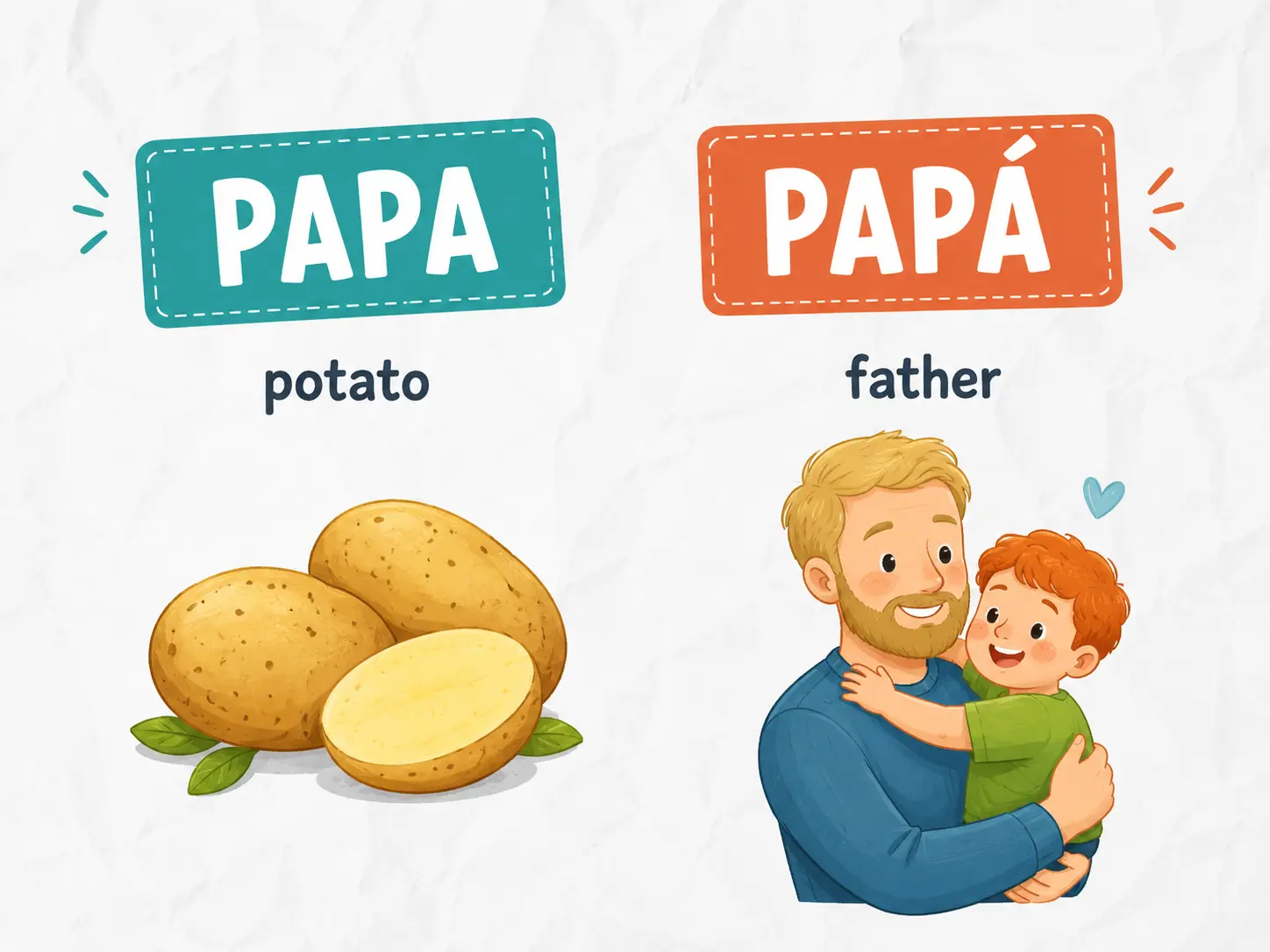
5. Accents can distinguish meaning
Some short words use accents to separate meaning or function.
si = if · sí = yes
tu = your · tú = you
6. Accents can break vowel combinations
A written accent can separate vowels into different syllables and change how the word is pronounced.
país · día · frío
The accented vowel is clearly pronounced.
Common mistakes with Spanish accents
- Forgetting accents in questions: write ¿Qué quieres?, not ¿Que quieres?.
- Confusing meaning: el means “the”, but él means “he”.
- Dropping accents on capitals: write Álvaro, not Alvaro.
- Guessing stress from English: Spanish has its own predictable stress system.
- Ignoring accents in listening: stress helps you recognize words faster.
Exercises: Spanish accents and stress
Work through the tasks first. The answers are hidden so you can check yourself after trying.
Exercise 1: Find the stressed syllable
Divide each word into syllables mentally and identify which syllable is stressed. Then compare with the answer key.
- casa
- papel
- ciudad
- hablan
Show answer key
- ca-sa
- pa-pel
- ciu-dad
- ha-blan
Exercise 2: Add the missing accent
Rewrite each word with the correct written accent.
- cancion
- medico
- arbol
- telefono
Show answer key
- canción
- médico
- árbol
- teléfono
Exercise 3: Choose the right form
Choose the accented or unaccented form that fits the meaning in English.
- ___ hablas español. (you)
- ___ libro está aquí. (your)
- ___ quiere café. (he)
- ___ café está frío. (the)
Show answer key
- Tú hablas español.
- Tu libro está aquí.
- Él quiere café.
- El café está frío.
Exercise 4: Accents in questions
Add the correct accent marks to the question words. Also check punctuation where needed.
- Que quieres comer?
- Donde vive Ana?
- No se cuando empieza la clase.
- Como te llamas?
Show answer key
- ¿Qué quieres comer?
- ¿Dónde vive Ana?
- No sé cuándo empieza la clase.
- ¿Cómo te llamas?
Related Spanish grammar basics
Want personal guidance?
If accents and pronunciation still feel confusing, individual guidance can help you hear, read and write Spanish with more confidence.
FAQ: Accents and stress in Spanish
What do accent marks do in Spanish?
Accent marks can show stress, distinguish meaning or separate vowels that would otherwise be pronounced together.
Do all Spanish words need written accents?
No. Most Spanish words follow regular stress rules and do not need a written accent.
When do question words need accents?
Question words such as qué, cómo, cuándo and dónde usually need accents in direct and indirect questions.
Do capital letters need accents in Spanish?
Yes. Capital letters keep written accents when the word requires them, for example Álvaro or África.
Can accents change meaning?
Yes. For example, si means “if”, while sí means “yes”; tu means “your”, while tú means “you”.

MundoDele – Spanish learning for education, work and intercultural understanding
MundoDele connects online Spanish courses, DELE preparation, Business Spanish and cultural context into a personal Spanish learning platform.
Travel and culture content help you understand Spanish not as abstract grammar, but as language used in real situations, conversations and written communication.