
Spanish Punctuation Basics: Marks, Rules & Examples
Learn how Spanish punctuation works with inverted question marks, inverted exclamation marks, commas, periods, colons, quotation marks and clear sentence rhythm.
Why learn Spanish punctuation with MundoDele?
MundoDele teaches punctuation as part of real communication, not as isolated symbols. You learn how Spanish punctuation changes reading rhythm, tone and clarity — especially in questions, exclamations and short everyday messages.
How does Spanish punctuation work?
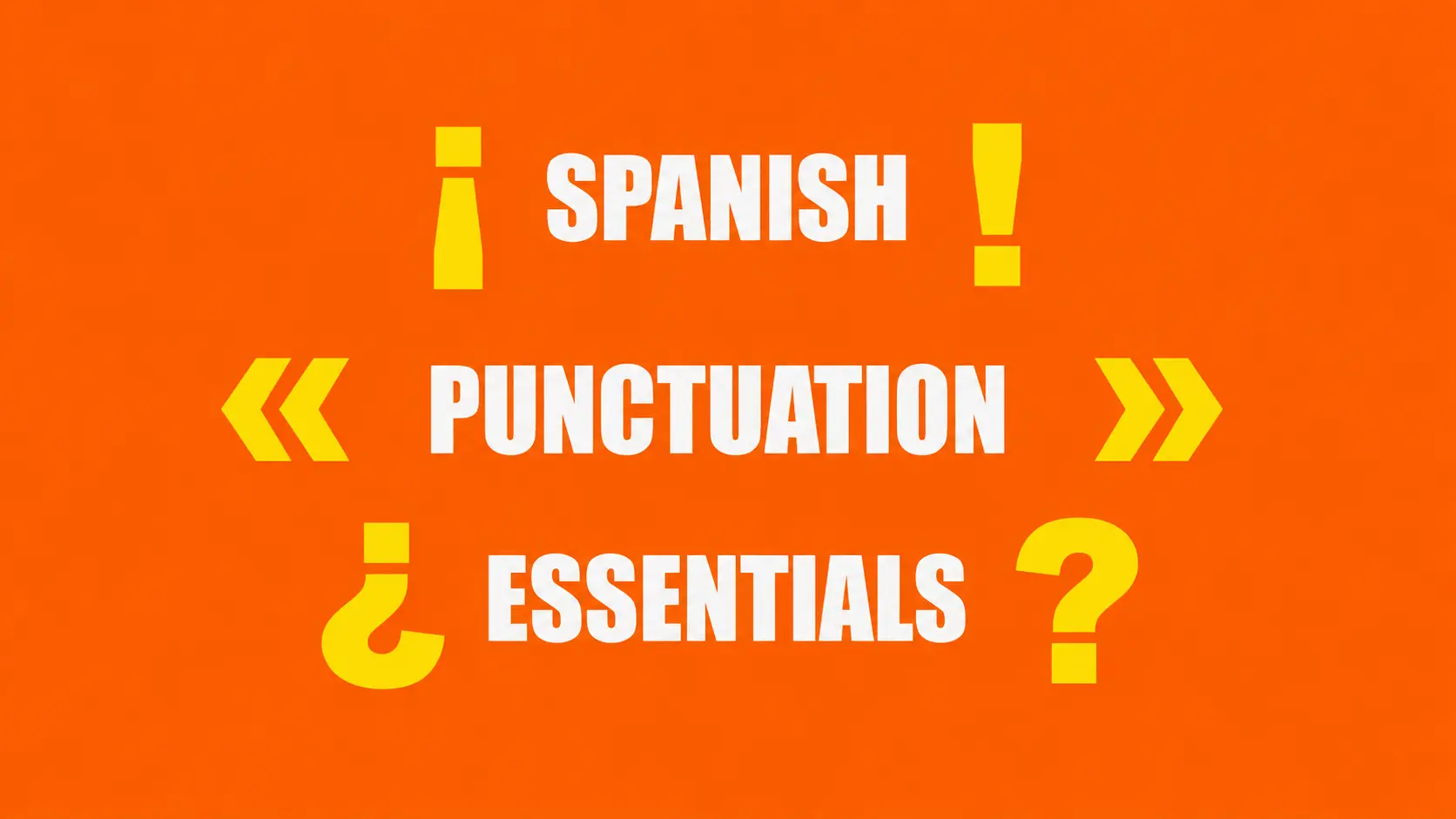
Most Spanish punctuation marks look familiar to English speakers. The important difference is that Spanish often prepares the reader before the tone changes. That is why questions and exclamations begin with an inverted mark.
1. Questions use ¿...?
Spanish places an inverted question mark at the beginning of the question and a normal one at the end.
¿Dónde está la estación?
Where is the station?
2. Exclamations use ¡...!
Strong emotion, surprise, warning or emphasis can be marked with inverted exclamation marks.
¡Qué bonito!
How beautiful!
3. Commas guide rhythm
Spanish commas separate items, pauses and introductory elements, but they should not interrupt a simple subject-verb structure.
Hoy, después de clase, vamos al mercado.
Today, after class, we are going to the market.
4. Colons introduce explanations
A colon can introduce a list, explanation or quoted idea.
Necesito tres cosas: agua, pan y fruta.
I need three things: water, bread and fruit.
5. Quotation marks may vary
Spanish can use English-style quotation marks, but angled quotation marks are also common in formal writing.
«Hola», dijo Ana.
“Hello,” Ana said.
6. Punctuation and accents work together
Question words usually keep their written accent in direct and indirect questions.
¿Cómo te llamas?
What is your name?
Common mistakes with Spanish punctuation
- Missing the opening mark: write ¿Cómo estás?, not only Cómo estás?
- Using the opening mark too early: only the question part needs it: Juan, ¿vienes mañana?
- Forgetting accents in questions: que and qué are not the same in function.
- Overusing commas: Spanish does not need a comma between a short subject and its verb.
Exercises: Spanish punctuation
Work through the tasks first. The answers are hidden so you can check yourself after trying.
Exercise 1: Add the correct question marks
Rewrite each sentence as a correct Spanish question. Add the opening and closing question marks.
- Cómo te llamas
- Dónde está el museo
- Por qué estudias español
- Cuándo empieza la clase
Show answer key
- ¿Cómo te llamas?
- ¿Dónde está el museo?
- ¿Por qué estudias español?
- ¿Cuándo empieza la clase?
Exercise 2: Choose question or exclamation
Decide whether each sentence is a question or an exclamation. Then add the correct opening and closing marks.
- Qué sorpresa
- Quién vive aquí
- Qué día tan bonito
- Cuánto cuesta el billete
Show answer key
- ¡Qué sorpresa!
- ¿Quién vive aquí?
- ¡Qué día tan bonito!
- ¿Cuánto cuesta el billete?
Exercise 3: Add commas where they help the sentence
Add commas only where they make the sentence clearer. Do not add unnecessary commas between the subject and verb.
- Hola Ana cómo estás
- Hoy después del trabajo voy al supermercado
- Mi hermano vive en Valencia
- Necesito pan queso fruta y agua
Show answer key
- Hola, Ana, ¿cómo estás?
- Hoy, después del trabajo, voy al supermercado.
- Mi hermano vive en Valencia.
- Necesito pan, queso, fruta y agua.
Exercise 4: Correct the punctuation
Correct each sentence. Pay attention to inverted marks, accents in question words and final punctuation.
- Que quieres comer?
- !Muy bien!
- Maria donde esta la llave
- No entiendo porque
Show answer key
- ¿Qué quieres comer?
- ¡Muy bien!
- María, ¿dónde está la llave?
- No entiendo por qué.
Related Spanish grammar basics
Want personal guidance?
If you want to use Spanish grammar in real speaking and writing, individual guidance can help you turn rules into natural communication.
FAQ: Spanish punctuation
Why does Spanish use inverted question marks?
Spanish uses inverted question marks so readers know from the beginning that the sentence is a question.
Do all Spanish questions need ¿...?
Direct written questions normally use both marks: an opening inverted question mark and a closing question mark.
Does Spanish use inverted exclamation marks?
Yes. Direct exclamations are usually written with an opening inverted exclamation mark and a closing exclamation mark.
Are Spanish commas the same as English commas?
Many uses are similar, but comma habits are not always identical. Spanish commas often help rhythm and clarity, but they should not separate a simple subject from its verb.
Do question words always need accents?
Question words such as qué, cómo, cuándo and dónde usually carry accents in direct and indirect questions.

MundoDele – Spanish learning for education, work and intercultural understanding
MundoDele connects online Spanish courses, DELE preparation, Business Spanish and cultural context into a personal Spanish learning platform.
Travel and culture content help you understand Spanish not as abstract grammar, but as language used in real situations, conversations and written communication.