
Costa da Morte & Cape Finisterre: Full-Day Tour from A Coruña
Drive the legendary Coast of Death — Cabo Vilán lighthouse and its shipwreck history, the sea sanctuary of Muxía, lunch in the town of Finisterre at the edge of the world, and the Ézaro Waterfall, the only river in Europe that falls directly into the Atlantic.
At a Glance
The Costa da Morte — the Coast of Death — is one of Europe's most elemental coastlines. Dramatic cliffs, centuries of shipwrecks, lighthouses standing guard over treacherous waters, and fishing villages that have lived by the sea for thousands of years. The day tour from A Coruña takes you along this entire arc: from Cabo Vilán and its first electric lighthouse in Spain, through the wild sanctuary of Muxía, out to Cape Finisterre where Romans believed the earth ended, and back via the extraordinary Ézaro Waterfall — fresh water plunging straight into the Atlantic.
The Costa da Morte — Complete Day Tour Guide
Table of Contents
The Coast of Death — Why the Name?
The Costa da Morte stretches from Malpica de Bergantiños in the north down to Muros in the south — roughly 130 kilometers of Galician coastline where the land meets the open Atlantic with nothing between it and North America. The name is not poetic invention. It is a record of centuries of maritime catastrophe.
Hidden reefs lurking just below the surface, sudden storms rolling in without warning, treacherous currents and ferocious westerly winds — this coastline sank ships from the Roman era through the 20th century. The English Cemetery at Camariñas is one of the starkest reminders: it marks the burial place of sailors from the HMS Serpent, a British naval vessel wrecked on these rocks in 1890 with the loss of 172 lives. Of the crew, only three survived.
And yet the Costa da Morte is also one of the most beautiful places in Spain. Endless wild beaches, green cliffs dropping to turquoise water, stone villages where fishermen still pull in barnacles and octopus, and a sky that changes every twenty minutes as Atlantic weather systems roll through. The name has sadness; the landscape has extraordinary, unhurried beauty.
A Coast of Legends
The shipwrecks are only one layer. The Costa da Morte has been a place of myth and spiritual significance since before recorded history. Celtic ritual sites, Roman pilgrimage routes, and medieval Christian traditions all converged on this coastline — drawn by the same thing that makes it dangerous: it is where the known world ends and the unknown begins. Cabo Vilán's lighthouse museum explores this intersection of tragedy and legend in detail.
Tour Itinerary: Five Stops Along the Wild Coast
The tour departs from A Coruña in the morning and follows the coastline southwest, covering the five essential landmarks of the Costa da Morte:
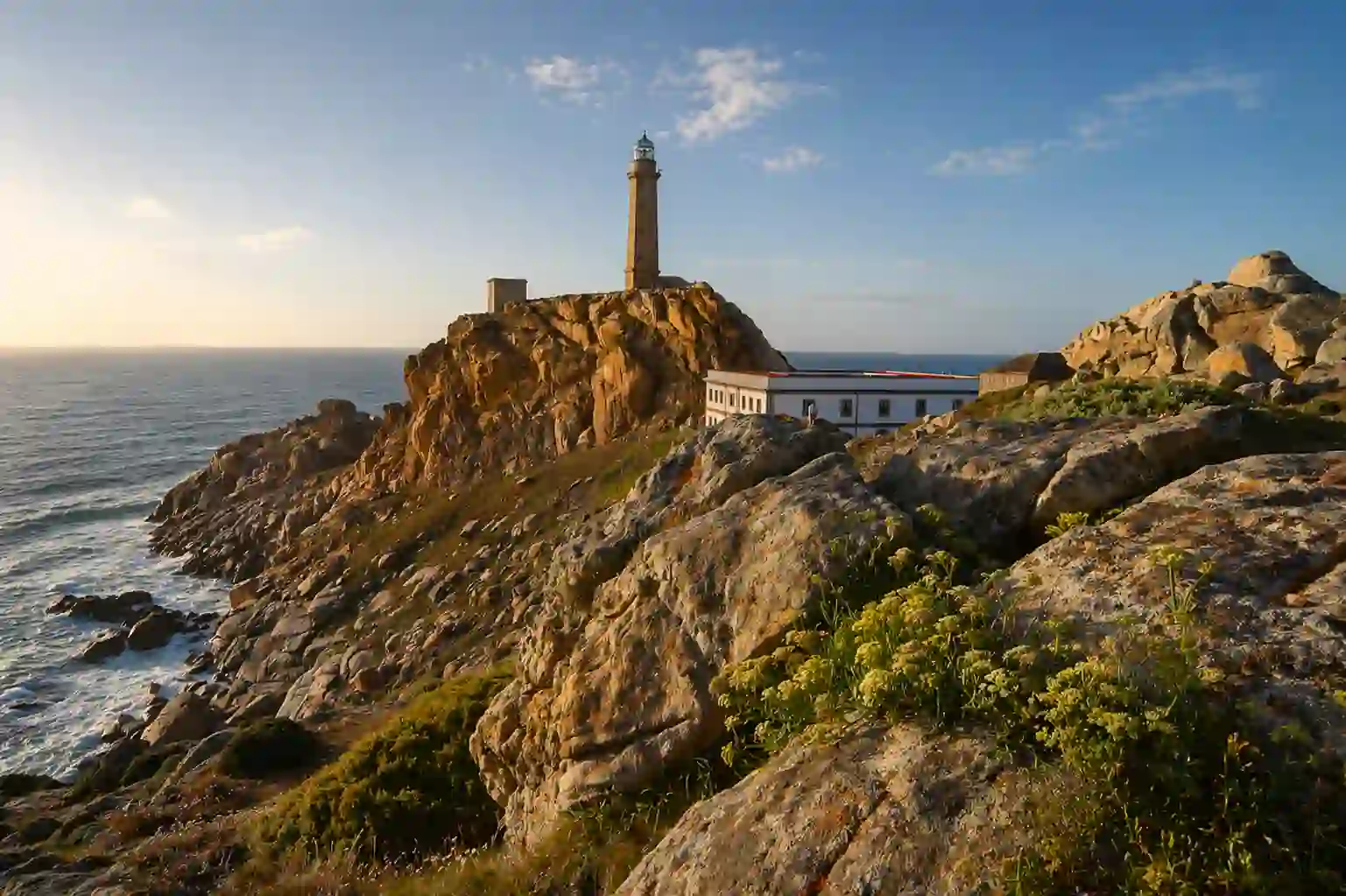
Spain's first lighthouse to run on electricity, standing 27 metres high on a steep cape above the Atlantic. The technical building beside it houses a museum dedicated to the coast's shipwrecks, lighthouses, and maritime signals — a fascinating record of the centuries during which this stretch of coast claimed vessels from across Europe. The views from the cape are among the most dramatic on the entire Galician coast.
A baroque sanctuary built on a narrow finger of rock surrounded on three sides by crashing Atlantic swells. The Santuario da Virxe da Barca is the oldest sanctuary in Galicia and one of the most spiritually significant sites on any branch of the Camino de Santiago. Sailors have come here for centuries to pray before crossing the Atlantic, and pilgrims still walk here from Santiago de Compostela. Whatever your beliefs, the location alone is extraordinary.
The westernmost point of the Iberian Peninsula and, in Roman and Celtic imagination, the edge of the known world. Finis Terrae — the end of the earth. The lighthouse perches above cliffs that drop to the Atlantic, and the view west is nothing but open ocean all the way to the Americas. Celts, Romans, medieval pilgrims, and Camino walkers have made this journey for thousands of years. You will understand why the moment you stand there.
The small fishing town of Finisterre sits in a sheltered bay below the cape. Free time here means Galician seafood — octopus, percebes (barnacles harvested from the rocks just offshore), fresh fish, and the local Albariño white wine. Restaurants and cafés line the small harbor. This is one of the best places in Galicia to eat simply and well.
The Xallas river descends 40 metres directly into the Atlantic — the only waterfall in continental Europe where fresh river water falls straight into the ocean. A footbridge and viewpoint allow you to see the full cascade. Depending on rainfall and season, the volume of water varies considerably, but the setting — steep wooded slopes, churning sea, and the spray where fresh and salt water collide — is always remarkable.
Recommended Experience
From A Coruña: Costa da Morte & Cape Finisterre Day Tour
Full-day guided tour along Galicia's Coast of Death — Cabo Vilán lighthouse, Muxía sanctuary, Cape Finisterre, lunch in the town, and the Ézaro Waterfall. Lighthouses, shipwrecks, legends, and one of Europe's most dramatic coastlines in a single day from A Coruña.
Book on GetYourGuide →Cape Finisterre — The Edge of the World
The name says everything: Finis Terrae — the end of the earth. For the Romans who named it, Cape Finisterre was genuinely the boundary of the known world. Beyond this headland was the open Atlantic, which they called Mare Tenebrosum — the Dark Sea — a place of monsters, storms, and void. The lighthouse they could not yet build; instead, they built a cult. Evidence of Roman ritual fires on the cape dates back to the first century AD.
For medieval Christian pilgrims, Finisterre became the natural continuation of the Camino de Santiago. Having reached the tomb of Saint James in Santiago de Compostela, many continued west — following the sun toward the sea. The cape was a liminal place, a threshold. Pilgrims traditionally burned their boots or their old clothes on the rocks as a symbolic completion of the journey.
The Faro de Finisterre — the lighthouse — stands near the tip of the cape and remains in operation. The walk from the parking area to the lighthouse follows the cliff edge, and the view from the top is one that stays with you: cliff after cliff falling into open ocean, and nothing beyond until the Americas. On a clear day the horizon feels impossibly distant. On a stormy day, it is terrifying.
Finisterre and the Camino de Santiago
The town of Finisterre (Fisterra in Galician) lies 90 kilometers west of Santiago de Compostela on the Camino Finisterre — an extension of the Camino Francés that many pilgrims walk after completing the main route. The small harbor town, sheltered from the open Atlantic by the cape itself, is one of the most atmospheric fishing villages in Galicia. If you are traveling the Camino, combining the walking route to Finisterre with this day tour back to A Coruña is a natural option.
Ézaro Waterfall — Europe's Only Ocean Waterfall
The Cascada do Ézaro is the final stop on the tour and one of its most unexpected sights. The Xallas river, having descended from the Galician interior through a dramatic gorge, reaches the coast at the village of Ézaro and drops 40 metres directly into the sea — the only waterfall in continental Europe where fresh river water falls straight into the Atlantic.
The phenomenon is the result of an unusual combination: a river that runs to the coast at a high elevation, a dramatic cliff at the shoreline, and the absence of any estuary or beach to break the fall. A footbridge and viewing platform have been built to let visitors stand within the spray and look up at the full cascade. At high flow — after heavy rain — the waterfall is genuinely powerful; in dry summer months the flow is reduced but the setting remains extraordinary.
The viewpoint above the gorge offers a panorama of the estuaries and the town of Ézaro that is one of the finest coastal views on the entire Costa da Morte. It is a fittingly dramatic end to the day.
Tips for Booking & What to Bring
What to Expect on the Day
- Duration: Plan for a full day — typically 9 to 10 hours from departure to return in A Coruña
- Transport: Coach or minibus — comfortable for the coastal road distances involved
- Lunch: Free time in the town of Finisterre — budget €15–25 for a proper seafood lunch at a harbor restaurant
- Walking: The tour involves moderate walking at each stop — comfortable shoes are essential, especially at Cabo Vilán and Finisterre where paths can be uneven
- Weather: Atlantic weather on the Costa da Morte changes rapidly. Pack a waterproof layer regardless of the forecast — it is part of the experience.
Best Time of Year
- May to October offer the most reliable weather, with June, July, and September the optimal months for clear sea views and warm afternoons
- Spring (April–May): The coastal cliffs are green from winter rain and the waterfall at Ézaro runs at full force — excellent for photography
- Autumn (September–October): Dramatic skies, fewer tourists, and the sea still warm enough to enjoy at Finisterre beach
- Winter: The tour runs year-round. Atlantic storms make the coast even more dramatic — but dress accordingly
What to Bring
- Waterproof jacket: Non-negotiable on the Costa da Morte at any time of year
- Camera: Cabo Vilán, the Muxía sanctuary at sea level, the Finisterre lighthouse, and the Ézaro waterfall are all exceptional photography subjects
- Cash or card: For lunch in Finisterre — smaller restaurants may prefer cash
- Comfortable walking shoes: Paths at the cape and at Cabo Vilán can be uneven and exposed
Combining with A Coruña
The day tour pairs naturally with one or two nights in A Coruña. The city's historic walking tour covers the old town and Galerías de la Marina on day one, and the Costa da Morte excursion fills a full second day. Santiago de Compostela is 35 minutes by train from A Coruña and rounds out the Galicia circuit perfectly. If you are a Camino pilgrim, walking the Camino Finisterre (90km from Santiago) and catching the day tour back from A Coruña is a popular final chapter to the journey.
Galician Before You Go
Galicia has its own language — Galego — closer to Portuguese than to Castilian Spanish. Most people in the Costa da Morte villages speak Galician as their first language. Spanish works everywhere, but a few words of the local language open doors. If you are planning a longer stay in Spain or Galicia, private Spanish lessons are the fastest route to genuine communication with the people you will meet.
Book the Costa da Morte Day Tour
★★★★★ Full-day from A Coruña · Cabo Vilán · Muxía · Finisterre · Ézaro · Free cancellation
Ready to Stand at the Edge of the World?
The Costa da Morte is not a postcard coast. It is raw, wind-scoured, and genuinely unlike anything else in Spain. One day from A Coruña is enough to understand why Celts, Romans, and pilgrims have been drawn here for two thousand years.
Cabo Vilán · Muxía Sanctuary · Cape Finisterre · Ézaro Waterfall
Book Costa da Morte Day Tour on GetYourGuide →