
A Coruña Old Town Walking Tour: History, Glass Balconies & Galician Identity
A 1.5-hour guided walk through A Coruña's medieval heart — Plaza de María Pita, the iconic Galerías de la Marina, the Collegiate Church of Santa María del Campo, and the streets that built Galicia's most distinctive coastal city.
At a Glance
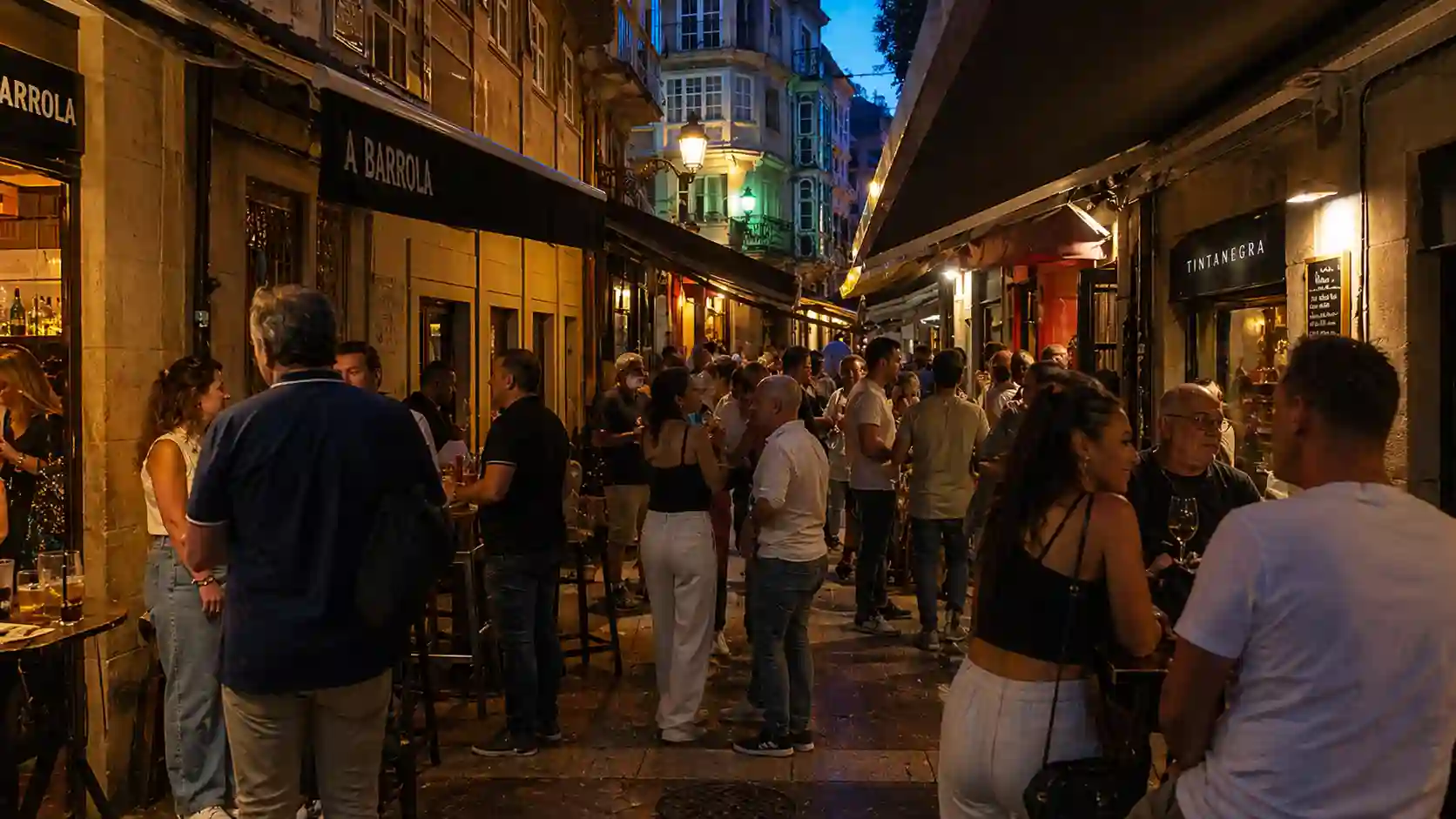
A Coruña is one of Spain's most underrated cities — a Roman lighthouse, a medieval old town, and a seafront lined with glass-enclosed balconies that gave the city its nickname, The City of Glass. The historic walking tour threads through all of it: the Ciudad Vieja, the Plaza de María Pita and its story of resistance, the Galerías de la Marina, Romanesque churches, and the lively Pescadería neighborhood where Galician urban life plays out daily. Ninety minutes that make the rest of your visit make sense.
A Coruña on Foot — The Complete Old Town Tour Guide
Table of Contents
Why A Coruña Rewards a Walking Tour
A Coruña sits on a narrow peninsula jutting into the Atlantic — a city shaped at every turn by the sea. Its history runs deeper than most visitors expect. The Romans built a port here called Brigantium and raised a lighthouse on the headland that still stands and still operates: the Tower of Hercules, the world's only ancient Roman lighthouse in continuous use, designated a UNESCO World Heritage Site in 2009.
But the city's character is not just ancient. A Coruña's medieval old town — the Ciudad Vieja — sits on the highest ground of the peninsula, surrounded by the remains of its medieval walls. Its seafront is lined with the Galerías de la Marina, those glass-enclosed balconies unique to A Coruña that catch the Atlantic light and earned the city its nickname: La Ciudad de Cristal — The City of Glass.
A walking tour is the right format for A Coruña because the city's stories are embedded in its streets. The guide does not simply point at buildings — they connect the medieval defensive walls to the 1589 siege by Drake's fleet, the glass galleries to the Atlantic winds, and the food market to the fishing culture that shaped Galician identity for centuries. Ninety minutes with a good guide restructures everything you see for the rest of the trip.
What You See: Landmarks of the Old Town
The tour moves through the historic center in a coherent arc — from the Teatro Colón to the City of Glass seafront, through the medieval streets, and out to the Obelisk that caps Calle Real:
Plaza de María Pita — The City's Symbolic Heart
The Plaza de María Pita is not simply a town square. It is A Coruña's identity in architectural form — and understanding the woman it honors is part of understanding the city itself.
In 1589, an English fleet commanded by Sir Francis Drake — the same privateer who had attacked the Spanish Armada the year before — laid siege to A Coruña. The city's defenses were close to collapse when, according to Galician tradition, a local woman named María Pita rallied the defenders after her husband was killed. Her courage in the breach became a story that A Coruña has told about itself ever since.
The bronze statue at the center of the square shows her in the moment of defiance — pike raised, facing seaward. The Municipal Palace behind her, begun in 1908 by architect Pedro Mariño, frames the square on its north side in a confident modernist style that contrasts with the medieval streets of the Ciudad Vieja just beyond.
The Old Town Beyond the Square
From the Plaza, the tour moves into the Ciudad Vieja — the medieval upper town that preserves the street pattern of the original peninsula settlement. The narrow streets here were built before carriages, oriented around the cathedral, the churches, and the defensive walls rather than commerce or transit. Walking them with a guide who can read the palimpsest — the Roman foundations under the medieval walls, the baroque additions to the Romanesque churches — is something no map app can replicate.
The Collegiate Church of Santa María del Campo, the Church of Santiago, and the Gardens of San Carlos — where the English general Sir John Moore is buried after the 1809 Battle of A Coruña — form the tour's medieval circuit. Each site is a chapter in a city that has been fought over, traded through, and rebuilt across more than two thousand years.
Recommended Experience
A Coruña: Historic Walking Tour — Old Town and Highlights
1.5 hours through the Ciudad Vieja, Plaza de María Pita, Galerías de la Marina, and the Pescadería neighborhood. Small groups, expert local guides praised for their storytelling and humor. The ideal starting point for any visit to Galicia's coastal capital.
Book A Coruña Walking Tour on GetYourGuide →The Galerías de la Marina — The City of Glass
No building type defines A Coruña more completely than the Galerías de la Marina — the glass-enclosed balconies that line the Avenida da Mariña along the harbor front. There is nothing quite like them in Spain, and very little like them anywhere in Europe.
They were built over the 18th and 19th centuries as a practical response to A Coruña's Atlantic climate: the city faces the open sea, and the prevailing winds from the northwest drive rain hard against the city's façades. The enclosed galleries — wooden frames holding hundreds of small glass panes — allowed residents to have a sea view and daylight without exposure to the elements. The result is a streetscape of extraordinary visual richness: an entire boulevard in which every building appears to be wrapped in light.
The Avenida da Mariña where the galleries are most concentrated runs along the harbor, and the walking tour passes directly in front of them. The best perspective — where the full rhythm of glass and frame becomes visible — is from the waterside promenade, looking back at the city. It is one of the defining images of northern Spain.
Modernist A Coruña: A Hidden Layer
The walking tour also surfaces a strand of A Coruña's architectural character that first-time visitors often miss entirely: its modernist buildings. Scattered through the Pescadería neighborhood and along the main streets of the 19th-century city, these façades — tiled, ornate, colored — represent the ambition of a prosperous port city at the turn of the 20th century.
The Palacio de Cornide, the Municipal Palace on the Plaza de María Pita, and the various modernist residential buildings along the route collectively tell the story of a city that was, at moments, among the most commercially dynamic in Spain — an Atlantic port connecting Galicia to Latin America through emigration, trade, and the long-distance postal routes that ran through its harbor.
Tips for Booking & What to Expect
What the Tour Covers — and What It Doesn't
- Teatro Colón meeting point
- Plaza de María Pita
- Galerías de la Marina (exterior)
- Ciudad Vieja medieval streets
- Collegiate Church of Santa María del Campo
- Pescadería neighborhood
- Calle Real and the Obelisk
- Expert local guide commentary
- Tower of Hercules (separate site, outside old town)
- Interior of churches and museums
- Riazor / Orzán beaches
- Food tastings (see separate food tours)
- Casa Museo Picasso (Picasso spent early childhood years in A Coruña)
When to Visit A Coruña
- May to September are the most comfortable months — long days, mild Atlantic temperatures, and the city at its most vibrant
- July and August bring higher crowds, especially from Spanish domestic tourism — book early for tours and accommodation
- Weather note: A Coruña is one of the greener, rainier corners of Spain — pack a compact umbrella whatever the season. The walking tour runs in light rain.
- Camino travelers: A Coruña is a stage on the English Way (Camino Inglés) — the walking tour is a perfect way to understand the city before or after a Camino arrival
Before and After the Tour
- The Tower of Hercules: Allocate a separate half-morning — it is 3km from the old town and deserves its own visit. The UNESCO Roman lighthouse is A Coruña's most extraordinary site.
- Mercado de San Agustín: A Coruña's main food market, a short walk from the old town — the best place for a post-tour lunch of Galician octopus (pulpo), empanada, or local cheese
- Orzán and Riazor beaches: Two surf beaches at the base of the peninsula — rare for a city center of this size
- Day trip to Santiago de Compostela: Just 35 minutes by train — the Cathedral and old city pair perfectly with a day in A Coruña
Learning Spanish Before You Go
Galicia has its own language — Galician (Galego) — closely related to Portuguese. But Spanish is the working language for tourists everywhere in the region. A few words of Spanish go a long way in A Coruña, especially in the markets, the old-town bars, and the smaller neighborhood restaurants away from the tourist circuit. If you are planning a longer stay in Spain or Galicia, private Spanish lessons are the fastest way to build practical confidence before you travel.
Book the A Coruña Walking Tour
★★★★★ Historic Old Town & Highlights · 1.5 hours · Small group · Free cancellation
Ready to Read A Coruña the Way It Was Built?
Medieval streets, glass-wrapped balconies, a heroine's square, and two thousand years of Atlantic history — all in ninety minutes with a guide who knows every stone.
Old Town & Ciudad Vieja · Plaza de María Pita · Galerías de la Marina · Small group
Book A Coruña Walking Tour on GetYourGuide →