
Dénia Cova Tallada Kayak Trip: Coastal Paddling, Cave Exploration & Snorkeling
Paddle along the cliff walls of the Cabo de San Antonio Marine Reserve, enter a cave quarried by hand over centuries, and snorkel in crystal-clear protected waters. A 3-hour sea kayak adventure from Les Rotes beach in Dénia — no prior experience needed.
At a Glance
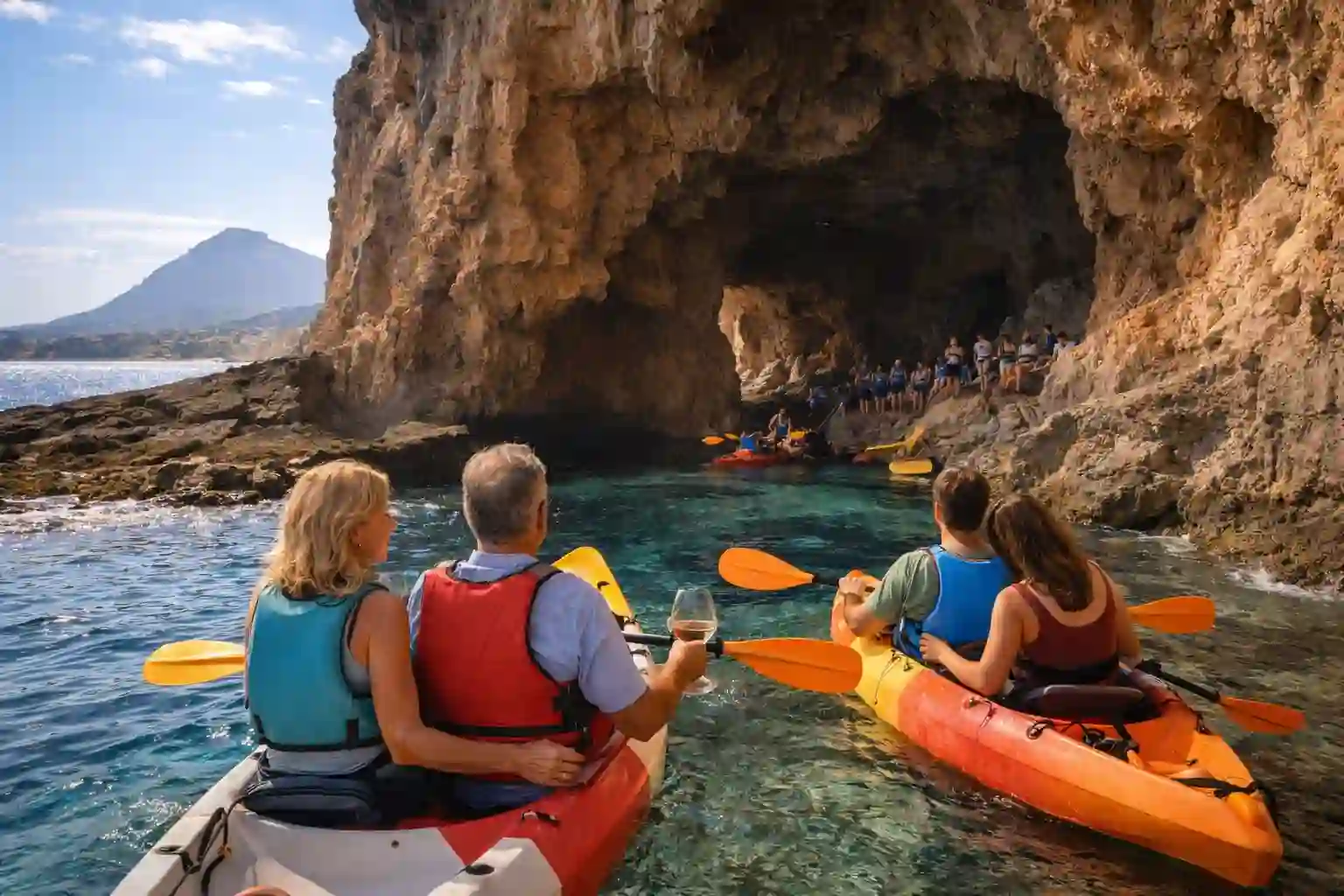
The Dénia Cova Tallada Kayak Trip is a 3-hour guided adventure that begins at Les Rotes beach and follows the coastal cliffs of the Cabo de San Antonio Marine Reserve to the Cova Tallada — a sea-level cave carved into the sandstone by quarry workers whose stone built the town of Dénia itself. Guides provide full safety instructions and accompany the group throughout. Inside the cave, headlamps on, you learn the history while your eyes adjust to the light filtering through the rock. Snorkeling in the natural pool at the cave entrance, the marine reserve delivers exactly what a protected ecosystem should: clear water and visible fish. A snack is included. Small groups, all equipment provided, 5.0 stars from 273 reviews.
Dénia Cova Tallada Kayak Trip — The Complete Guide
Table of Contents
Why Kayak to the Cova Tallada
The Cova Tallada can be reached on foot — a cliff path connects it to the car park above Les Rotes. But arriving on foot means descending to an entrance carved for people who carried stone, not visitors. Arriving by kayak means approaching the way the quarry workers' supply boats did: from the sea, at water level, with the cave mouth opening directly in front of you as you paddle in.
There is a practical reason kayaking is the better approach and an aesthetic one. The practical reason is the Cabo de San Antonio Marine Reserve — the protected stretch of coastline that surrounds the cave and makes the snorkeling worthwhile. Access on foot gives you the cave. Access by kayak gives you the cave, the reserve, the cliffs, the snorkeling, and the perspective of the whole coastline between Dénia and Jávea from the water. The kayak route shows you what the land route cannot.
The tour operator — Alicante Aventura — has run this route long enough that its guides know the water, the cave's history, the marine life in the reserve, and exactly how to pace a group so that no one feels rushed and no one falls behind. A perfect 5.0 rating from 273 GetYourGuide reviews is not an accident. It reflects a route that genuinely delivers and guides who know how to make it work for every participant regardless of experience level.
What You Do: Paddle, Cave, Snorkel
The experience runs for 3 hours across a sequence of distinct environments — open water, cliff walls, cave interior, marine pool — each one requiring something different from the participant and offering something different in return.
The Socarrat Equivalent: Getting the Entry Right
The Cova Tallada's sea entrance requires timing — the opening is at water level, and approaching it by kayak means reading the swell and entering when the water is calm enough to do so safely. The guides manage this entirely, choosing the moment and communicating clearly. Reviewers note this as one of the memorable instants in the experience — the shift from open Mediterranean light to the filtered interior of a cave that took generations to carve.
The Cave: History Carved in Stone
The name says exactly what it is. Cova Tallada — carved cave — was not formed by geological time alone. It was shaped by human labour, over centuries, by workers extracting the sandstone that built the houses, walls, and castle of Dénia. The stone quarried here was durable, workable, and accessible from the sea — which made the Cova Tallada one of the most productive supply points on this stretch of coast.
What You See Inside
The cave's interior retains the evidence of its working history in a way that geological formations do not. Carved channels guided water through the rock. Storage areas were cut into the walls. The geometry of the space is not random — it follows the logic of extraction, of where the stone was thickest, of how the workers moved their tools and their materials. Guides explain this as the group moves through, connecting the shapes in the rock to the specific demands of the quarrying process and to the buildings in Dénia that the stone went on to become.
Light enters the cave from the sea-facing entrance and from cracks in the ceiling, creating conditions that change with the time of day and the angle of the sun. Morning visits — when the sun is lower and the light enters more directly — produce the most dramatic interior illumination. The headlamps are not decorative: the deeper chambers are genuinely dark, and the cave's depth is greater than its entrance suggests.
The Marine Reserve: Why the Snorkeling Works
The Cabo de San Antonio Marine Reserve was established specifically to protect the ecosystem that the cave's coastline anchors. Fishing is restricted. Anchoring is controlled. The seabed is undisturbed. The result is the kind of underwater visibility and fish density that makes snorkeling genuinely rewarding rather than a formality. Reviewers consistently describe the snorkeling as a highlight — not as an add-on. The natural pool at the cave entrance is sheltered enough for comfortable swimming and clear enough to watch the fish moving beneath the surface without special effort.
The Guides and the Marine Reserve
Guides named in reviews — Aaron, Alex, Juan, Samuel, Piti, Vicente — appear repeatedly with specific praise for their knowledge of the area, their ability to manage groups of mixed experience levels, and their capacity to keep the experience enjoyable rather than anxious. "Our guide Aaron was exceptional, knowledgeable and made our experience one of the best excursions we have done." "Alex was a brilliant guide. Very knowledgeable and we felt safe in his care." "Juan's guidance" is credited with making a swell-affected day feel consistently safe.
This specificity in reviews is informative. When participants remember guide names and cite particular moments — the cave entrance, the snorkel stop, the coastal storytelling — it reflects a level of engagement that comes from guides who know the material and care about the delivery. The maximum group size of 12 is what makes this possible: small enough that the guide is genuinely present for every participant rather than managing a crowd from the front.
Equipment and Safety
The kayaks are two-seater, self-bailing models — stable and manageable for participants with no prior experience. Life vests, paddles, snorkeling masks and fins, helmets, and front lights for cave exploration are all included. The Cova Tallada entry ticket is covered. Personal accident and liability insurance applies for the full duration. Photos or videos of the activity are provided — an inclusion that reviewers specifically mention, since the route produces images that are difficult to capture while paddling.
The Moment That Stays With People
Reviews of this trip are unusually consistent about which moment defines it. Not the open-water paddle, not the snorkeling — though both receive praise — but the entry into the cave itself: the transition from Mediterranean sunlight to filtered interior light, the scale of the carved space becoming clear as the eyes adjust, the guides beginning to explain what is visible on the walls. It is the kind of experience that changes how you look at the town above — at the castle, at the old stone buildings — once you understand where the material came from and how it got there.
Top Recommended Experience
Dénia: Cova Tallada Kayak Trip
3-hour guided sea kayak trip from Les Rotes beach to the historic Cova Tallada cave — paddle the Cabo de San Antonio Marine Reserve, explore the carved cave interior with headlamps, snorkel in the natural pool, and visit San Antonio cove and lighthouse. Snack included. All equipment provided. Small groups (max 12). No prior kayaking experience required.
Book Kayak Trip on GetYourGuide →Tips for Booking & What to Bring
When to Go
- Summer is peak season: July and August see the warmest water and longest days — book well in advance as the 12-person group limit fills quickly
- Spring and early autumn: May, June, September, and October offer the best balance of warm conditions, calmer seas, and easier availability
- Weather dependency: The tour operates subject to sea conditions — the operator will contact participants in advance if conditions require rescheduling. This is rare but worth knowing for tight itineraries
- Morning slots: The cave interior light is at its best in the morning when the sun angle reaches the entrance directly
What to Bring
- Water shoes or old trainers: The cave rocks are slippery — reviewers specifically flag this. Flip-flops are not adequate
- Sun protection: Sunscreen, a hat, and UV-protective clothing for the open-water sections
- Change of clothes: You will get wet — a dry set of clothes for the drive back is the one item people wish they had remembered
- Small dry bag: For phone, keys, and anything you want to keep dry. Leave valuables in the car — the walk from the car park to the meeting point is 800 metres
- Arrive 15 minutes early: The guides leave on time. Five minutes courtesy waiting is the maximum
Who the Trip Works For
- Minimum age 14: Younger participants are not permitted — the physical requirements and safety protocols require this threshold
- Swimming ability required: Non-swimmers cannot participate. Basic swimming competence is sufficient — this is snorkeling in a sheltered pool, not open-water swimming
- Not suitable for: Pregnant participants, those with serious heart conditions, or those with severe seasickness history
- Physical level: Moderate — the paddle is not strenuous, but 3 hours on the water requires reasonable baseline fitness and comfort in a kayak
Combining with Dénia
The kayak trip works best as a morning activity — it finishes well before midday and leaves the rest of the day open for Dénia's old town, the hilltop castle, and the evening paseo along the waterfront. For a complete Costa Blanca water day, consider combining the kayak morning with an afternoon catamaran trip to Cova Tallada — the contrast between arriving by paddle power and by sail is instructive. Further afield, the routes between Dénia and Jávea by coastal kayak, and the snorkeling conditions at Cala Granadella near Jávea, extend naturally from the skills and orientation this trip provides.
Book Dénia Experiences
★★★★★ Top-rated outdoor & water activities in Dénia · Verified reviews · Free cancellation on most tours
Paddle Into a Cave Built by History
Sea kayaking along protected cliff walls, a carved cave at water level, snorkeling in the marine reserve — 3 hours, small groups, no experience required. The best way to see this stretch of the Costa Blanca.
★★★★★ 5.0 · 273 reviews · Free cancellation on most tours
Book Cova Tallada Kayak Trip & See All Dénia Tours →